Before you start
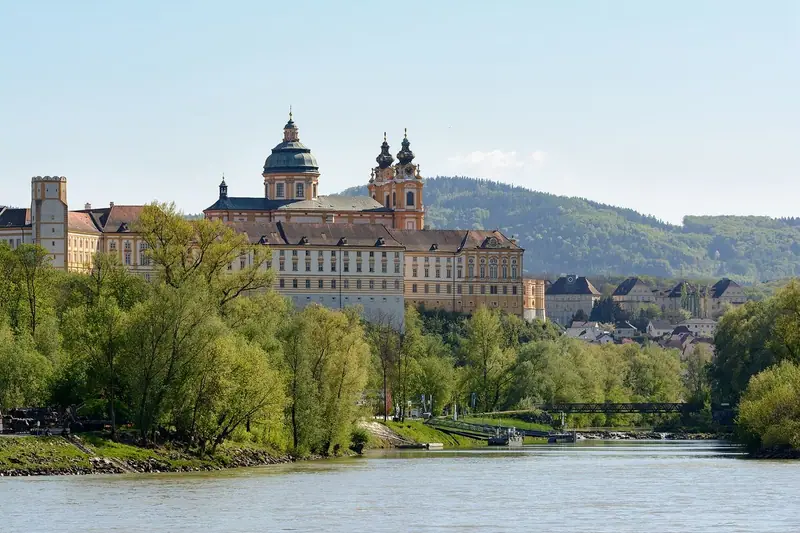
The Wachau is the stretch of the Danube valley between Melk and Krems in Lower Austria, where the river winds between steep hills terraced with vineyards. People have lived here for tens of thousands of years, and over the centuries the valley gathered abbeys, castles, fortified churches and small wine towns, so well preserved that the whole landscape is a World Heritage Site. This guide follows the valley downstream, from the great Baroque abbey of Melk past Willendorf, Spitz and Weißenkirchen to Dürnstein, where Richard the Lionheart was held prisoner, and on to the old town of Krems, ending at the abbey of Göttweig on its hill. The route is about forty kilometres and is best followed by car, by bicycle along the riverside path, or in part by boat; allow a full day.
Use it as a self-guided tour of Melk Abbey and the Wachau: 7 stops in visit order, each played when you’re ready, at your own pace.
 Free preview · Stop 1
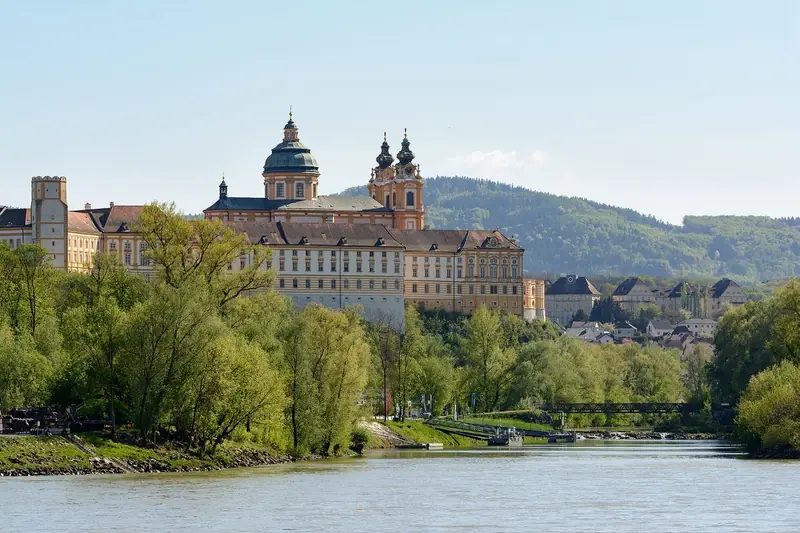
Melk Abbey
Melk Abbey stands on a rocky outcrop high above the Danube, its yellow and white facades and twin towers visible from far along the river. The rock was once a castle of the Babenberg family, the first dynasty to rule Austria, and in 1089 Margrave Leopold the Second gave it to Benedictine monks. Several of the Babenbergs are buried here, along with Saint Coloman, an Irish pilgrim who was killed at Stockerau in 1012 and was long honoured as Austria’s patron saint. In the Middle Ages the abbey was famous for its school and its library of manuscripts, and in the fifteenth century it led a movement to reform the monasteries of Austria and southern Germany. The present abbey was built between 1702 and 1736 to designs by Jakob Prandtauer. Its church glows with gold, marble and ceiling paintings by Johann Michael Rottmayr, and the visit leads through the imperial rooms, the Marble Hall and the library, lined with old books and manuscripts, to a terrace with views over the river. The abbey survived when the emperor Joseph the Second closed many Austrian monasteries in the 1780s, and Benedictine monks still live and teach here. From Melk, follow the Danube downstream; on the right bank, the ruins of Aggstein Castle stand high on a rock above the river. Continue on the left bank to Willendorf.
Photo: Uoaei1 · CC BY-SA 4.0 · Wikimedia Commons
What to see at Melk Abbey and the Wachau: 7 stops, in visit order
- 01
 Melk AbbeyThe Baroque monastery on the rockFree preview
- 02
 WillendorfWhere the Venus was foundIn the guide
- 03
 SpitzThe Hill of a Thousand BucketsIn the guide
- 04
 WeißenkirchenThe fortified churchIn the guide
- 05
 DürnsteinWhere Richard the Lionheart was heldIn the guide
- 06
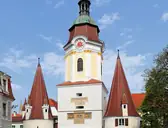 KremsThe old wine townIn the guide
- 07
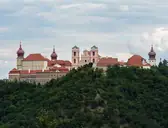 Göttweig AbbeyThe abbey on the hillIn the guide
Site map of Melk Abbey and the Wachau
History of Melk Abbey and the Wachau
Some of the oldest traces of people in Austria have been found in the Wachau, including the figure known as the Venus of Willendorf, carved about thirty thousand years ago. In 15 BCE the Romans took the land south of the river, and the Danube became the frontier of their empire, guarded by forts along its southern bank. In the Middle Ages, the Babenberg rulers of Austria and the great monasteries owned much of the valley, and local lords such as the Kuenring family built castles on the heights. Monks and lords cleared the slopes and built the stone terraces for vines that still shape the valley today. Melk was refounded as a Benedictine abbey in 1089, and Göttweig was founded in 1083. In the eighteenth century both abbeys were rebuilt in the Baroque style.
The full history continues in the guide.
Melk Abbey and the Wachau guide: questions
How many stops does the Melk Abbey and the Wachau guide have?
7 stops, in visit order: 1. Melk Abbey; 2. Willendorf; 3. Spitz; 4. Weißenkirchen; 5. Dürnstein; 6. Krems; 7. Göttweig Abbey.
Can I do a self-guided tour of Melk Abbey and the Wachau with this guide?
Yes. The guide is made for a self-guided tour: 7 stops in visit order, each with a photo, a story and a voice, so you can explore Melk Abbey and the Wachau at your own pace, without joining a group. Download it before you go and it works offline.
How long is each guide?
The 7 stops add up to about 6 minutes of listening in total. You play each stop when you’re ready, so you can go at your own pace.
Does the guide work offline?
Yes, once it’s downloaded. The guide is a single self-contained web page (about 7.4 MB) with the photos, text and audio built in. Download it to your phone before you go (Wi-Fi is best); after that it opens in any modern browser on iPhone or Android, with no app, account or mobile signal needed.
Does it use GPS or need my location?
No. The guide doesn’t use GPS and doesn’t know where you are: you play each stop when you reach it. It works on iPhone and Android in any modern browser, and it’s in English.
What’s included?
One self-contained HTML guide: 7 stops in visit order, each with a photo, text and a voice, plus the story of who built the site.
Who built Melk Abbey and the Wachau?
Some of the oldest traces of people in Austria have been found in the Wachau, including the figure known as the Venus of Willendorf, carved about thirty thousand years ago. In 15 BCE the Romans took the land south of the river, and the Danube became the frontier of their empire, guarded by forts along its southern bank.
Where is Melk Abbey and the Wachau?
The Wachau is the stretch of the Danube valley between Melk and Krems in Lower Austria, where the river winds between steep hills terraced with vineyards.
Is there a free audio guide to Melk Abbey and the Wachau?
The first stop, Melk Abbey, is free to read and hear on this page, so you can try the Melk Abbey and the Wachau audio tour before you buy. The full guide, with all 7 stops, is a one-off purchase: download it once and it’s yours to keep, working offline.
Is the Melk Abbey and the Wachau guide worth it?
If you’d like to know what you’re looking at, yes. For $10 you get 7 stops in visit order, each with a photo, a short history and a voice you play when you’re ready, plus a site map of the stops, and about 6 minutes of listening in all. It’s short on purpose, so you spend your time looking, not listening. It’s yours to keep, works offline and needs no app. The first stop is free on this page, so you can try it before you buy. If you’d like hours of detail, a guided tour will go deeper.
Audio guide or guided tour?
It depends how you like to visit. This guide lets you explore Melk Abbey and the Wachau at your own pace, at any time, for a one-off price. A guided tour gives you a live expert you can ask questions, but at fixed times and usually for a higher price. Many people use both: a tour for the big picture, and the guide to read beforehand or to revisit the stops in their own time.
Is this the official Melk Abbey and the Wachau guide?
No. It’s an independent guide by The Historian Guide, not affiliated with or endorsed by the operator of Melk Abbey and the Wachau. For tickets and opening hours, check the official site operator before you go.
Does the guide include entry tickets or opening hours?
No. The guide is a digital companion only. Admission to Melk Abbey and the Wachau is separate, so check the official site operator for current tickets and opening hours before you go.
- Stop 1 · Melk Abbey (also the cover): Uoaei1 · CC BY-SA 4.0 · Wikimedia Commons · resized
- Stop 2 · Willendorf: SchiDD · CC BY-SA 4.0 · Wikimedia Commons · resized
- Stop 3 · Spitz: Isiwal · CC BY-SA 4.0 · Wikimedia Commons · resized
- Stop 4 · Weißenkirchen: Uoaei1 · CC BY-SA 4.0 · Wikimedia Commons · resized
- Stop 5 · Dürnstein: Uoaei1 · CC BY-SA 4.0 · Wikimedia Commons · resized
- Stop 6 · Krems: C.Stadler/Bwag · CC BY-SA 4.0 · Wikimedia Commons · resized
- Stop 7 · Göttweig Abbey: Uoaei1 · CC BY-SA 4.0 · Wikimedia Commons · resized


All photographs from Wikimedia Commons under the licences shown.
More guides in Austria
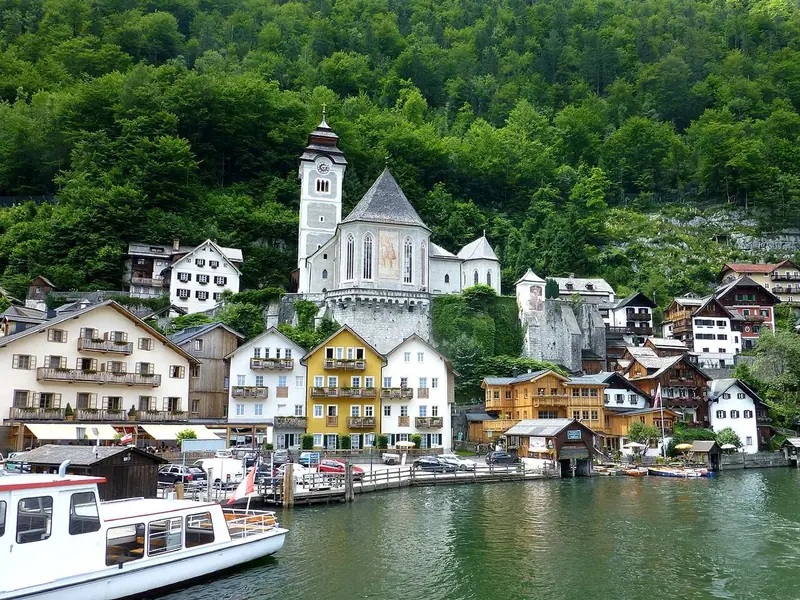 Hallstatt culture11 stops · c. 800 – 400 BCE (Hallstatt period; mining from c. 1500 BCE)
Hallstatt audio guide
A lakeside salt town that named a prehistoric age: the world’s oldest salt mine, the Iron Age cemetery, a painted-skull ossuary and the Dachstein ice caves.
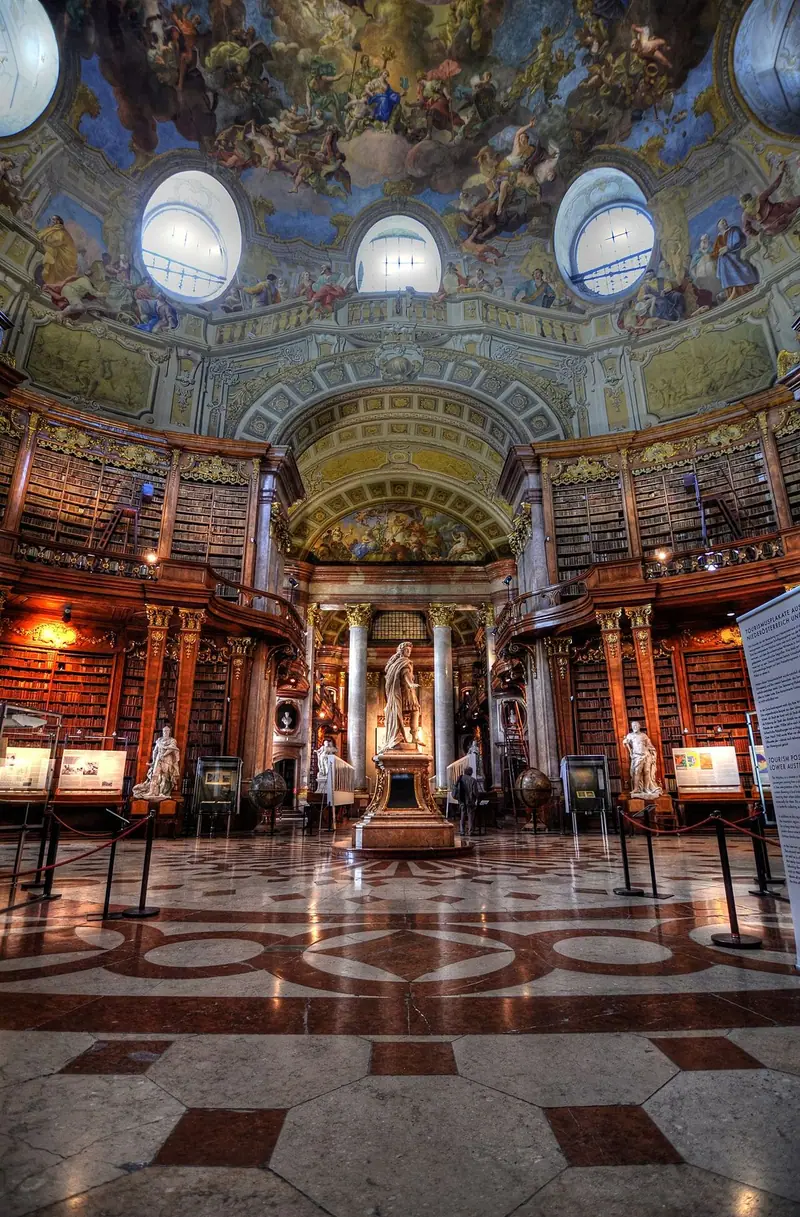 Habsburg8 stops · 13th century – 1918 CE
Hofburg audio guide
The courtyards of the Habsburgs’ winter palace in Vienna, from the Swiss Gate and the Imperial Treasury to the Spanish Riding School.
 Medieval7 stops · from 1077 CE
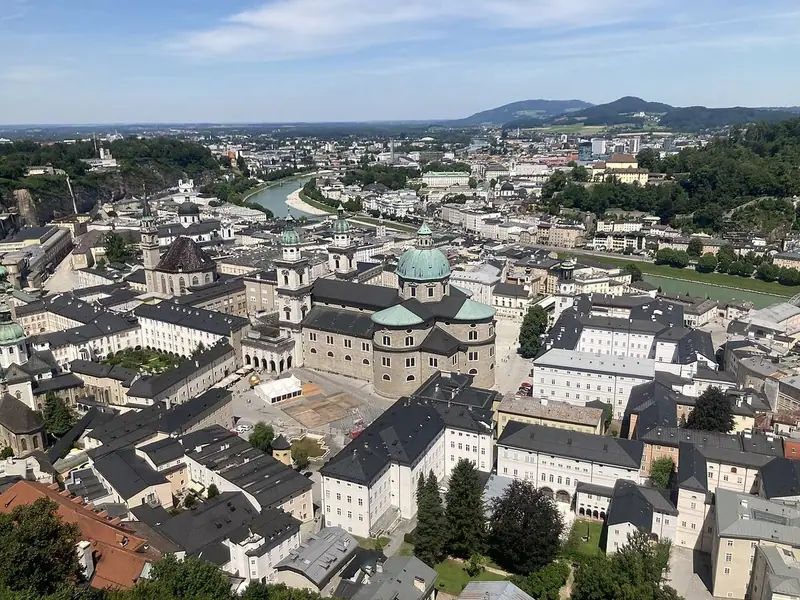
Hohensalzburg Fortress audio guide
Ride the funicular up to the prince-archbishops’ fortress above Salzburg, through its bastions to the Golden Hall.
 Habsburg8 stops · Ringstraße era
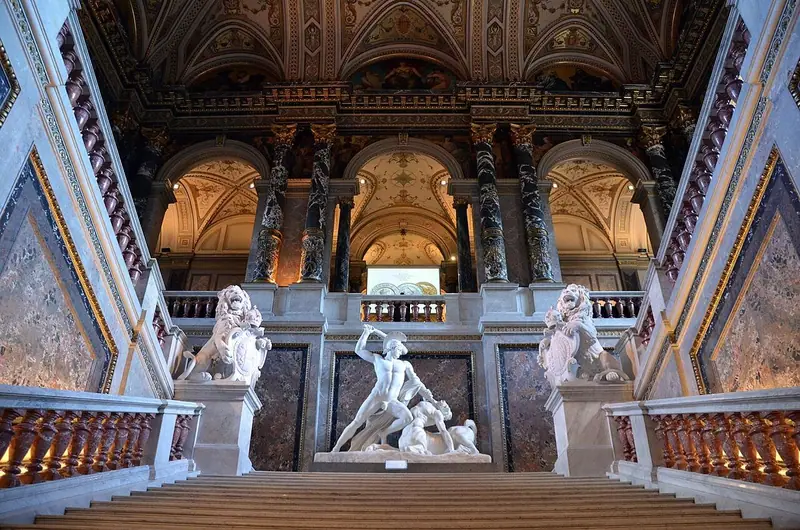
Kunsthistorisches Museum audio guide
Climb the grand staircase of the Habsburgs’ art museum to the Cupola Hall, the Kunstkammer and the finest collection of Bruegel in the world.
 Prince-Archbishopric of Salzburg7 stops · 696–1803
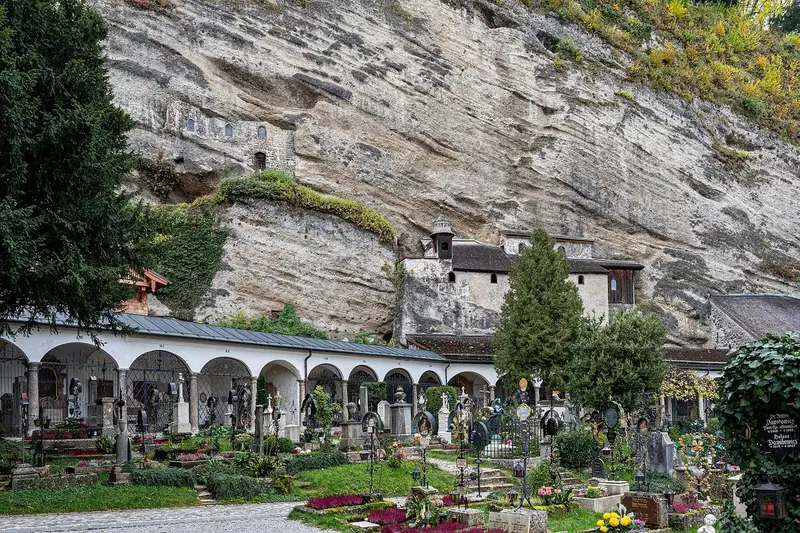
Salzburg Old Town audio guide
From Mirabell Palace and the Mozart family home across the Salzach to Mozart’s birthplace, the Collegiate Church, the archbishops’ Residenz, the cathedral and the ancient abbey of St Peter.
 Habsburg8 stops · 1569–1918 CE
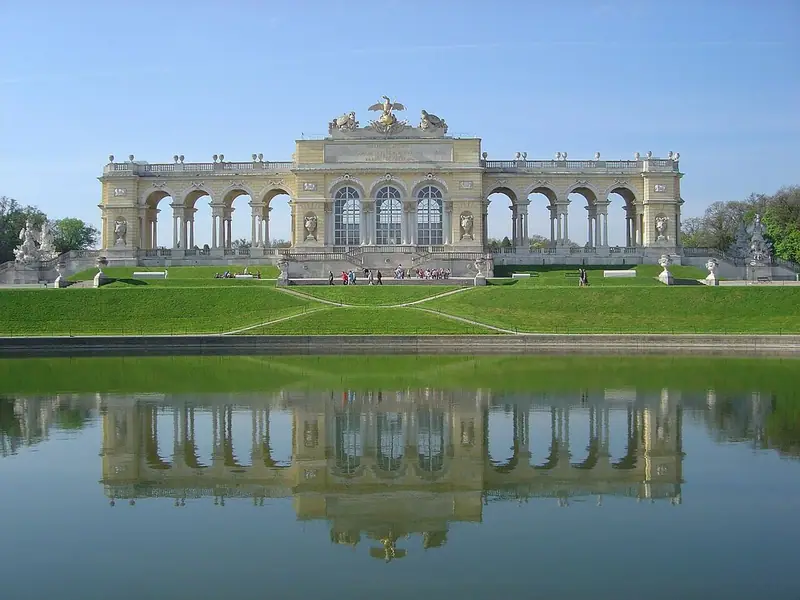
Schönbrunn Palace audio guide
Explore the Habsburgs’ summer palace from the Great Gallery and Franz Joseph’s apartments up through the gardens to the Gloriette.
Every guide, in every country
Melk Abbey and the Wachau and every other guide we publish, including future ones. One payment, no subscription.