Before you start
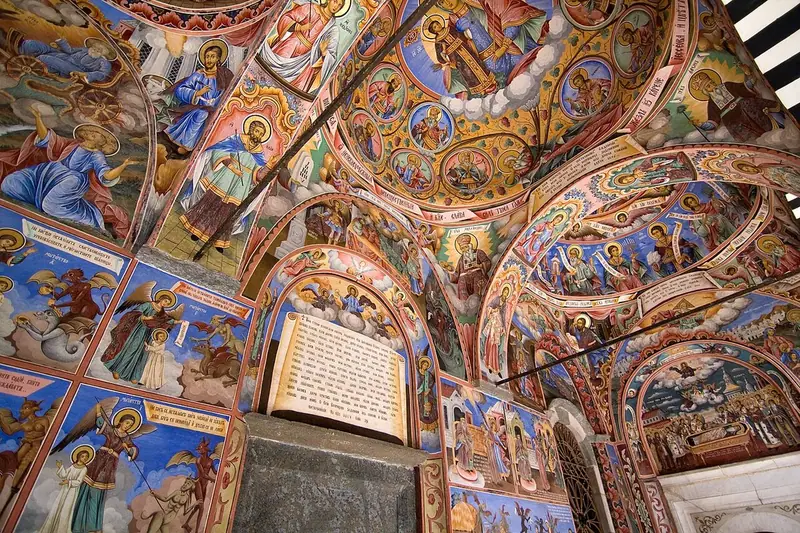
Rila Monastery lies deep in a forested valley of the Rila Mountains, about two hours’ drive south of Sofia, its striped arcades and painted church enclosed by high walls. Founded in the tenth century by the hermit Saint Ivan of Rila, the patron saint of Bulgaria, it kept the language and faith of the Bulgarians alive through centuries of Ottoman rule, and it is a UNESCO World Heritage Site. This guide takes you through the gates, around the courtyard and into the painted church, to the medieval tower, the great kitchen and the museum, and ends at the cave of Saint Ivan. It is a working monastery, so dress modestly and be quiet.
Use it as a self-guided tour of Rila Monastery: 7 stops in visit order, each played when you’re ready, at your own pace.
 Free preview · Stop 1
The Gates
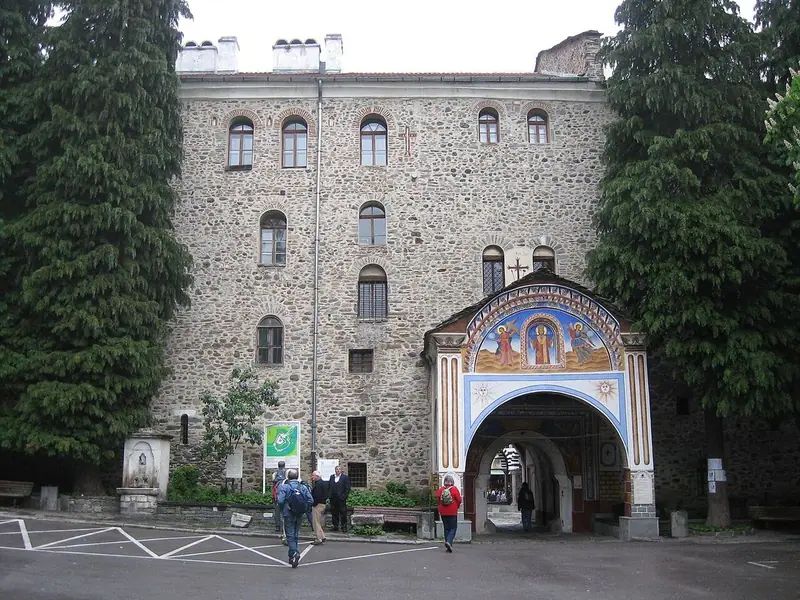
Begin outside the walls, by one of the two gates. The monastery stands in a valley more than eleven hundred metres up, surrounded by forests of beech and pine and by the peaks of the Rila Mountains. From outside, the high stone walls make it look like a fortress, with few windows. This was deliberate. For centuries the monastery was vulnerable to raids, and its walls protected the monks and the treasures inside. Look at the gateway, painted inside with frescoes of saints and monks. Then step through, into the courtyard, and look at the sudden burst of colour around you: the black and white stripes and red arches of the galleries, the wooden balconies, and the domes of the church in the centre. Notice the contrast between the plain, severe walls outside and the light and colour within.
Photo: Explorer1940 · CC BY-SA 4.0 · Wikimedia Commons
What to see at Rila Monastery: 7 stops, in visit order
- 01
 The GatesInto the valleyFree preview
- 02
 The CourtyardArcades of stripesIn the guide
- 03
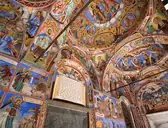 The Church of the NativityHeaven and hellIn the guide
- 04
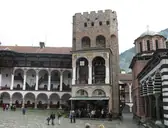 Hrelyo’s TowerThe oldest buildingIn the guide
- 05
 The KitchenCauldrons for pilgrimsIn the guide
- 06
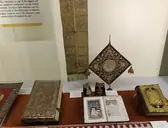 The MuseumRafail’s CrossIn the guide
- 07
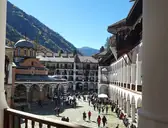 The Cave of Saint IvanWhere it beganIn the guide
Site map of Rila Monastery
History of Rila Monastery
The First Bulgarian Empire adopted Christianity in the ninth century, and in the tenth the hermit Ivan of Rila came to live in a cave in these mountains, where disciples gathered around him. Under the Second Bulgarian Empire, from the late twelfth century, the monastery was richly endowed by the tsars. The Ottomans conquered Bulgaria at the end of the fourteenth century, and the monastery was destroyed in the fifteenth, then rebuilt. It burned in 1833 and was rebuilt in the years that followed, during the Bulgarian National Revival. Bulgaria won its freedom from the Ottomans in 1878.
Rila Monastery guide: questions
How many stops does the Rila Monastery guide have?
7 stops, in visit order: 1. The Gates; 2. The Courtyard; 3. The Church of the Nativity; 4. Hrelyo’s Tower; 5. The Kitchen; 6. The Museum; 7. The Cave of Saint Ivan.
Can I do a self-guided tour of Rila Monastery with this guide?
Yes. The guide is made for a self-guided tour: 7 stops in visit order, each with a photo, a story and a voice, so you can explore Rila Monastery at your own pace, without joining a group. Download it before you go and it works offline.
How long is each guide?
The 7 stops add up to about 5 minutes of listening in total. You play each stop when you’re ready, so you can go at your own pace.
Does the guide work offline?
Yes, once it’s downloaded. The guide is a single self-contained web page (about 6.7 MB) with the photos, text and audio built in. Download it to your phone before you go (Wi-Fi is best); after that it opens in any modern browser on iPhone or Android, with no app, account or mobile signal needed.
Does it use GPS or need my location?
No. The guide doesn’t use GPS and doesn’t know where you are: you play each stop when you reach it. It works on iPhone and Android in any modern browser, and it’s in English.
What’s included?
One self-contained HTML guide: 7 stops in visit order, each with a photo, text and a voice, plus the story of who built the site.
Who built Rila Monastery?
The First Bulgarian Empire adopted Christianity in the ninth century, and in the tenth the hermit Ivan of Rila came to live in a cave in these mountains, where disciples gathered around him. Under the Second Bulgarian Empire, from the late twelfth century, the monastery was richly endowed by the tsars.
Is there a free audio guide to Rila Monastery?
The first stop, The Gates, is free to read and hear on this page, so you can try the Rila Monastery audio tour before you buy. The full guide, with all 7 stops, is a one-off purchase: download it once and it’s yours to keep, working offline.
Is the Rila Monastery guide worth it?
If you’d like to know what you’re looking at, yes. For $10 you get 7 stops in visit order, each with a photo, a short history and a voice you play when you’re ready, plus a site map of the stops, and about 5 minutes of listening in all. It’s short on purpose, so you spend your time looking, not listening. It’s yours to keep, works offline and needs no app. The first stop is free on this page, so you can try it before you buy. If you’d like hours of detail, a guided tour will go deeper.
Audio guide or guided tour?
It depends how you like to visit. This guide lets you explore Rila Monastery at your own pace, at any time, for a one-off price. A guided tour gives you a live expert you can ask questions, but at fixed times and usually for a higher price. Many people use both: a tour for the big picture, and the guide to read beforehand or to revisit the stops in their own time.
Is this the official Rila Monastery guide?
No. It’s an independent guide by The Historian Guide, not affiliated with or endorsed by the operator of Rila Monastery. For tickets and opening hours, check the official site operator before you go.
Does the guide include entry tickets or opening hours?
No. The guide is a digital companion only. Admission to Rila Monastery is separate, so check the official site operator for current tickets and opening hours before you go.
- Stop 1 · The Gates: Explorer1940 · CC BY-SA 4.0 · Wikimedia Commons · resized
- Stop 2 · The Courtyard: Daniel Dimitrov · CC BY-SA 4.0 · Wikimedia Commons · resized
- Stop 3 · The Church of the Nativity (also the cover): Raggatt2000 · CC BY-SA 3.0 · Wikimedia Commons · resized
- Stop 4 · Hrelyo’s Tower: Explorer1940 · CC BY-SA 4.0 · Wikimedia Commons · resized
- Stop 5 · The Kitchen: Elena Krasteva · CC BY-SA 4.0 · Wikimedia Commons · resized
- Stop 6 · The Museum: Ivano Giambattista · CC0 · Wikimedia Commons · resized
- Stop 7 · The Cave of Saint Ivan: IngimarE · CC BY-SA 4.0 · Wikimedia Commons · resized


All photographs from Wikimedia Commons under the licences shown.
More guides in Bulgaria
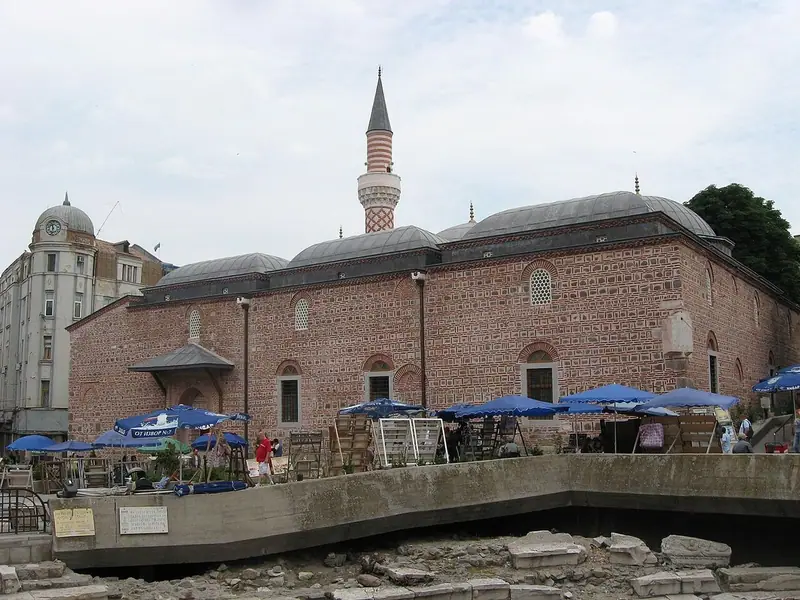 Roman8 stops · 1st–2nd century CE; 18th–19th century
Old Plovdiv audio guide
Find a Roman stadium beneath the main square, a Roman theatre still used for concerts and the colourful merchants’ houses of the old town.
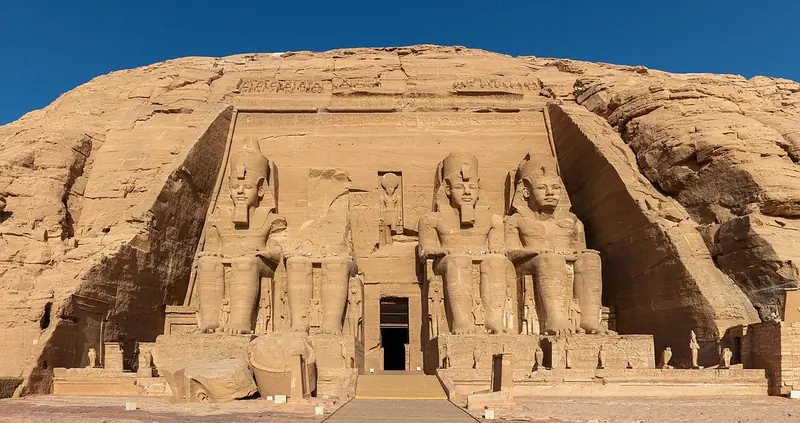 Ancient Egyptian8 stops · 13th century BCE
Abu Simbel audio guide
Ramesses II’s colossal temple façade, the Temple of Nefertari, and how both were rescued from the waters of Lake Nasser.
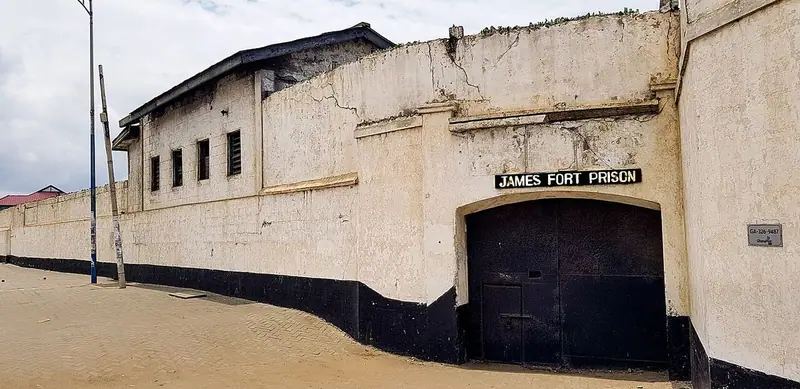 Ga7 stops · 1649–1957
Old Accra audio guide
From the old forts and lighthouse of Jamestown, through the Ga fishing quarter, to the monuments of Ghana’s independence and Osu Castle.
Every guide, in every country
Rila Monastery and every other guide we publish, including future ones. One payment, no subscription.