Before you start
Rano Kau is the great extinct volcano that forms the south-western headland of Rapa Nui, its vast crater filled with a reed-covered lake. On its rim, high above the ocean, lies Orongo, a ceremonial village of stone houses, the centre of the birdman cult. Both are part of Rapa Nui National Park, a UNESCO World Heritage Site, cared for by the Maʻu Henua indigenous community. Visitors need a park ticket and an accredited guide, and Orongo may be visited only once on each ticket. The wind on the rim can be fierce, so hold on to hats and keep well back from the cliff edges, and stay on the marked paths.
Use it as a self-guided tour of Orongo and Rano Kau: 7 stops in visit order, each played when you’re ready, at your own pace.
 Free preview · Stop 1
The Crater of Rano Kau
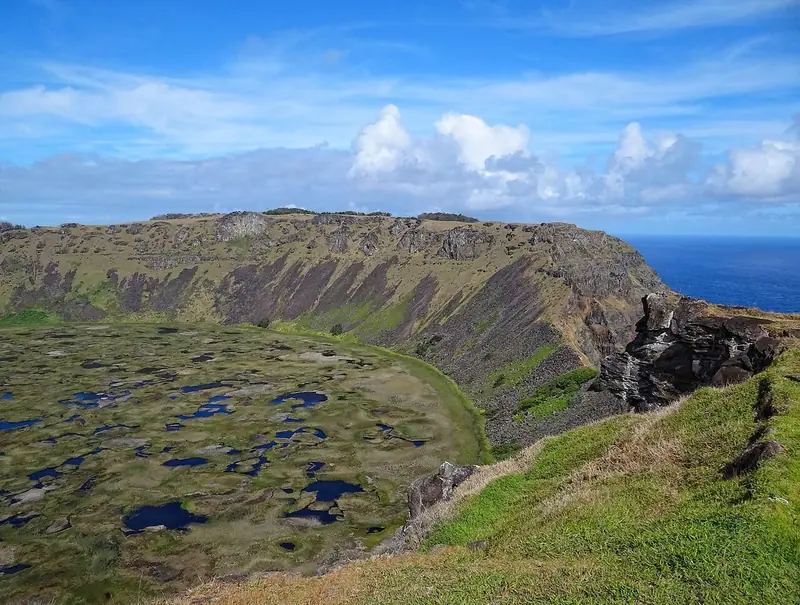
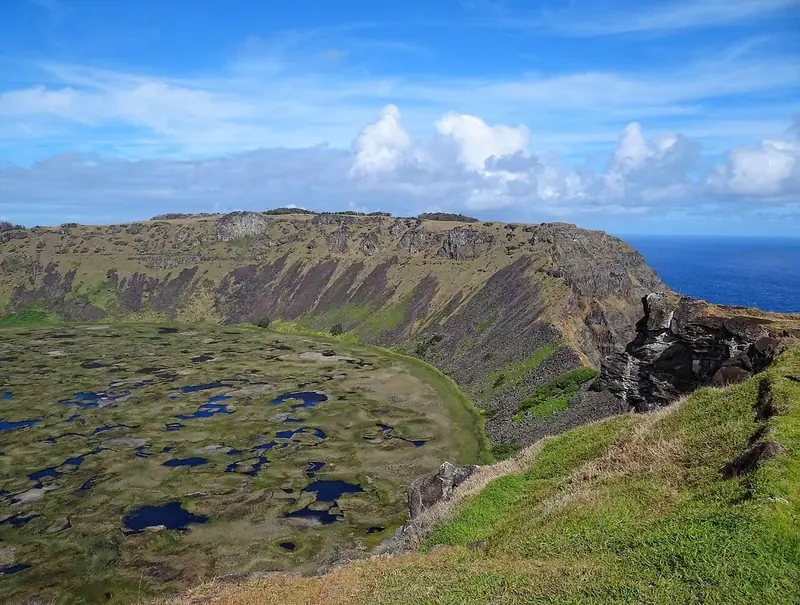
Begin at the viewpoint on the rim of Rano Kau, and look down into its enormous crater, about one and a half kilometres across. The volcano rises to three hundred and twenty-four metres, and its name is often explained as a broad volcano filled with water. Look at the steep inner walls, falling away to the lake far below, and the sea beyond, where the ocean has eaten away the outer wall, cutting a notch in the rim. On its northern side, the volcano slopes down towards the airport and the town of Hanga Roa. Notice the sheltered microclimate of the crater, where figs and other plants flourish out of the wind. The inner slopes were the home of the last wild toromiro tree, a native tree of the island, until it was cut down in 1960.
Photo: Bjørn Christian Tørrissen · CC BY-SA 3.0 · Wikimedia Commons
What to see at Orongo and Rano Kau: 7 stops, in visit order
- 01
 The Crater of Rano KauA Volcano Filled with WaterFree preview
- 02
 The Crater LakeThe Floating GardenIn the guide
- 03
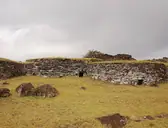 OrongoThe Ceremonial VillageIn the guide
- 04
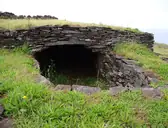 The Stone HousesBuilt of Thin SlabsIn the guide
- 05
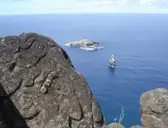 Mata NgarauThe Birdman CarvingsIn the guide
- 06
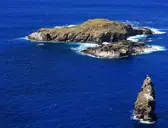
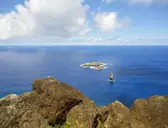 Motu NuiThe Islet of the EggIn the guide
- 07
 The BirdmanThe Winner and His YearIn the guide
Site map of Orongo and Rano Kau
History of Orongo and Rano Kau
Rano Kau was formed by lava flows hundreds of thousands of years ago. In the age after the great moai were carved, the people of Rapa Nui developed a new religion, centred on the god Makemake and the birdman, the tangata manu. Between the eighteenth and the mid-nineteenth centuries, Orongo was the scene of an annual contest to bring back the first egg of the sooty tern from the islet of Motu Nui. In the 1860s, most of the islanders died of disease or were taken away as slaves, and after the survivors converted to Christianity, Orongo fell out of use. Its houses were restored in the 1970s, under the American archaeologist William Mulloy, with the Rapa Nui archaeologist Sonia Haoa.
Orongo and Rano Kau guide: questions
How many stops does the Orongo and Rano Kau guide have?
7 stops, in visit order: 1. The Crater of Rano Kau; 2. The Crater Lake; 3. Orongo; 4. The Stone Houses; 5. Mata Ngarau; 6. Motu Nui; 7. The Birdman.
Can I do a self-guided tour of Orongo and Rano Kau with this guide?
Yes. The guide is made for a self-guided tour: 7 stops in visit order, each with a photo, a story and a voice, so you can explore Orongo and Rano Kau at your own pace, without joining a group. Download it before you go and it works offline.
How long is each guide?
The 7 stops add up to about 5 minutes of listening in total. You play each stop when you’re ready, so you can go at your own pace.
Does the guide work offline?
Yes, once it’s downloaded. The guide is a single self-contained web page (about 6.6 MB) with the photos, text and audio built in. Download it to your phone before you go (Wi-Fi is best); after that it opens in any modern browser on iPhone or Android, with no app, account or mobile signal needed.
Does it use GPS or need my location?
No. The guide doesn’t use GPS and doesn’t know where you are: you play each stop when you reach it. It works on iPhone and Android in any modern browser, and it’s in English.
What’s included?
One self-contained HTML guide: 7 stops in visit order, each with a photo, text and a voice, plus the story of who built the site.
Who built Orongo and Rano Kau?
Rano Kau was formed by lava flows hundreds of thousands of years ago. In the age after the great moai were carved, the people of Rapa Nui developed a new religion, centred on the god Makemake and the birdman, the tangata manu.
Where is Orongo and Rano Kau?
Rano Kau is the great extinct volcano that forms the south-western headland of Rapa Nui, its vast crater filled with a reed-covered lake.
Is there a free audio guide to Orongo and Rano Kau?
The first stop, The Crater of Rano Kau, is free to read and hear on this page, so you can try the Orongo and Rano Kau audio tour before you buy. The full guide, with all 7 stops, is a one-off purchase: download it once and it’s yours to keep, working offline.
Is the Orongo and Rano Kau guide worth it?
If you’d like to know what you’re looking at, yes. For $10 you get 7 stops in visit order, each with a photo, a short history and a voice you play when you’re ready, plus a site map of the stops, and about 5 minutes of listening in all. It’s short on purpose, so you spend your time looking, not listening. It’s yours to keep, works offline and needs no app. The first stop is free on this page, so you can try it before you buy. If you’d like hours of detail, a guided tour will go deeper.
Audio guide or guided tour?
It depends how you like to visit. This guide lets you explore Orongo and Rano Kau at your own pace, at any time, for a one-off price. A guided tour gives you a live expert you can ask questions, but at fixed times and usually for a higher price. Many people use both: a tour for the big picture, and the guide to read beforehand or to revisit the stops in their own time.
Is this the official Orongo and Rano Kau guide?
No. It’s an independent guide by The Historian Guide, not affiliated with or endorsed by the operator of Orongo and Rano Kau. For tickets and opening hours, check the official site operator before you go.
Does the guide include entry tickets or opening hours?
No. The guide is a digital companion only. Admission to Orongo and Rano Kau is separate, so check the official site operator for current tickets and opening hours before you go.
- Stop 1 · The Crater of Rano Kau (also the cover): Bjørn Christian Tørrissen · CC BY-SA 3.0 · Wikimedia Commons · resized
- Stop 2 · The Crater Lake: Alanbritom · CC BY-SA 2.0 · Wikimedia Commons · resized
- Stop 3 · Orongo: Jucar1967 · CC BY-SA 3.0 · Wikimedia Commons · resized
- Stop 4 · The Stone Houses: Koppas · CC BY-SA 3.0 · Wikimedia Commons · resized
- Stop 5 · Mata Ngarau: Patricio Antonio Soto Latrille · CC BY-SA 3.0 · Wikimedia Commons · resized
- Stop 6 · Motu Nui: Gonzalezavila · CC BY-SA 3.0 · Wikimedia Commons · resized
- Stop 7 · The Birdman: TravelingOtter · CC BY 2.0 · Wikimedia Commons · resized


All photographs from Wikimedia Commons under the licences shown.
More guides in Chile
 Rapa Nui8 stops · from c. 1200 CE
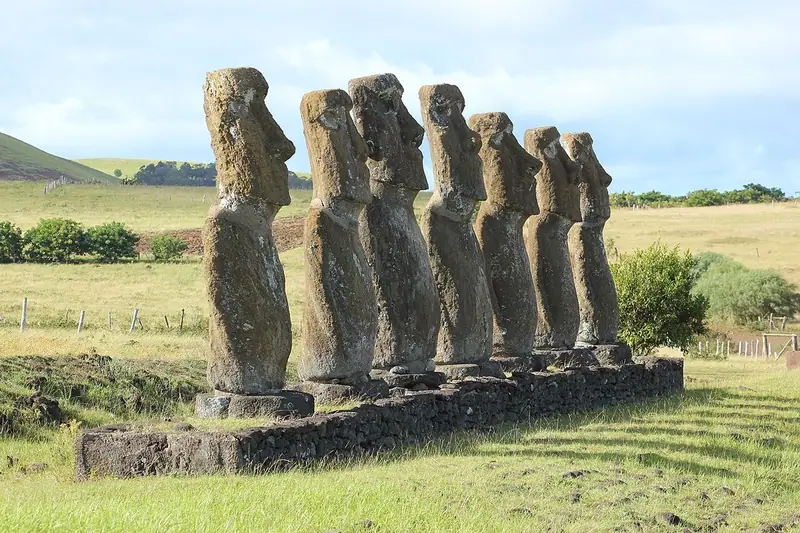
Anakena and the North of Rapa Nui audio guide
Cross Rapa Nui from the red topknot quarry of Puna Pau and the seven moai of Ahu Akivi to the white sand of Anakena, where tradition says Hotu Matuʻa landed.
 Rapa Nui8 stops · c. 500 years to the early 18th century
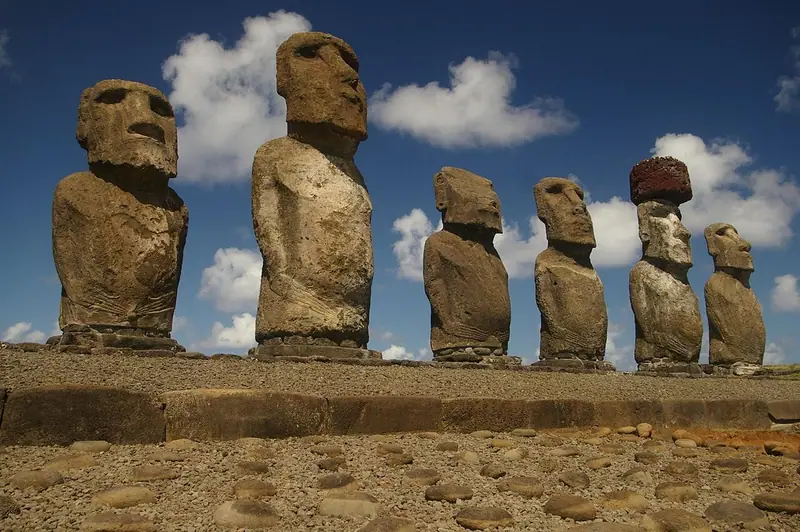
Rano Raraku and Ahu Tongariki audio guide
The quarry slopes of Rano Raraku, with buried heads and unfinished giants, then the fifteen restored moai of Ahu Tongariki.
 Modern9 stops · late 19th – early 20th century
Valparaíso audio guide
Chile’s historic port, with its civic squares, Prat Pier, funicular lifts and the colourful hillside quarters of Cerro Concepción and Cerro Alegre.
Every guide, in every country
Orongo and Rano Kau and every other guide we publish, including future ones. One payment, no subscription.