Before you start
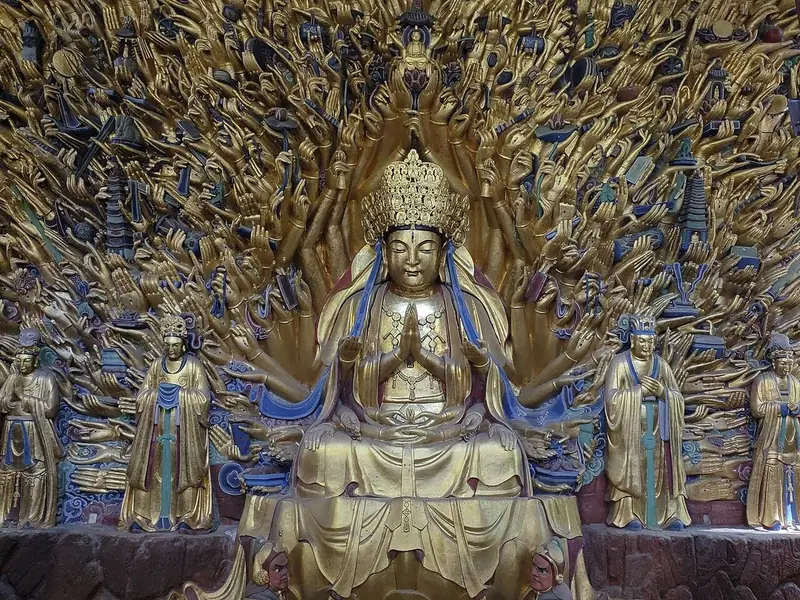
In the green hills of Dazu District, in the west of Chongqing Municipality, tens of thousands of figures are carved into the cliffs. The Dazu Rock Carvings comprise seventy-five protected sites with some fifty thousand statues and more than a hundred thousand characters of inscriptions, made mostly between the ninth and thirteenth centuries. UNESCO inscribed five of these sites as a World Heritage Site in 1999, praising their aesthetic quality, their variety of subjects, and the light they shed on everyday life in China. They are celebrated, above all, for bringing together Buddhism, Taoism and Confucianism. The two most important groups lie at Beishan, the North Mountain, just outside Dazu town, and at Baodingshan, about fifteen kilometres to the north-east. The route begins at Beishan, the earlier site, and then follows the great horseshoe of carvings at Baodingshan.
Use it as a self-guided tour of the Dazu Rock Carvings: 9 stops in visit order, each played when you’re ready, at your own pace.
 Free preview · Stop 1
The Beishan Cliff
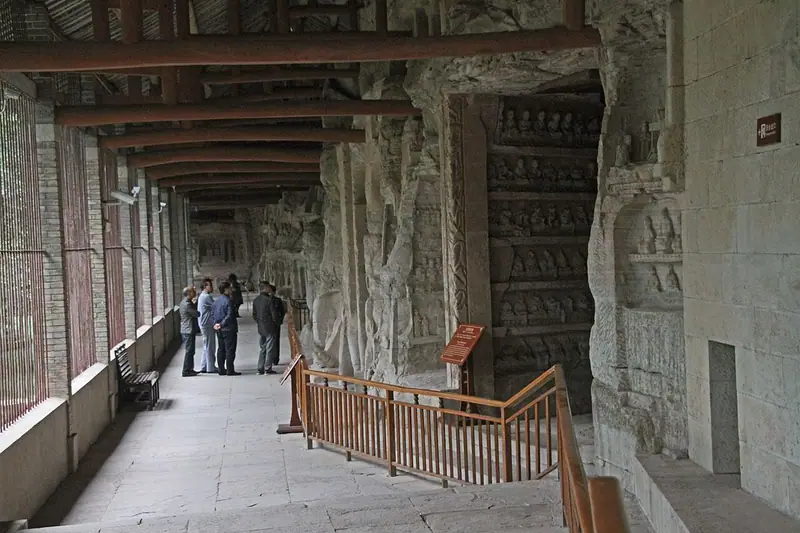
Begin at Beishan, the North Mountain, about a kilometre and a half north of Dazu town. Here a crescent-shaped cliff, divided into southern and northern sections, holds some two hundred and sixty niches and caves, numbered in 1952, with thousands of figures. The southern section holds mostly works of the late Tang and the Five Dynasties, and the northern mostly works of the Song. Follow the covered gallery along the foot of the cliff. Among the oldest is niche number five, where Vaishravana, the Heavenly King of the North, stands on two demons, perhaps carved to guard the fortified camp that Wei Junjing built here in 892. Notice how the earlier figures are fuller and more rounded than the later ones. Roughly a third of the subjects come from Tantric Buddhism, and many show Guanyin, the bodhisattva of compassion, who appears in more than half of the Song carvings.
Photo: Gerd Eichmann · CC BY-SA 4.0 · Wikimedia Commons
What to see at the Dazu Rock Carvings: 9 stops, in visit order
- 01
 The Beishan CliffWhere the carving beganFree preview
- 02
 The Peacock King CaveThe refinement of the SongIn the guide
- 03
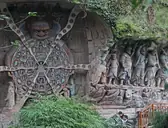 The Wheel of RebirthThe six paths of existenceIn the guide
- 04
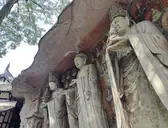 The Three Sages of HuayanThe largest standing figuresIn the guide
- 05
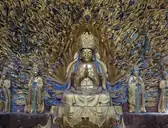 The Thousand-Armed GuanyinA thousand hands of goldIn the guide
- 06
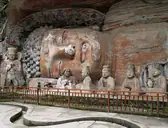 The Reclining BuddhaThe Buddha’s passing into nirvanaIn the guide
- 07
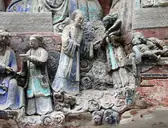 Parental KindnessConfucian virtue in Buddhist stoneIn the guide
- 08
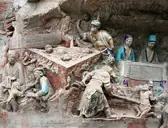 The HellsRetribution and the deeds of Liu BenzunIn the guide
- 09
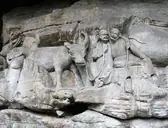 The Herding of the OxenThe path to a tranquil mindIn the guide
Site map of the Dazu Rock Carvings
History of the Dazu Rock Carvings
The earliest carvings at Dazu date from 650, early in the Tang dynasty, but the main period of work began in 892, when Wei Junjing, the prefect of Changzhou, built a fortified camp on the North Mountain and began the carvings there. After the fall of the Tang in 907, officials, gentry, monks, nuns and ordinary people followed his example, and work at Beishan continued for more than two hundred and fifty years, until 1146. Under the Song dynasty, this region was one of the wealthiest in China. In 1179 a local monk, Zhao Zhifeng, began an immense project at Baodingshan, and he directed it for some seventy years, creating a planned sequence of carvings unlike any other in China. Long closed to outsiders, the carvings were opened to Chinese visitors in 1961 and to foreign visitors in 1980.
Dazu Rock Carvings guide: questions
How many stops does the Dazu Rock Carvings guide have?
9 stops, in visit order: 1. The Beishan Cliff; 2. The Peacock King Cave; 3. The Wheel of Rebirth; 4. The Three Sages of Huayan; 5. The Thousand-Armed Guanyin; 6. The Reclining Buddha; 7. Parental Kindness; 8. The Hells; 9. The Herding of the Oxen.
Can I do a self-guided tour of the Dazu Rock Carvings with this guide?
Yes. The guide is made for a self-guided tour: 9 stops in visit order, each with a photo, a story and a voice, so you can explore the Dazu Rock Carvings at your own pace, without joining a group. Download it before you go and it works offline.
How long do you need at the Dazu Rock Carvings?
We suggest allowing A full day. The 9 stops add up to about 7 minutes of listening, and you play each one when you’re ready, so you can linger wherever you like.
How long is each guide?
The 9 stops add up to about 7 minutes of listening in total. You play each stop when you’re ready, so you can go at your own pace.
Does the guide work offline?
Yes, once it’s downloaded. The guide is a single self-contained web page (about 8.7 MB) with the photos, text and audio built in. Download it to your phone before you go (Wi-Fi is best); after that it opens in any modern browser on iPhone or Android, with no app, account or mobile signal needed.
Does it use GPS or need my location?
No. The guide doesn’t use GPS and doesn’t know where you are: you play each stop when you reach it. It works on iPhone and Android in any modern browser, and it’s in English.
What’s included?
One self-contained HTML guide: 9 stops in visit order, each with a photo, text and a voice, plus the story of who built the site.
Who built the Dazu Rock Carvings?
The earliest carvings at Dazu date from 650, early in the Tang dynasty, but the main period of work began in 892, when Wei Junjing, the prefect of Changzhou, built a fortified camp on the North Mountain and began the carvings there. After the fall of the Tang in 907, officials, gentry, monks, nuns and ordinary people followed his example, and work at Beishan continued for more than two hundred and fifty years, until 1146.
Where is the Dazu Rock Carvings?
In the green hills of Dazu District, in the west of Chongqing Municipality, tens of thousands of figures are carved into the cliffs.
Is there a free audio guide to the Dazu Rock Carvings?
The first stop, The Beishan Cliff, is free to read and hear on this page, so you can try the Dazu Rock Carvings audio tour before you buy. The full guide, with all 9 stops, is a one-off purchase: download it once and it’s yours to keep, working offline.
Is the Dazu Rock Carvings guide worth it?
If you’d like to know what you’re looking at, yes. For $10 you get 9 stops in visit order, each with a photo, a short history and a voice you play when you’re ready, plus a site map of the stops, and about 7 minutes of listening in all. It’s short on purpose, so you spend your time looking, not listening. It’s yours to keep, works offline and needs no app. The first stop is free on this page, so you can try it before you buy. If you’d like hours of detail, a guided tour will go deeper.
Audio guide or guided tour?
It depends how you like to visit. This guide lets you explore the Dazu Rock Carvings at your own pace, at any time, for a one-off price. A guided tour gives you a live expert you can ask questions, but at fixed times and usually for a higher price. Many people use both: a tour for the big picture, and the guide to read beforehand or to revisit the stops in their own time.
Is this the official Dazu Rock Carvings guide?
No. It’s an independent guide by The Historian Guide, not affiliated with or endorsed by the operator of the Dazu Rock Carvings. For tickets and opening hours, check the official site operator before you go.
Does the guide include entry tickets or opening hours?
No. The guide is a digital companion only. Admission to the Dazu Rock Carvings is separate, so check the official site operator for current tickets and opening hours before you go.
- Stop 1 · The Beishan Cliff: Gerd Eichmann · CC BY-SA 4.0 · Wikimedia Commons · resized
- Stop 2 · The Peacock King Cave: Truthven · CC BY-SA 3.0 · Wikimedia Commons · resized
- Stop 3 · The Wheel of Rebirth: Gerd Eichmann · CC BY-SA 4.0 · Wikimedia Commons · resized
- Stop 4 · The Three Sages of Huayan: Yumeto · CC BY-SA 4.0 · Wikimedia Commons · resized
- Stop 5 · The Thousand-Armed Guanyin (also the cover): Yumeto · CC BY-SA 4.0 · Wikimedia Commons · resized
- Stop 6 · The Reclining Buddha: Gerd Eichmann · CC BY-SA 4.0 · Wikimedia Commons · resized
- Stop 7 · Parental Kindness: Gerd Eichmann · CC BY-SA 4.0 · Wikimedia Commons · resized
- Stop 8 · The Hells: Gerd Eichmann · CC BY-SA 4.0 · Wikimedia Commons · resized
- Stop 9 · The Herding of the Oxen: Gerd Eichmann · CC BY-SA 4.0 · Wikimedia Commons · resized


All photographs from Wikimedia Commons under the licences shown.
More guides in China
 Ming8 stops · 1406–1912 CE
The Forbidden City audio guide
Follow the central axis of China’s imperial palace through its gates and halls of harmony, roofed in the emperor’s golden-yellow tiles.
 Ming6 stops · 1368–1644 CE
Great Wall at Badaling audio guide
Climb the grey brick battlements and watchtowers of the Great Wall as it rides the mountain crests on either side of the Badaling pass.
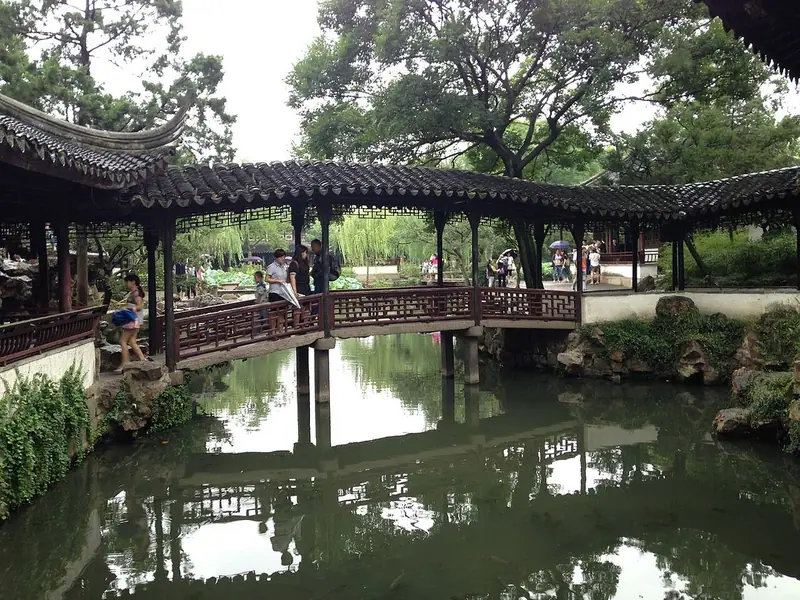 Ming7 stops · from c. 1510 CE
Humble Administrator’s Garden audio guide
Suzhou’s largest classical garden, a landscape in miniature of ponds, islands, bridges and pavilions, each framing a composed view.
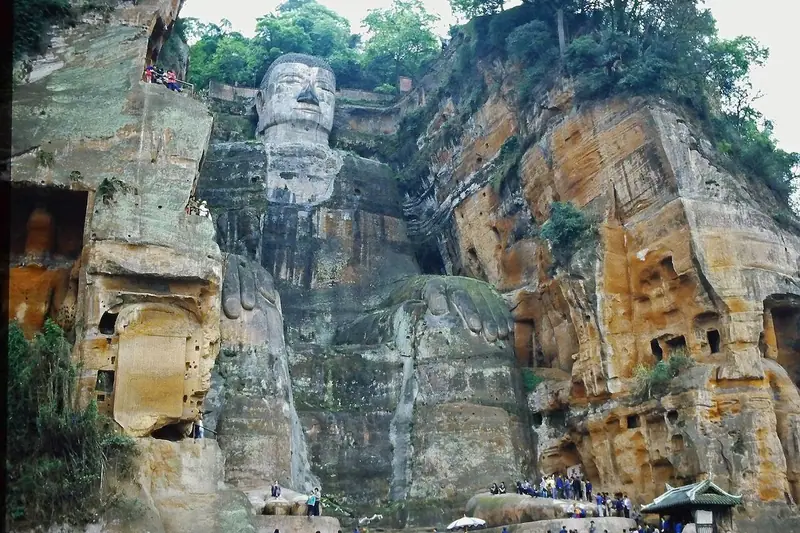 Tang6 stops · early 8th century – 803 CE
Leshan Giant Buddha audio guide
Climb down the Nine-Turn Plank Road beside the 71-metre Giant Buddha, carved into a red sandstone cliff where three rivers meet.
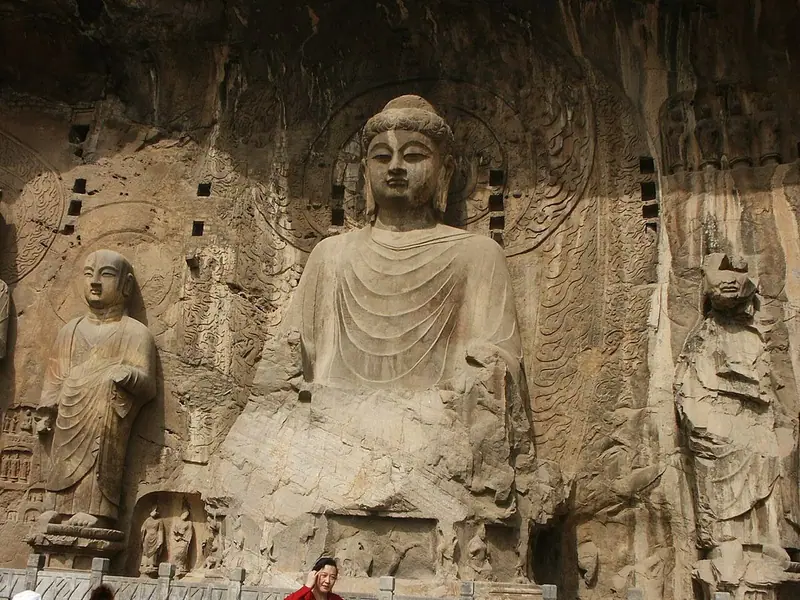 Tang7 stops · 494–907 CE
Longmen Grottoes audio guide
Follow the Yi River past limestone cliffs honeycombed with Buddhist caves and niches to the colossal statues of the Fengxian Temple.
 Portuguese9 stops · 1557 – 1999 (Portuguese administration)
Macao audio guide
Chinese temples and Portuguese churches, squares and fortresses side by side in a port under Portuguese administration for more than four centuries.
Every guide, in every country
Dazu Rock Carvings and every other guide we publish, including future ones. One payment, no subscription.