Before you start
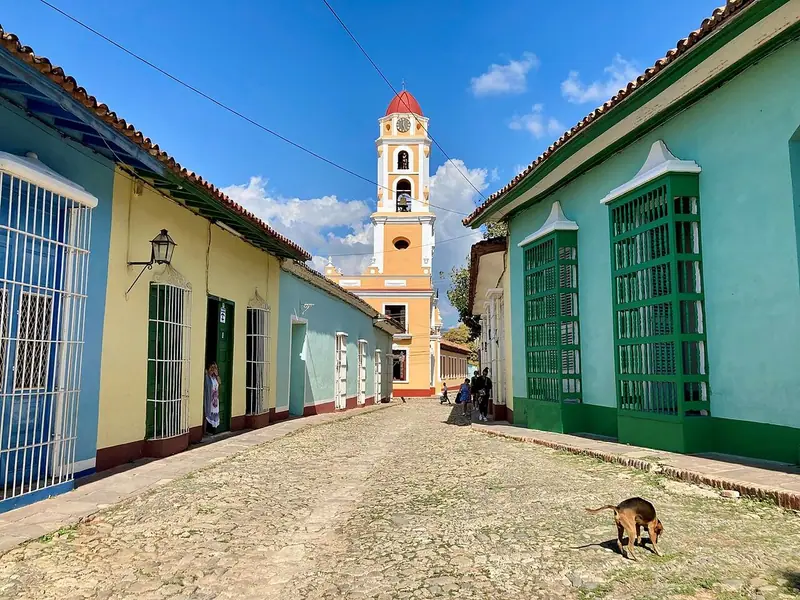
Trinidad lies on the south coast of central Cuba, between the Escambray Mountains and the Caribbean Sea. It is one of the best-preserved colonial towns in the Caribbean, with cobbled streets, pastel houses with iron window grilles, and the mansions of the sugar barons who made it rich. Together with the nearby Valle de los Ingenios, it was inscribed as a UNESCO World Heritage Site in 1988. The tour starts in the Plaza Mayor, visits the parish church and two palaces that are now museums, climbs a bell tower, and ends with the valley of the sugar mills. The cobbles are rough, so wear sturdy shoes.
Use it as a self-guided tour of Trinidad: 7 stops in visit order, each played when you’re ready, at your own pace.
 Free preview · Stop 1
Plaza Mayor
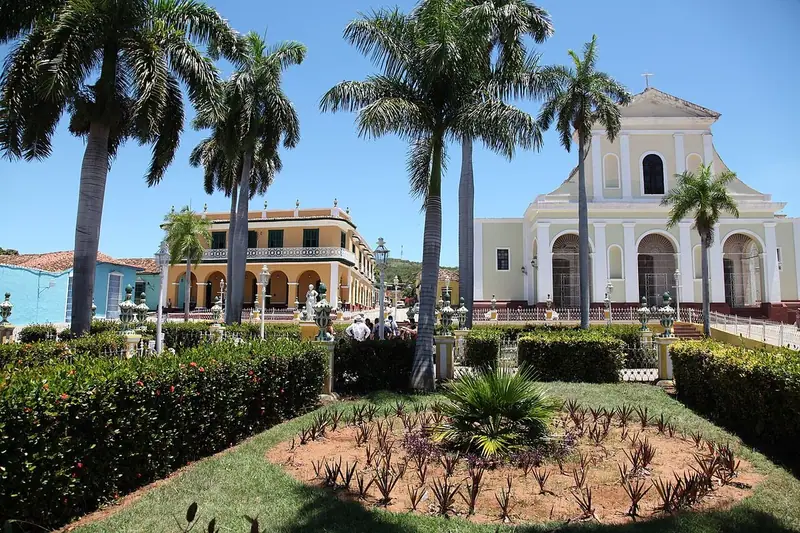
Begin in the Plaza Mayor, the main square, on a gentle slope at the top of the old town. It is the oldest public space in the city, and the first church and town hall are said to have stood here, built of simple materials. Today it is a small garden, with palm trees, white wrought-iron railings, and statues and urns brought from Europe. Around it stand some of Trinidad’s finest houses, built by wealthy families in the late eighteenth and nineteenth centuries, painted in yellow, green and blue, with tiled roofs and tall wooden doors. The square was later named after a local doctor, José Manuel García, whose son, also a doctor, was remembered for his charity. Sit for a while and watch the town around you, with its horses, carts and old cars rattling over the cobbles.
Photo: Marc-Lautenbacher · CC BY-SA 4.0 · Wikimedia Commons
What to see at Trinidad: 7 stops, in visit order
- 01
 Plaza MayorThe heart of the old townFree preview
- 02
 The Parish ChurchThe Holy TrinityIn the guide
- 03
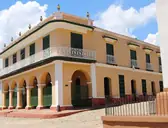 Museo RománticoThe Brunet PalaceIn the guide
- 04
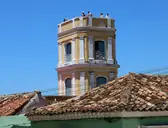 The Palacio CanteroA sugar baron’s mansionIn the guide
- 05
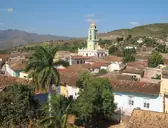 The San Francisco TowerSymbol of the townIn the guide
- 06
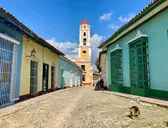 The Streets of TrinidadCobbles, grilles and musicIn the guide
- 07
 Valle de los IngeniosThe valley of the sugar millsIn the guide
Site map of Trinidad
History of Trinidad
Before the Spanish arrived, this part of Cuba was home to the Taíno people. The Spanish conquistador Diego Velázquez founded Trinidad in 1514, one of the first Spanish towns in Cuba, and in 1518 Hernán Cortés recruited men here for his expedition to Mexico. For two centuries it was a small, remote town, living from cattle and smuggling. From the late eighteenth century, sugar plantations in the valleys nearby, worked by tens of thousands of enslaved Africans, made its planters among the richest in Cuba. The wars of independence and the decline of the sugar trade in the late nineteenth century left the town poor and isolated, and that is why so much of it survives.
Trinidad guide: questions
How many stops does the Trinidad guide have?
7 stops, in visit order: 1. Plaza Mayor; 2. The Parish Church; 3. Museo Romántico; 4. The Palacio Cantero; 5. The San Francisco Tower; 6. The Streets of Trinidad; 7. Valle de los Ingenios.
Can I do a self-guided tour of Trinidad with this guide?
Yes. The guide is made for a self-guided tour: 7 stops in visit order, each with a photo, a story and a voice, so you can explore Trinidad at your own pace, without joining a group. Download it before you go and it works offline.
How long is each guide?
The 7 stops add up to about 5 minutes of listening in total. You play each stop when you’re ready, so you can go at your own pace.
Does the guide work offline?
Yes, once it’s downloaded. The guide is a single self-contained web page (about 6.6 MB) with the photos, text and audio built in. Download it to your phone before you go (Wi-Fi is best); after that it opens in any modern browser on iPhone or Android, with no app, account or mobile signal needed.
Does it use GPS or need my location?
No. The guide doesn’t use GPS and doesn’t know where you are: you play each stop when you reach it. It works on iPhone and Android in any modern browser, and it’s in English.
What’s included?
One self-contained HTML guide: 7 stops in visit order, each with a photo, text and a voice, plus the story of who built the site.
Who built Trinidad?
Before the Spanish arrived, this part of Cuba was home to the Taíno people. The Spanish conquistador Diego Velázquez founded Trinidad in 1514, one of the first Spanish towns in Cuba, and in 1518 Hernán Cortés recruited men here for his expedition to Mexico.
Where is Trinidad?
Trinidad lies on the south coast of central Cuba, between the Escambray Mountains and the Caribbean Sea.
Is there a free audio guide to Trinidad?
The first stop, Plaza Mayor, is free to read and hear on this page, so you can try the Trinidad audio tour before you buy. The full guide, with all 7 stops, is a one-off purchase: download it once and it’s yours to keep, working offline.
Is the Trinidad guide worth it?
If you’d like to know what you’re looking at, yes. For $10 you get 7 stops in visit order, each with a photo, a short history and a voice you play when you’re ready, plus a site map of the stops, and about 5 minutes of listening in all. It’s short on purpose, so you spend your time looking, not listening. It’s yours to keep, works offline and needs no app. The first stop is free on this page, so you can try it before you buy. If you’d like hours of detail, a guided tour will go deeper.
Audio guide or guided tour?
It depends how you like to visit. This guide lets you explore Trinidad at your own pace, at any time, for a one-off price. A guided tour gives you a live expert you can ask questions, but at fixed times and usually for a higher price. Many people use both: a tour for the big picture, and the guide to read beforehand or to revisit the stops in their own time.
Is this the official Trinidad guide?
No. It’s an independent guide by The Historian Guide, not affiliated with or endorsed by the operator of Trinidad. For tickets and opening hours, check the official site operator before you go.
Does the guide include entry tickets or opening hours?
No. The guide is a digital companion only. Admission to Trinidad is separate, so check the official site operator for current tickets and opening hours before you go.
- Stop 1 · Plaza Mayor: Marc-Lautenbacher · CC BY-SA 4.0 · Wikimedia Commons · resized
- Stop 2 · The Parish Church: Dudva · CC0 · Wikimedia Commons · resized
- Stop 3 · Museo Romántico: Maesi64 · CC0 · Wikimedia Commons · resized
- Stop 4 · The Palacio Cantero: Maesi64 · CC0 · Wikimedia Commons · resized
- Stop 5 · The San Francisco Tower: User: Bgabel at wikivoyage shared · CC BY-SA 3.0 · Wikimedia Commons · resized
- Stop 6 · The Streets of Trinidad (also the cover): Dudva · CC0 · Wikimedia Commons · resized
- Stop 7 · Valle de los Ingenios: Schwarzenfelder · CC BY-SA 4.0 · Wikimedia Commons · resized


All photographs from Wikimedia Commons under the licences shown.
More guides in Cuba
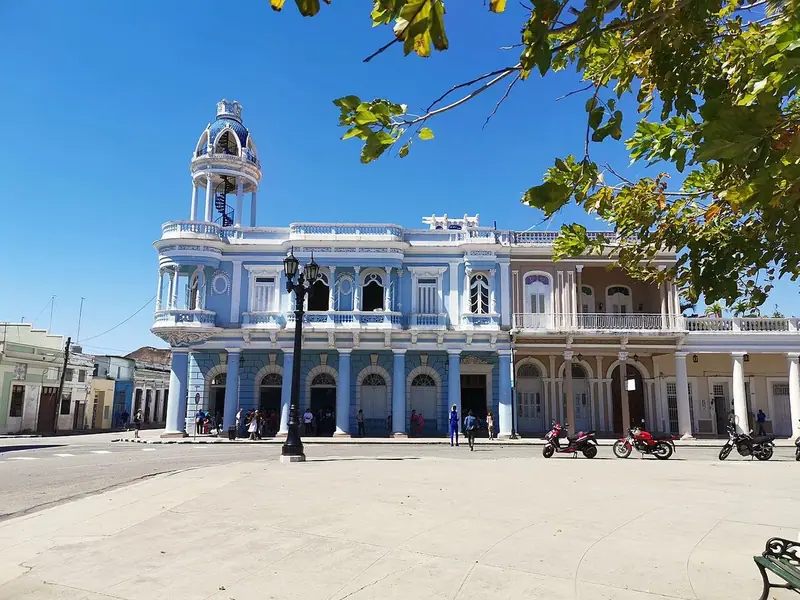 Spanish Colonial7 stops · 1819–1918
Historic Cienfuegos audio guide
Explore one of Cuba’s youngest colonial cities, with its grid of wide streets, colonnades and pastel façades on a sheltered bay.
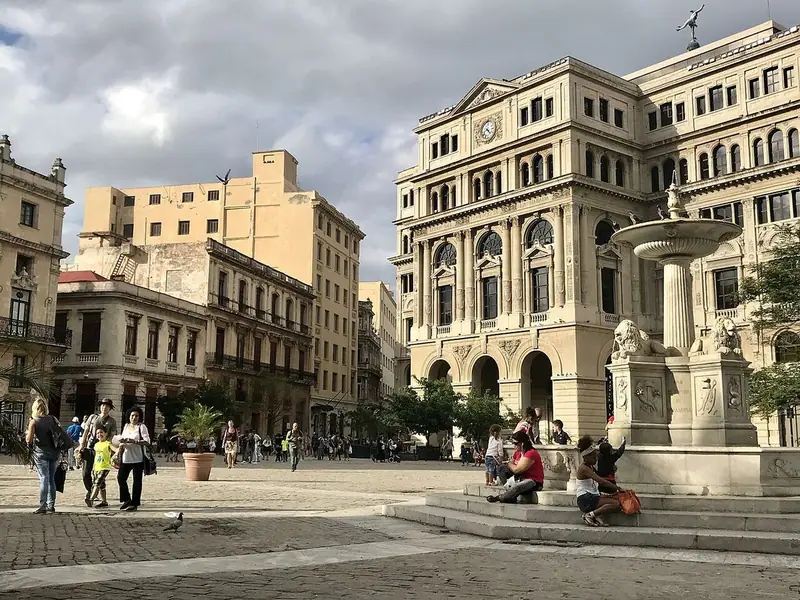 Spanish Colonial8 stops · 1519 – early 20th century
Old Havana audio guide
Link the great squares of Old Havana, from the cathedral and the Plaza de Armas along Calle Obispo to El Capitolio.
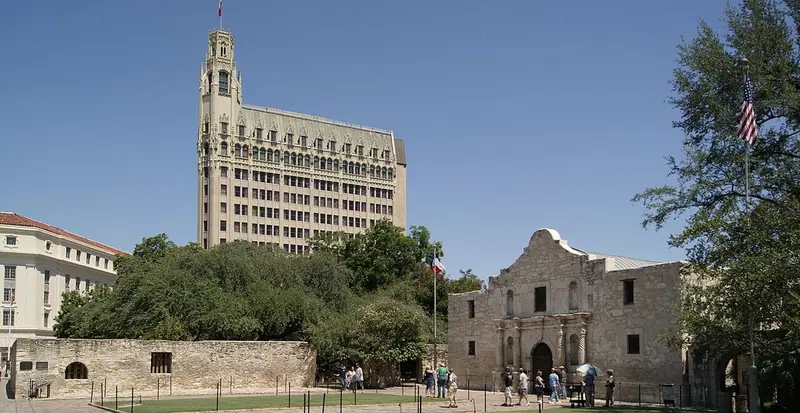 Spanish Colonial7 stops · 1718–1782
Alamo and San Antonio Missions audio guide
From the battle-scarred Alamo to Mission San José and the Espada Aqueduct, the five missions that made San Antonio.
Every guide, in every country
Trinidad and every other guide we publish, including future ones. One payment, no subscription.