Before you start
Quito, the capital of Ecuador, lies high in the Andes, at around 2,850 metres, in a valley beneath the Pichincha volcano. Its historic centre is among the largest and best preserved in the Americas, a grid of steep streets, plazas, churches and monasteries built from the sixteenth century onwards. In 1978 Quito and Kraków became the first cities inscribed by UNESCO as World Heritage Sites. The route starts at the great neo-Gothic basilica in the north, crosses the Plaza Grande, visits the presidential palace, the cathedral and the golden Jesuit church, then continues to the Franciscan monastery and ends in the old street of La Ronda. Because of the altitude, walk slowly, rest often and drink plenty of water.
Use it as a self-guided tour of Historic Quito: 7 stops in visit order, each played when you’re ready, at your own pace.
 Free preview · Stop 1
Basílica del Voto Nacional
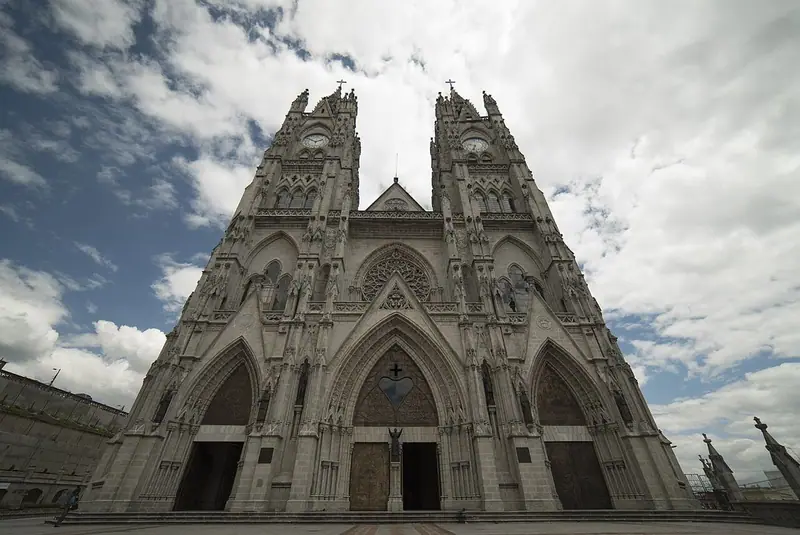
Begin at the Basílica del Voto Nacional, the vast neo-Gothic church that rises above the northern edge of the old town. It was built to honour the dedication of Ecuador to the Sacred Heart of Jesus, an idea proposed by Father Julio Matovelle in 1883. The first stone was laid in 1892, and construction went on for nearly a century; the basilica was blessed by Pope John Paul II in 1985 and consecrated in 1988. Look at the towers and the flying buttresses, and then at the gargoyles: instead of the usual monsters, many represent animals of Ecuador, such as tortoises, iguanas and armadillos. If you have a head for heights, you can climb the towers, using steep stairs and ladders, for a spectacular view over the city. From the top you can see the Panecillo hill, crowned by a statue of the Virgin, and the volcanoes around the valley.
Photo: Michael Shade · CC0 · Wikimedia Commons
What to see at Historic Quito: 7 stops, in visit order
- 01
 Basílica del Voto NacionalGothic in the AndesFree preview
- 02
 Plaza GrandeHeart of the cityIn the guide
- 03
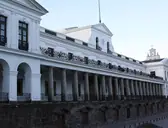 Carondelet PalaceThe presidential palaceIn the guide
- 04
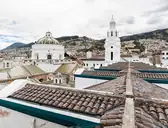 The CathedralSeat of the bishopsIn the guide
- 05
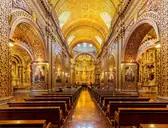 La CompañíaA church of goldIn the guide
- 06
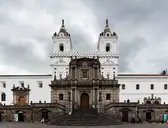 San FranciscoThe Escorial of the New WorldIn the guide
- 07
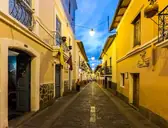 La RondaThe old streetIn the guide
Site map of Historic Quito
History of Historic Quito
People lived in the Quito valley for thousands of years before the city was founded, and the Quitu and other local peoples had settlements here. In the late fifteenth century the Inca emperor Huayna Cápac brought the region into the Inca Empire, which had grown from its heartland around Cusco from the early fifteenth century and fell to the Spanish in the 1530s. As Spanish forces approached, the Inca general Rumiñahui is said to have destroyed the city rather than surrender it. The Spanish founded San Francisco de Quito in 1534, and it became the seat of a royal court, the Audiencia of Quito. Under Spanish rule, which ended with the Battle of Pichincha in 1822, Quito became famous for its churches and for the painters and sculptors of the Quito School.
Historic Quito guide: questions
How many stops does the Historic Quito guide have?
7 stops, in visit order: 1. Basílica del Voto Nacional; 2. Plaza Grande; 3. Carondelet Palace; 4. The Cathedral; 5. La Compañía; 6. San Francisco; 7. La Ronda.
Can I do a self-guided tour of Historic Quito with this guide?
Yes. The guide is made for a self-guided tour: 7 stops in visit order, each with a photo, a story and a voice, so you can explore Historic Quito at your own pace, without joining a group. Download it before you go and it works offline.
How long is each guide?
The 7 stops add up to about 5 minutes of listening in total. You play each stop when you’re ready, so you can go at your own pace.
Does the guide work offline?
Yes, once it’s downloaded. The guide is a single self-contained web page (about 6.6 MB) with the photos, text and audio built in. Download it to your phone before you go (Wi-Fi is best); after that it opens in any modern browser on iPhone or Android, with no app, account or mobile signal needed.
Does it use GPS or need my location?
No. The guide doesn’t use GPS and doesn’t know where you are: you play each stop when you reach it. It works on iPhone and Android in any modern browser, and it’s in English.
What’s included?
One self-contained HTML guide: 7 stops in visit order, each with a photo, text and a voice, plus the story of who built the site.
Who built Historic Quito?
People lived in the Quito valley for thousands of years before the city was founded, and the Quitu and other local peoples had settlements here. In the late fifteenth century the Inca emperor Huayna Cápac brought the region into the Inca Empire, which had grown from its heartland around Cusco from the early fifteenth century and fell to the Spanish in the 1530s.
Where is Historic Quito?
Quito, the capital of Ecuador, lies high in the Andes, at around 2,850 metres, in a valley beneath the Pichincha volcano.
Is there a free audio guide to Historic Quito?
The first stop, Basílica del Voto Nacional, is free to read and hear on this page, so you can try the Historic Quito audio tour before you buy. The full guide, with all 7 stops, is a one-off purchase: download it once and it’s yours to keep, working offline.
Is the Historic Quito guide worth it?
If you’d like to know what you’re looking at, yes. For $10 you get 7 stops in visit order, each with a photo, a short history and a voice you play when you’re ready, plus a site map of the stops, and about 5 minutes of listening in all. It’s short on purpose, so you spend your time looking, not listening. It’s yours to keep, works offline and needs no app. The first stop is free on this page, so you can try it before you buy. If you’d like hours of detail, a guided tour will go deeper.
Audio guide or guided tour?
It depends how you like to visit. This guide lets you explore Historic Quito at your own pace, at any time, for a one-off price. A guided tour gives you a live expert you can ask questions, but at fixed times and usually for a higher price. Many people use both: a tour for the big picture, and the guide to read beforehand or to revisit the stops in their own time.
Is this the official Historic Quito guide?
No. It’s an independent guide by The Historian Guide, not affiliated with or endorsed by the operator of Historic Quito. For tickets and opening hours, check the official site operator before you go.
Does the guide include entry tickets or opening hours?
No. The guide is a digital companion only. Admission to Historic Quito is separate, so check the official site operator for current tickets and opening hours before you go.
- Stop 1 · Basílica del Voto Nacional: Michael Shade · CC0 · Wikimedia Commons · resized
- Stop 2 · Plaza Grande: Diego Delso · CC BY-SA 4.0 · Wikimedia Commons · resized
- Stop 3 · Carondelet Palace: Taty2007 · CC BY 3.0 · Wikimedia Commons · resized
- Stop 4 · The Cathedral: Diego Delso · CC BY-SA 4.0 · Wikimedia Commons · resized
- Stop 5 · La Compañía: Diego Delso · CC BY-SA 4.0 · Wikimedia Commons · resized
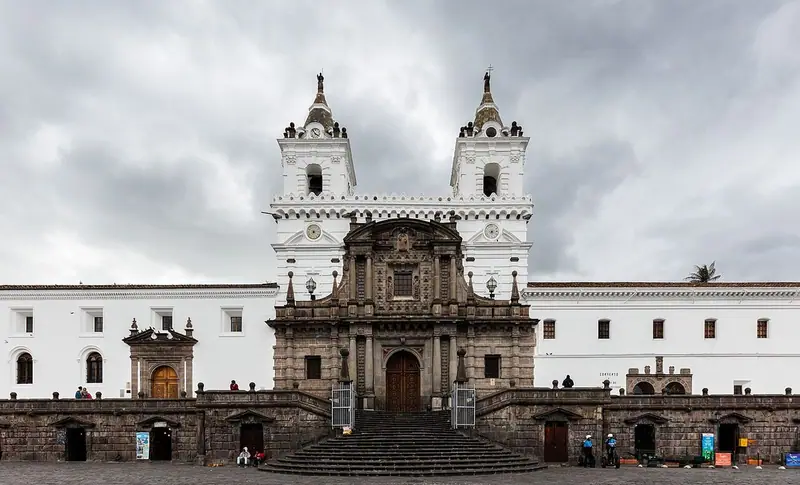
- Stop 6 · San Francisco (also the cover): Diego Delso · CC BY-SA 4.0 · Wikimedia Commons · resized
- Stop 7 · La Ronda: Diego Delso · CC BY-SA 4.0 · Wikimedia Commons · resized


All photographs from Wikimedia Commons under the licences shown.
More guides in Ecuador
 Spanish Colonial7 stops · 1557 onwards
Historic Cuenca audio guide
The Andean city founded by the Spanish in 1557 on the ruins of Inca Tomebamba, from the blue-tiled domes of the new cathedral and the flower market to the Barranco above the river and the Inca ruins of Pumapungo.
 Spanish Colonial7 stops · 1718–1782
Alamo and San Antonio Missions audio guide
From the battle-scarred Alamo to Mission San José and the Espada Aqueduct, the five missions that made San Antonio.
 Spanish Colonial7 stops · 1543–1773 CE
Antigua Guatemala audio guide
The grid of Santiago de los Caballeros beneath three volcanoes, from the Central Park and the cathedral to the Santa Catalina Arch, La Merced and the Capuchinas.
Every guide, in every country
Historic Quito and every other guide we publish, including future ones. One payment, no subscription.