
Before you start
Castle Hill, a long limestone ridge above the Danube on the Buda side of Budapest, holds the royal palace of the kings of Hungary, a medieval quarter of narrow streets, the Matthias Church and the Fisherman’s Bastion, with some of the finest views in Europe. Together with the Danube banks, it is part of a World Heritage Site. This guide starts by the river at the Chain Bridge, rides the funicular up the hill, visits the palace and then heads north through the Castle District to the Fisherman’s Bastion. The streets and terraces are free to walk around, while the museums, the church, the funicular and the upper terraces of the bastion have their own tickets. The hill is steep and cobbled in places, so wear comfortable shoes, or take the funicular or bus up.
Use it as a self-guided tour of Buda Castle Hill: 8 stops in visit order, each played when you’re ready, at your own pace.
 Free preview · Stop 1
The Chain Bridge
Begin at the foot of Castle Hill, beside the Széchenyi Chain Bridge, the first permanent bridge across the Danube in Hungary, opened in 1849. It was designed by the English engineer William Tierney Clark and built under the Scottish engineer Adam Clark, who gave his name to the square where you stand. The bridge was the idea of Count István Széchenyi, a great reformer, and it helped bind Buda and Pest together, until they were united as one city, Budapest, in 1873. Look at the great stone arches and the stone lions guarding each end. In January 1945, retreating German troops blew up the bridge, along with the other Danube bridges, and it was rebuilt and reopened in 1949. Near the funicular, look for the Zero Kilometre Stone, from which road distances in Hungary are measured.
Photo: Perituss · CC0 · Wikimedia Commons
What to see at Buda Castle Hill: 8 stops, in visit order
- 01
 The Chain BridgeLinking Buda and PestFree preview
- 02
 The FunicularUp the HillIn the guide
- 03
 The TurulThe Mythical BirdIn the guide
- 04
 The Royal PalacePalace of the KingsIn the guide
- 05
 The Matthias FountainThe King’s HuntIn the guide
- 06
 Holy Trinity SquareThe Plague ColumnIn the guide
- 07
 Matthias ChurchThe Coronation ChurchIn the guide
- 08
 The Fisherman’s BastionThe Seven TowersIn the guide
Site map of Buda Castle Hill
History of Buda Castle Hill
Buda became a royal seat after the Mongol invasion of 1241, when King Béla IV built a fortified town on Castle Hill. Under King Matthias Corvinus in the fifteenth century, the court at Buda was one of the most splendid of Renaissance Europe. The Ottoman Turks held Buda from 1541 to 1686, and after its recapture by the Habsburg-led Holy League, the palace was rebuilt in Baroque style. Much was restored or rebuilt in the late nineteenth century, in the Austro-Hungarian era, and again after the terrible siege of Budapest in 1944 and 1945, which left the hill in ruins.
Buda Castle Hill guide: questions
How many stops does the Buda Castle Hill guide have?
8 stops, in visit order: 1. The Chain Bridge; 2. The Funicular; 3. The Turul; 4. The Royal Palace; 5. The Matthias Fountain; 6. Holy Trinity Square; 7. Matthias Church; 8. The Fisherman’s Bastion.
Can I do a self-guided tour of Buda Castle Hill with this guide?
Yes. The guide is made for a self-guided tour: 8 stops in visit order, each with a photo, a story and a voice, so you can explore Buda Castle Hill at your own pace, without joining a group. Download it before you go and it works offline.
How long is each guide?
The 8 stops add up to about 5 minutes of listening in total. You play each stop when you’re ready, so you can go at your own pace.
Does the guide work offline?
Yes, once it’s downloaded. The guide is a single self-contained web page (about 7.5 MB) with the photos, text and audio built in. Download it to your phone before you go (Wi-Fi is best); after that it opens in any modern browser on iPhone or Android, with no app, account or mobile signal needed.
Does it use GPS or need my location?
No. The guide doesn’t use GPS and doesn’t know where you are: you play each stop when you reach it. It works on iPhone and Android in any modern browser, and it’s in English.
What’s included?
One self-contained HTML guide: 8 stops in visit order, each with a photo, text and a voice, plus the story of who built the site.
Who built Buda Castle Hill?
Buda became a royal seat after the Mongol invasion of 1241, when King Béla IV built a fortified town on Castle Hill. Under King Matthias Corvinus in the fifteenth century, the court at Buda was one of the most splendid of Renaissance Europe.
Where is Buda Castle Hill?
Castle Hill, a long limestone ridge above the Danube on the Buda side of Budapest, holds the royal palace of the kings of Hungary, a medieval quarter of narrow streets, the Matthias Church and the Fisherman’s Bastion, with some of the finest views in Europe.
Is there a free audio guide to Buda Castle Hill?
The first stop, The Chain Bridge, is free to read and hear on this page, so you can try the Buda Castle Hill audio tour before you buy. The full guide, with all 8 stops, is a one-off purchase: download it once and it’s yours to keep, working offline.
Is the Buda Castle Hill guide worth it?
If you’d like to know what you’re looking at, yes. For $10 you get 8 stops in visit order, each with a photo, a short history and a voice you play when you’re ready, plus a site map of the stops, and about 5 minutes of listening in all. It’s short on purpose, so you spend your time looking, not listening. It’s yours to keep, works offline and needs no app. The first stop is free on this page, so you can try it before you buy. If you’d like hours of detail, a guided tour will go deeper.
Audio guide or guided tour?
It depends how you like to visit. This guide lets you explore Buda Castle Hill at your own pace, at any time, for a one-off price. A guided tour gives you a live expert you can ask questions, but at fixed times and usually for a higher price. Many people use both: a tour for the big picture, and the guide to read beforehand or to revisit the stops in their own time.
Is this the official Buda Castle Hill guide?
No. It’s an independent guide by The Historian Guide, not affiliated with or endorsed by the operator of Buda Castle Hill. For tickets and opening hours, check the official site operator before you go.
Does the guide include entry tickets or opening hours?
No. The guide is a digital companion only. Admission to Buda Castle Hill is separate, so check the official site operator for current tickets and opening hours before you go.
- Stop 1 · The Chain Bridge: Perituss · CC0 · Wikimedia Commons · resized
- Stop 2 · The Funicular: Jakub Hałun · CC BY-SA 4.0 · Wikimedia Commons · resized
- Stop 3 · The Turul: Jakub Hałun · CC BY-SA 4.0 · Wikimedia Commons · resized
- Stop 4 · The Royal Palace: Jakub Hałun · CC BY-SA 4.0 · Wikimedia Commons · resized
- Stop 5 · The Matthias Fountain: © Carl von Einem / Wikimedia Commons · CC BY-SA 4.0 · Wikimedia Commons · resized
- Stop 6 · Holy Trinity Square: Nikolai Karaneschev · CC BY 3.0 · Wikimedia Commons · resized
- Stop 7 · Matthias Church: Perituss · CC0 · Wikimedia Commons · resized
- Stop 8 · The Fisherman’s Bastion (also the cover): Perituss · CC0 · Wikimedia Commons · resized


All photographs from Wikimedia Commons under the licences shown.
More guides in Hungary
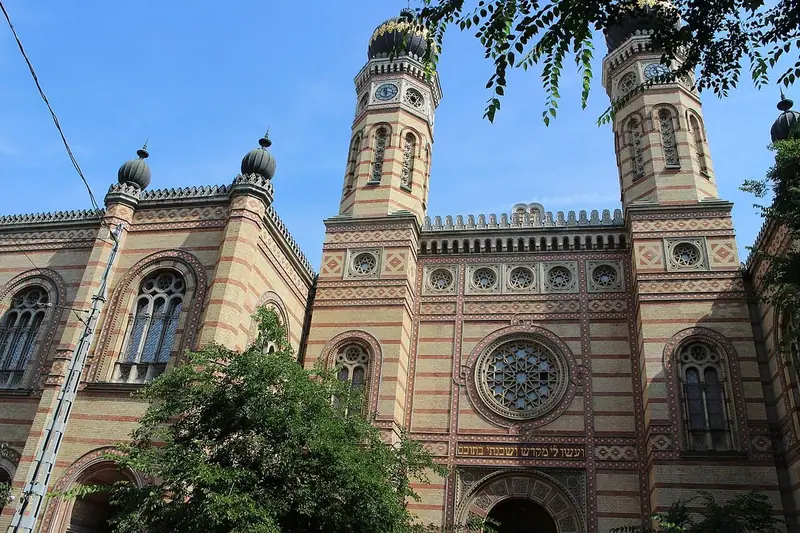 Jewish7 stops · 1854–1859 CE
Dohány Street Synagogue audio guide
Visit Europe’s largest synagogue, built in the Moorish style for the Jewish community of Pest, and its courtyards of remembrance.
 Modern Europe8 stops · 1885–1904 CE
Hungarian Parliament audio guide
Climb the grand staircase of Hungary’s Gothic Revival parliament on the Danube to the Dome Hall and the Holy Crown.
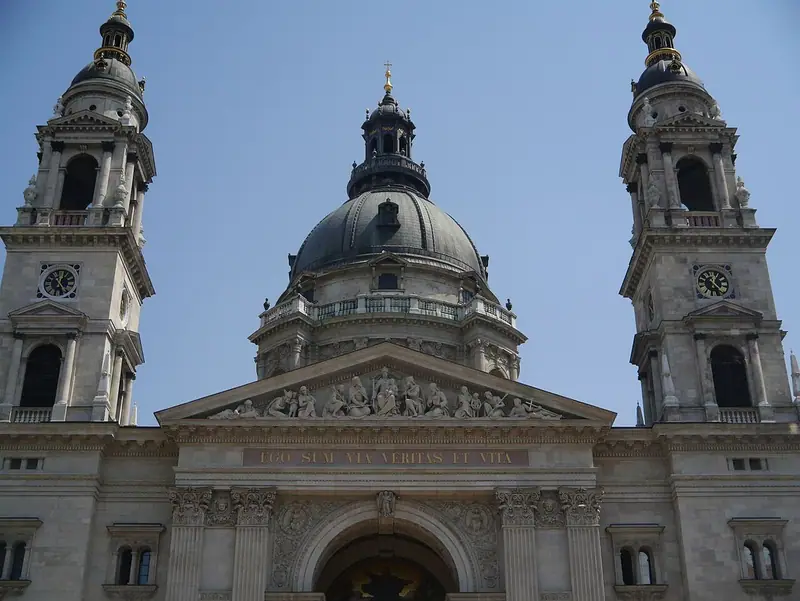 Modern Europe7 stops · 1851–1905 CE
St Stephen’s Basilica audio guide
Step under the great dome of Budapest’s largest church to see the Holy Right, then climb to the dome terrace above Pest.
Every guide, in every country
Buda Castle Hill and every other guide we publish, including future ones. One payment, no subscription.