Before you start
For at least twelve thousand years, people have lived and travelled among the sandstone mountains of Wadi Rum in southern Jordan, and they have left their mark on its rocks in tens of thousands of carvings and inscriptions. Caravans carrying incense and spices passed through on their way from Arabia to the Mediterranean, the Nabataeans built a temple beside its springs, and in 1917 T. E. Lawrence rode through it with the forces of the Arab Revolt. This guide begins at the visitor centre below the Seven Pillars of Wisdom, visits the Nabataean temple and Lawrence’s spring at Rum village, then crosses the desert to the carvings of Khazali Canyon and the natural rock bridge of Umm Fruth.
Use it as a self-guided tour of Wadi Rum: 5 stops in visit order, each played when you’re ready, at your own pace.
 Free preview · Stop 1
The Seven Pillars of Wisdom
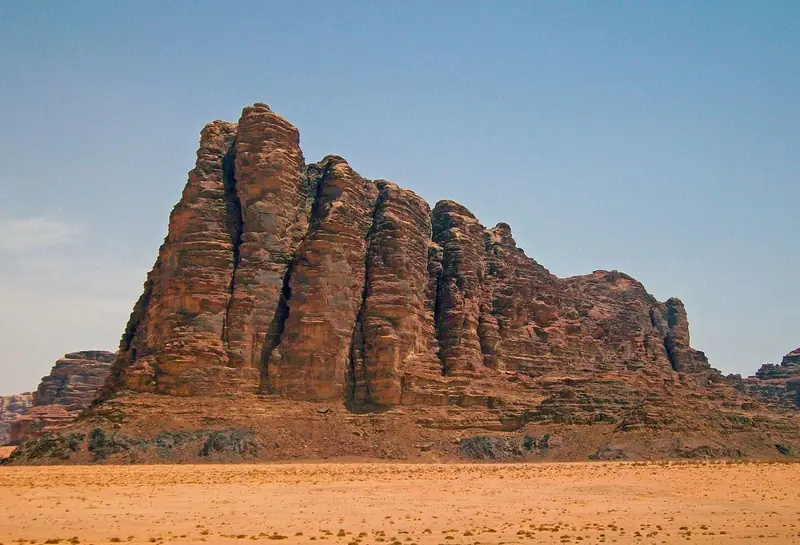
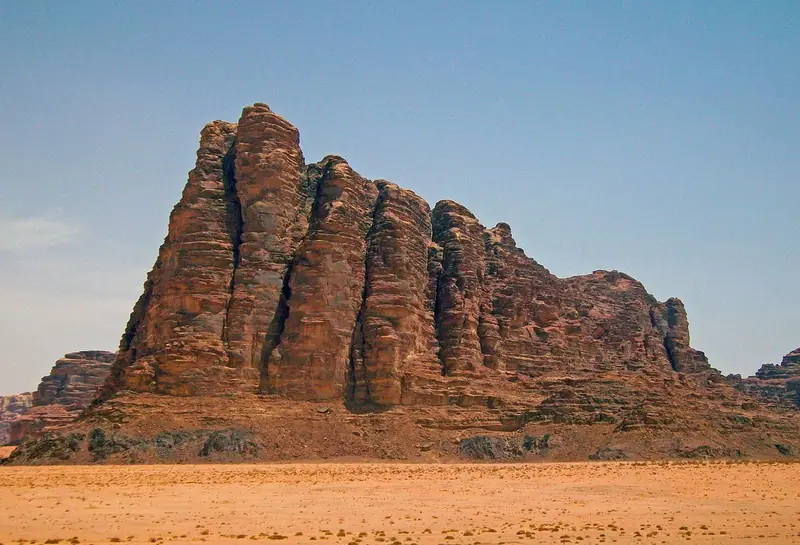
Begin at the visitor centre at the entrance to the protected area, where there are displays about the history, geology and people of Wadi Rum. Across the valley rises a great sandstone mountain whose face is divided by erosion into a row of rounded columns. Its old Arabic name was Jabal al-Mazmar, but in the 1980s it was renamed the Seven Pillars of Wisdom, after the title of T. E. Lawrence’s famous account of the Arab Revolt, although the pillars of his book had no connection with this place. Lawrence came through Wadi Rum several times in 1917 and 1918, while the Arab forces of the Sharif of Mecca fought the Ottoman Turks, and he described the valley as a processional way greater than imagination. From here, continue south along the road down the broad valley, between towering cliffs, to the village of Rum.
Photo: Daniel Case · CC BY-SA 3.0 · Wikimedia Commons
What to see at Wadi Rum: 5 stops, in visit order
- 01
 The Seven Pillars of WisdomThe gateway to the valleyFree preview
- 02
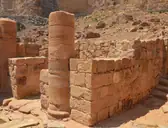 The Nabataean TempleA shrine beside the springsIn the guide
- 03
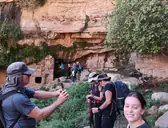 The Spring of ShallalehLawrence’s springIn the guide
- 04
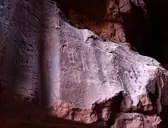 Khazali CanyonThe carvings in the cleftIn the guide
- 05
 The Rock Bridge of Umm FruthA landscape carved by timeIn the guide
Site map of Wadi Rum
History of Wadi Rum
Wadi Rum’s mountains of red and yellow sandstone, rising sheer from valleys of sand, were shaped over millions of years, and springs at the foot of the cliffs have drawn people here since prehistoric times. Hunters, herders and traders carved pictures of people, camels, ibex and antelope on the rocks, and wrote their names and prayers in several ancient Arabian scripts, known together as Thamudic, and later in Nabataean and Arabic. UNESCO counts some twenty-five thousand rock carvings and twenty thousand inscriptions here. In 2025 Jordanian archaeologists announced the discovery of an inscription bearing the name of the Egyptian pharaoh Ramesses the Third, the first royal hieroglyphic inscription found in the area. From around the fourth century BCE the Nabataeans, whose capital was Petra, controlled the caravan routes through this region and used Wadi Rum’s springs. In the twentieth century the valley became famous through T.
The full history continues in the guide.
Wadi Rum guide: questions
How many stops does the Wadi Rum guide have?
5 stops, in visit order: 1. The Seven Pillars of Wisdom; 2. The Nabataean Temple; 3. The Spring of Shallaleh; 4. Khazali Canyon; 5. The Rock Bridge of Umm Fruth.
Can I do a self-guided tour of Wadi Rum with this guide?
Yes. The guide is made for a self-guided tour: 5 stops in visit order, each with a photo, a story and a voice, so you can explore Wadi Rum at your own pace, without joining a group. Download it before you go and it works offline.
How long is each guide?
The 5 stops add up to about 3 minutes of listening in total. You play each stop when you’re ready, so you can go at your own pace.
Does the guide work offline?
Yes, once it’s downloaded. The guide is a single self-contained web page (about 5.0 MB) with the photos, text and audio built in. Download it to your phone before you go (Wi-Fi is best); after that it opens in any modern browser on iPhone or Android, with no app, account or mobile signal needed.
Does it use GPS or need my location?
No. The guide doesn’t use GPS and doesn’t know where you are: you play each stop when you reach it. It works on iPhone and Android in any modern browser, and it’s in English.
What’s included?
One self-contained HTML guide: 5 stops in visit order, each with a photo, text and a voice, plus the story of who built the site.
Who built Wadi Rum?
Wadi Rum’s mountains of red and yellow sandstone, rising sheer from valleys of sand, were shaped over millions of years, and springs at the foot of the cliffs have drawn people here since prehistoric times. Hunters, herders and traders carved pictures of people, camels, ibex and antelope on the rocks, and wrote their names and prayers in several ancient Arabian scripts, known together as Thamudic, and later in Nabataean and Arabic.
Where is Wadi Rum?
For at least twelve thousand years, people have lived and travelled among the sandstone mountains of Wadi Rum in southern Jordan, and they have left their mark on its rocks in tens of thousands of carvings and inscriptions.
Is there a free audio guide to Wadi Rum?
The first stop, The Seven Pillars of Wisdom, is free to read and hear on this page, so you can try the Wadi Rum audio tour before you buy. The full guide, with all 5 stops, is a one-off purchase: download it once and it’s yours to keep, working offline.
Is the Wadi Rum guide worth it?
If you’d like to know what you’re looking at, yes. For $10 you get 5 stops in visit order, each with a photo, a short history and a voice you play when you’re ready, plus a site map of the stops, and about 3 minutes of listening in all. It’s short on purpose, so you spend your time looking, not listening. It’s yours to keep, works offline and needs no app. The first stop is free on this page, so you can try it before you buy. If you’d like hours of detail, a guided tour will go deeper.
Audio guide or guided tour?
It depends how you like to visit. This guide lets you explore Wadi Rum at your own pace, at any time, for a one-off price. A guided tour gives you a live expert you can ask questions, but at fixed times and usually for a higher price. Many people use both: a tour for the big picture, and the guide to read beforehand or to revisit the stops in their own time.
Is this the official Wadi Rum guide?
No. It’s an independent guide by The Historian Guide, not affiliated with or endorsed by the operator of Wadi Rum. For tickets and opening hours, check the official site operator before you go.
Does the guide include entry tickets or opening hours?
No. The guide is a digital companion only. Admission to Wadi Rum is separate, so check the official site operator for current tickets and opening hours before you go.
- Stop 1 · The Seven Pillars of Wisdom (also the cover): Daniel Case · CC BY-SA 3.0 · Wikimedia Commons · resized
- Stop 2 · The Nabataean Temple: Carole Raddato from FRANKFURT, Germany · CC BY-SA 2.0 · Wikimedia Commons · resized
- Stop 3 · The Spring of Shallaleh: Gabi Loebl · Public domain · Wikimedia Commons · resized
- Stop 4 · Khazali Canyon: Berthold Werner · CC BY-SA 3.0 · Wikimedia Commons · resized
- Stop 5 · The Rock Bridge of Umm Fruth: Cadouf · CC BY-SA 4.0 · Wikimedia Commons · resized


All photographs from Wikimedia Commons under the licences shown.
More guides in Jordan
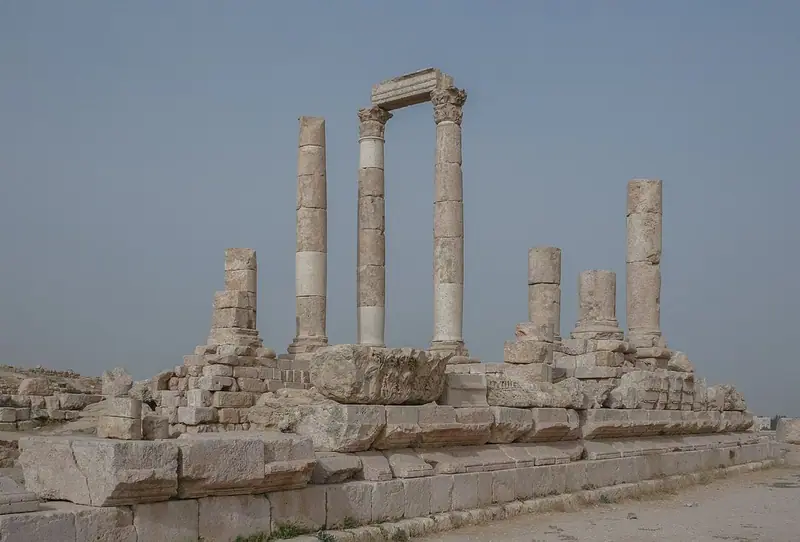 Roman7 stops · 2nd–8th century CE
Amman Citadel and Roman Theatre audio guide
From the Temple of Hercules and its colossal hand to the Umayyad palace, then down to the Roman Theatre carved into the hill.
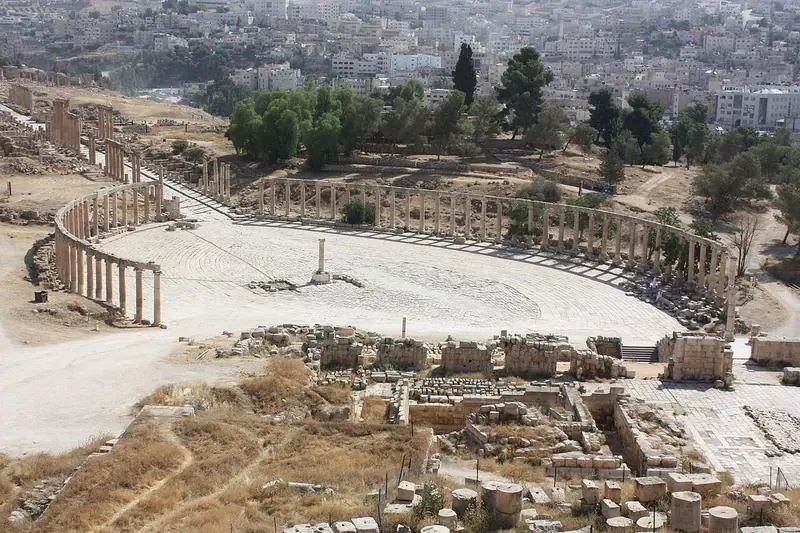 Roman8 stops · 1st–7th century CE
Jerash audio guide
Through Hadrian’s Arch to the Oval Plaza and down the colonnaded Cardo of Roman Gerasa.
 Crusader7 stops · from 1142 CE
Kerak Castle audio guide
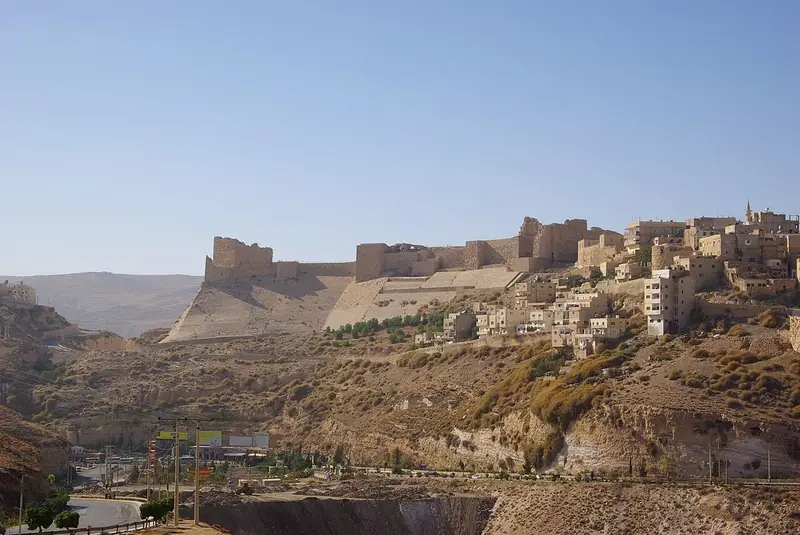
Crusader galleries and Mamluk halls in one of the great castles of the Levant, high above the King’s Highway.
 Byzantine7 stops · 6th–8th century CE
Madaba audio guide
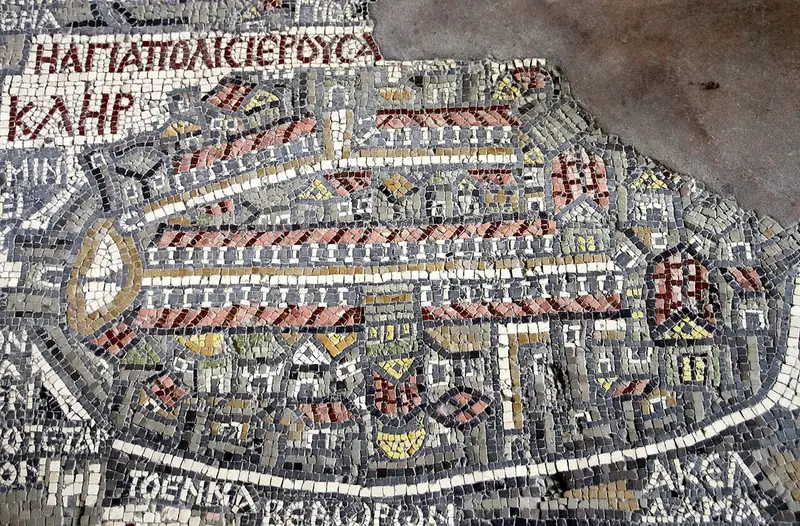
The City of Mosaics, home of the Madaba Map, laid in the floor of the Church of St George.
 Nabataean9 stops · c. 1st century BCE – 2nd century CE
Petra audio guide
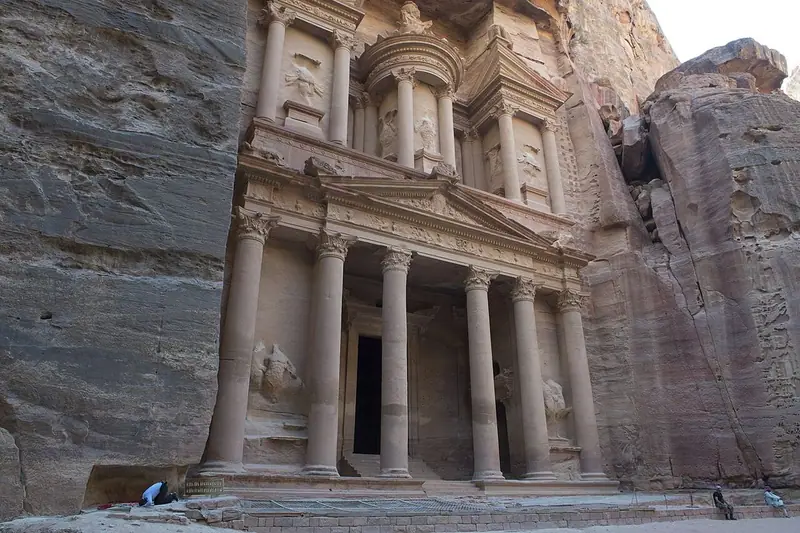
Through the narrow Siq to the Treasury, then on past the Royal Tombs to the climb up to the Monastery.
Every guide, in every country
Wadi Rum and every other guide we publish, including future ones. One payment, no subscription.