Before you start
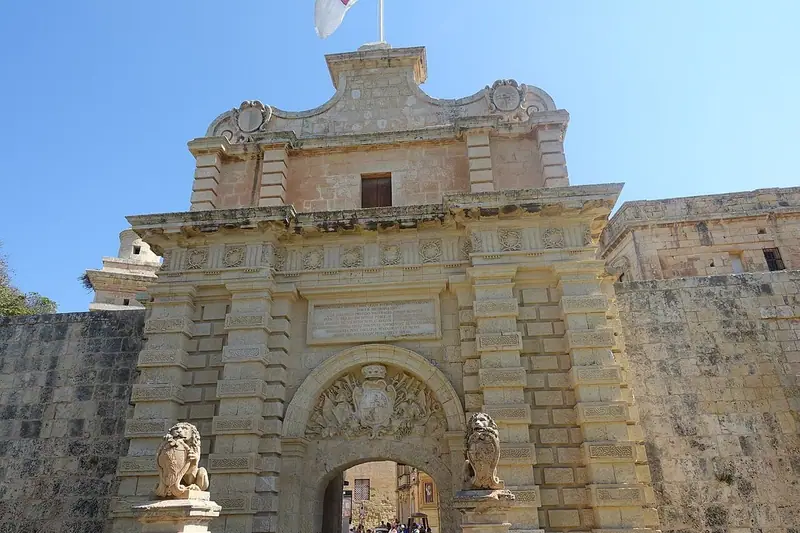
Mdina, the old capital of Malta, is a small walled city on a hilltop in the centre of the island, its golden walls rising above the fields. Known as the Silent City, it has kept its medieval street plan and many of its old palaces, and only a few hundred people live within its walls. This guide begins at the Roman house just outside the city, enters through the main gate, follows the main street past palaces and the cathedral, and ends on the bastions with views across the island. Most of the city is closed to cars, so its narrow, winding streets are best explored on foot. Please respect the quiet of a city where people still live, especially in the evening.
Use it as a self-guided tour of Mdina: 8 stops in visit order, each played when you’re ready, at your own pace.
 Free preview · Stop 1
The Domus Romana
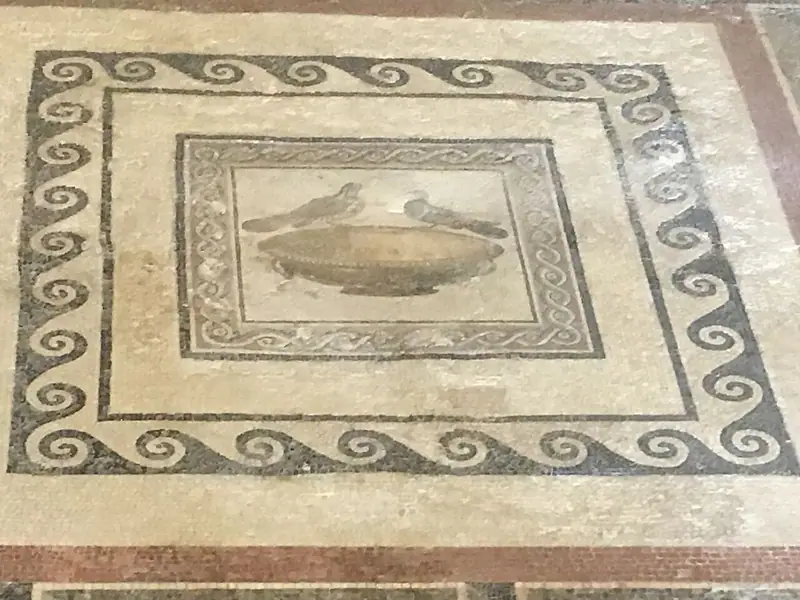
Begin just outside the walls, in the small museum of the Domus Romana, the remains of a wealthy Roman town house built in the first century BCE, in the Roman city of Melite. It was discovered in 1881, and has been open as a museum since 1882. Look at the fine mosaic floors, made in the Hellenistic style, among the finest Roman mosaics in the western Mediterranean. Find the famous central panel of two doves perched on the rim of a bowl, made of tiny stones, so finely set that they look almost painted. Notice also the marble statues found here, believed to show members of the imperial family. In the eleventh century, a Muslim cemetery was laid out over the ruins of the house, and some of its tombstones are displayed here too, with their Arabic inscriptions.
Photo: Justlettersandnumbers · CC BY-SA 4.0 · Wikimedia Commons
What to see at Mdina: 8 stops, in visit order
- 01
 The Domus RomanaThe Roman HouseFree preview
- 02
 The Main GateInto the Silent CityIn the guide
- 03
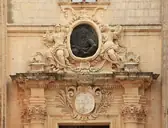 Vilhena PalaceThe Grand Master’s PalaceIn the guide
- 04
 St Paul’s CathedralThe Cathedral of MaltaIn the guide
- 05
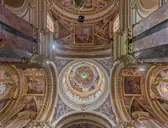 The Cathedral InteriorSaint Paul’s StoryIn the guide
- 06
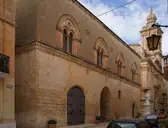 Villegaignon StreetPalazzo Santa SofiaIn the guide
- 07
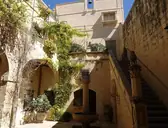 Palazzo FalsonA Medieval HouseIn the guide
- 08
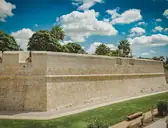 The Walls and BastionsViews over MaltaIn the guide
Site map of Mdina
History of Mdina
The hilltop has been settled since prehistory. The Phoenicians founded a town here around the eighth century BCE, and under the Romans it became Melite, a city about three times the size of present-day Mdina, stretching into modern Rabat. It was reduced to its present size in the early Middle Ages, and refounded in the eleventh century as Madina, from the Arabic word for a city, which gives Mdina its name. It remained the capital until the Knights of Saint John arrived in 1530 and made their base by the Grand Harbour. After an earthquake in 1693, much of the city was rebuilt in the Baroque style in the early eighteenth century.
Mdina guide: questions
How many stops does the Mdina guide have?
8 stops, in visit order: 1. The Domus Romana; 2. The Main Gate; 3. Vilhena Palace; 4. St Paul’s Cathedral; 5. The Cathedral Interior; 6. Villegaignon Street; 7. Palazzo Falson; 8. The Walls and Bastions.
Can I do a self-guided tour of Mdina with this guide?
Yes. The guide is made for a self-guided tour: 8 stops in visit order, each with a photo, a story and a voice, so you can explore Mdina at your own pace, without joining a group. Download it before you go and it works offline.
How long is each guide?
The 8 stops add up to about 6 minutes of listening in total. You play each stop when you’re ready, so you can go at your own pace.
Does the guide work offline?
Yes, once it’s downloaded. The guide is a single self-contained web page (about 7.1 MB) with the photos, text and audio built in. Download it to your phone before you go (Wi-Fi is best); after that it opens in any modern browser on iPhone or Android, with no app, account or mobile signal needed.
Does it use GPS or need my location?
No. The guide doesn’t use GPS and doesn’t know where you are: you play each stop when you reach it. It works on iPhone and Android in any modern browser, and it’s in English.
What’s included?
One self-contained HTML guide: 8 stops in visit order, each with a photo, text and a voice, plus the story of who built the site.
Who built Mdina?
The hilltop has been settled since prehistory. The Phoenicians founded a town here around the eighth century BCE, and under the Romans it became Melite, a city about three times the size of present-day Mdina, stretching into modern Rabat.
Where is Mdina?
Mdina, the old capital of Malta, is a small walled city on a hilltop in the centre of the island, its golden walls rising above the fields.
Is there a free audio guide to Mdina?
The first stop, The Domus Romana, is free to read and hear on this page, so you can try the Mdina audio tour before you buy. The full guide, with all 8 stops, is a one-off purchase: download it once and it’s yours to keep, working offline.
Is the Mdina guide worth it?
If you’d like to know what you’re looking at, yes. For $10 you get 8 stops in visit order, each with a photo, a short history and a voice you play when you’re ready, plus a site map of the stops, and about 6 minutes of listening in all. It’s short on purpose, so you spend your time looking, not listening. It’s yours to keep, works offline and needs no app. The first stop is free on this page, so you can try it before you buy. If you’d like hours of detail, a guided tour will go deeper.
Audio guide or guided tour?
It depends how you like to visit. This guide lets you explore Mdina at your own pace, at any time, for a one-off price. A guided tour gives you a live expert you can ask questions, but at fixed times and usually for a higher price. Many people use both: a tour for the big picture, and the guide to read beforehand or to revisit the stops in their own time.
Is this the official Mdina guide?
No. It’s an independent guide by The Historian Guide, not affiliated with or endorsed by the operator of Mdina. For tickets and opening hours, check the official site operator before you go.
Does the guide include entry tickets or opening hours?
No. The guide is a digital companion only. Admission to Mdina is separate, so check the official site operator for current tickets and opening hours before you go.
- Stop 1 · The Domus Romana: Justlettersandnumbers · CC BY-SA 4.0 · Wikimedia Commons · resized
- Stop 2 · The Main Gate (also the cover): Joseolgon · CC BY 4.0 · Wikimedia Commons · resized
- Stop 3 · Vilhena Palace: Frank Vincentz · CC BY-SA 3.0 · Wikimedia Commons · resized
- Stop 4 · St Paul’s Cathedral: Diego Delso · CC BY-SA 4.0 · Wikimedia Commons · resized
- Stop 5 · The Cathedral Interior: Diego Delso · CC BY-SA 4.0 · Wikimedia Commons · resized
- Stop 6 · Villegaignon Street: Mboesch · CC BY-SA 3.0 · Wikimedia Commons · resized
- Stop 7 · Palazzo Falson: Edelmauswaldgeist · CC0 · Wikimedia Commons · resized
- Stop 8 · The Walls and Bastions: VPDigital · CC BY-SA 4.0 · Wikimedia Commons · resized


All photographs from Wikimedia Commons under the licences shown.
More guides in Malta
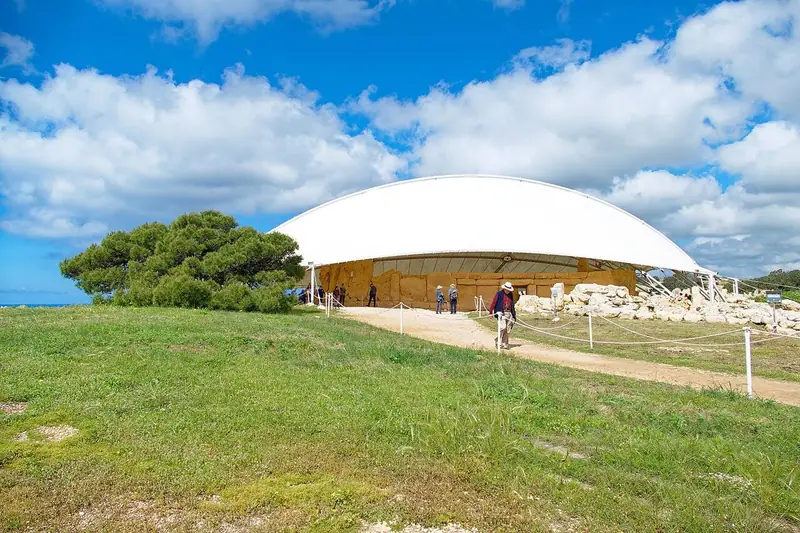 Maltese Temple8 stops · c. 3600–2500 BCE
Ħaġar Qim and Mnajdra audio guide
On a clifftop above the sea, two of the oldest buildings on Earth: the megalithic temples of Ħaġar Qim and Mnajdra.
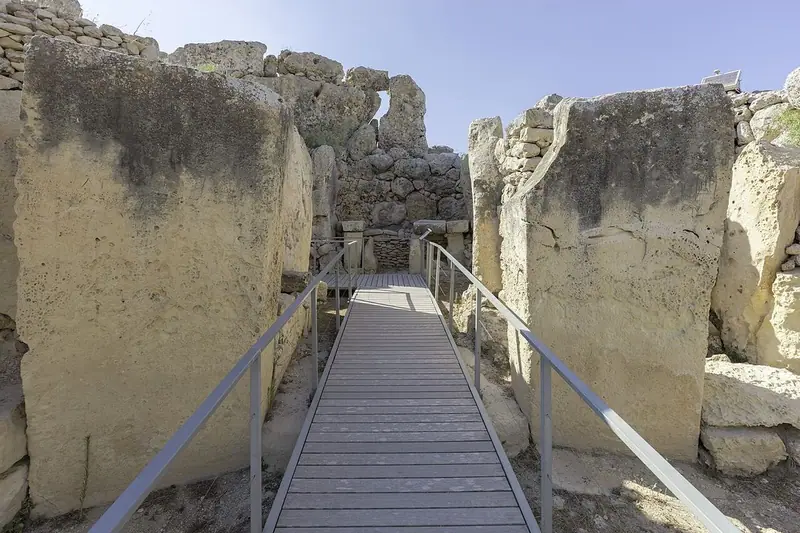 Maltese Temple7 stops · c. 3600–2500 BCE
Ġgantija Temples audio guide
Stand among the oldest of Malta’s megalithic temples, raised on Gozo around 3600 BCE, more than a thousand years before the great pyramids.
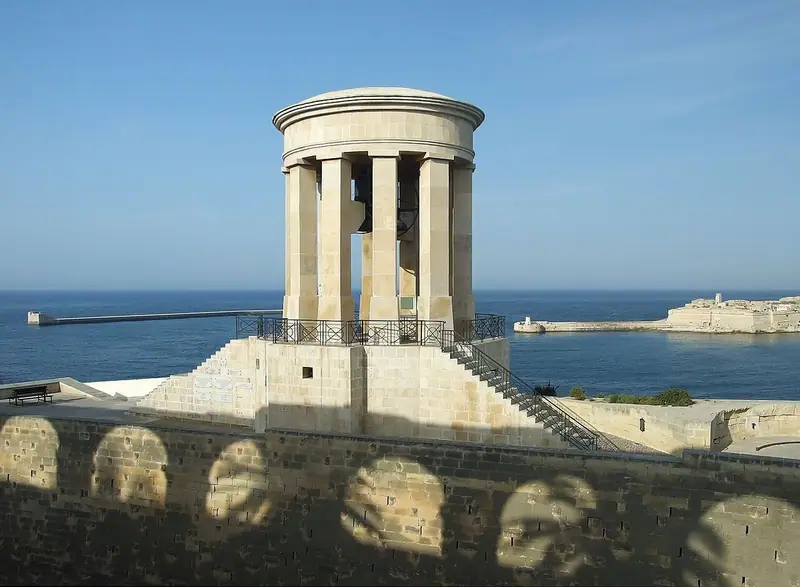 Knights Hospitaller8 stops · 1565–1798 CE
Valletta audio guide
The honey-coloured city of the Knights of Saint John, from City Gate to St John’s Co-Cathedral and its Caravaggio, and on to Fort Saint Elmo.
Every guide, in every country
Mdina and every other guide we publish, including future ones. One payment, no subscription.