Before you start
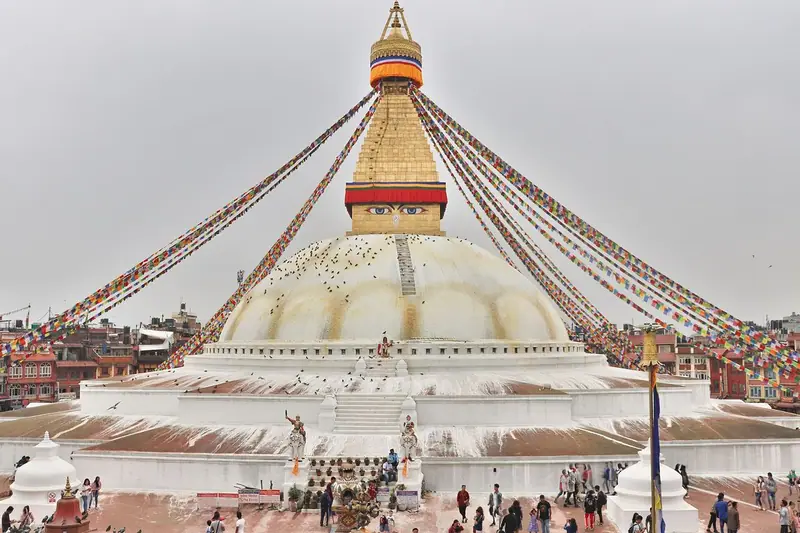
The two great Buddhist stupas of the Kathmandu Valley have drawn pilgrims for some fifteen hundred years. Swayambhunath, on its wooded hill west of the city, is the holiest shrine of the valley’s Newar Buddhists, and Boudhanath, on the old trade route to Tibet, is one of the largest stupas in the world and the heart of Nepal’s Tibetan community. Both belong to the Kathmandu Valley World Heritage Site. This guide climbs the eastern stairway at Swayambhunath to the great stupa and the temple of the goddess Hariti, then crosses the city to Boudhanath, to walk the circuit around its stupa, climb its terraces and visit the shrine at its northern gate.
Use it as a self-guided tour of Swayambhunath and Boudhanath: 6 stops in visit order, each played when you’re ready, at your own pace.
 Free preview · Stop 1
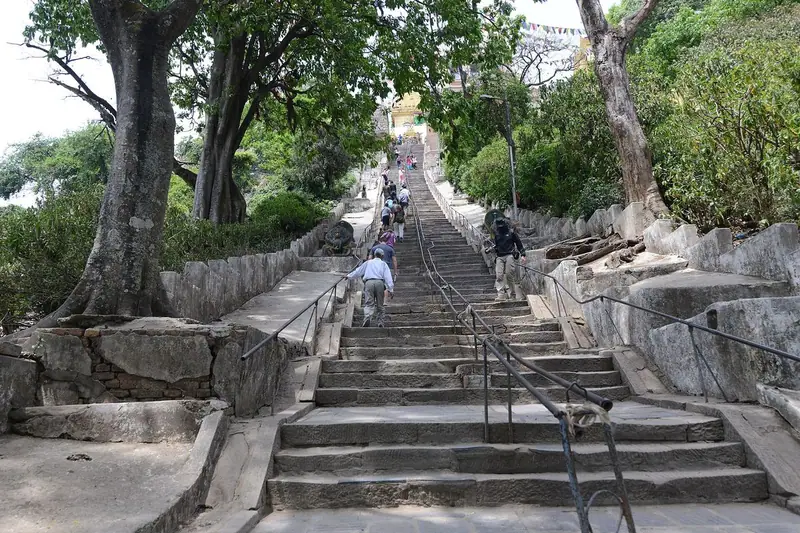
The Eastern Stairway
Begin at the foot of the long stone stairway that climbs the eastern side of Swayambhu hill. It was built in the seventeenth century by Pratap Malla, the king of Kathmandu, a Hindu ruler who honoured this Buddhist shrine, as many kings of the valley did. The climb is steep, with hundreds of steps, and on the way up you pass carved stone Buddhas and figures of the animals that carry the gods, while prayer flags flutter in the trees overhead. Watch out for the monkeys that live on the hill and give the shrine its nickname, the Monkey Temple: they are wild and will snatch food. At the top, the first thing you see is a huge gilded vajra, or thunderbolt, the symbol of the indestructible power of enlightenment, on a pedestal before the stupa. Pause to catch your breath and look back over Kathmandu, then walk around the vajra to the stupa.
Photo: Jorge Láscar from Melbourne, Australia · CC BY 2.0 · Wikimedia Commons
What to see at Swayambhunath and Boudhanath: 6 stops, in visit order
- 01
 The Eastern StairwayThe pilgrims’ climbFree preview
- 02
 The Great Stupa of SwayambhuThe self-created lightIn the guide
- 03
 The Temple of HaritiThe protector of childrenIn the guide
- 04
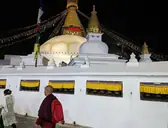 The Kora at BoudhanathThe circuit around the stupaIn the guide
- 05
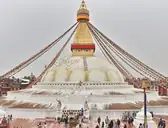 The Great Stupa of BoudhanathA mandala in stoneIn the guide
- 06
 The Shrine of AjimaThe goddess at the northern gateIn the guide
Site map of Swayambhunath and Boudhanath
History of Swayambhunath and Boudhanath
According to the Swayambhu Purana, the Kathmandu Valley was once a lake, and a lotus that grew in it gave out a self-created light, Swayambhu, which a great stupa was built to cover. Historians trace both stupas to the Licchavi kings, who ruled the valley from about the fourth to the ninth century CE: a damaged stone inscription at Swayambhunath records building work ordered by a Licchavi king, and Newar chronicles connect Boudhanath with the kings Manadeva and Shivadeva. Under the Malla kings, from the thirteenth to the eighteenth century, the valley’s Newar craftsmen rebuilt and adorned both shrines, and Tibetan pilgrims and traders came to worship at them. After the Chinese takeover of Tibet and the Tibetan uprising of 1959, thousands of Tibetan refugees settled around Boudhanath and built monasteries there. Both stupas were damaged in the earthquake of 2015 and have since been restored.
Swayambhunath and Boudhanath guide: questions
How many stops does the Swayambhunath and Boudhanath guide have?
6 stops, in visit order: 1. The Eastern Stairway; 2. The Great Stupa of Swayambhu; 3. The Temple of Hariti; 4. The Kora at Boudhanath; 5. The Great Stupa of Boudhanath; 6. The Shrine of Ajima.
Can I do a self-guided tour of Swayambhunath and Boudhanath with this guide?
Yes. The guide is made for a self-guided tour: 6 stops in visit order, each with a photo, a story and a voice, so you can explore Swayambhunath and Boudhanath at your own pace, without joining a group. Download it before you go and it works offline.
How long is each guide?
The 6 stops add up to about 5 minutes of listening in total. You play each stop when you’re ready, so you can go at your own pace.
Does the guide work offline?
Yes, once it’s downloaded. The guide is a single self-contained web page (about 5.9 MB) with the photos, text and audio built in. Download it to your phone before you go (Wi-Fi is best); after that it opens in any modern browser on iPhone or Android, with no app, account or mobile signal needed.
Does it use GPS or need my location?
No. The guide doesn’t use GPS and doesn’t know where you are: you play each stop when you reach it. It works on iPhone and Android in any modern browser, and it’s in English.
What’s included?
One self-contained HTML guide: 6 stops in visit order, each with a photo, text and a voice, plus the story of who built the site.
Who built Swayambhunath and Boudhanath?
According to the Swayambhu Purana, the Kathmandu Valley was once a lake, and a lotus that grew in it gave out a self-created light, Swayambhu, which a great stupa was built to cover. Historians trace both stupas to the Licchavi kings, who ruled the valley from about the fourth to the ninth century CE: a damaged stone inscription at Swayambhunath records building work ordered by a Licchavi king, and Newar chronicles connect Boudhanath with the kings Manadeva and Shivadeva.
Where is Swayambhunath and Boudhanath?
The two great Buddhist stupas of the Kathmandu Valley have drawn pilgrims for some fifteen hundred years.
Is there a free audio guide to Swayambhunath and Boudhanath?
The first stop, The Eastern Stairway, is free to read and hear on this page, so you can try the Swayambhunath and Boudhanath audio tour before you buy. The full guide, with all 6 stops, is a one-off purchase: download it once and it’s yours to keep, working offline.
Is the Swayambhunath and Boudhanath guide worth it?
If you’d like to know what you’re looking at, yes. For $10 you get 6 stops in visit order, each with a photo, a short history and a voice you play when you’re ready, plus a site map of the stops, and about 5 minutes of listening in all. It’s short on purpose, so you spend your time looking, not listening. It’s yours to keep, works offline and needs no app. The first stop is free on this page, so you can try it before you buy. If you’d like hours of detail, a guided tour will go deeper.
Audio guide or guided tour?
It depends how you like to visit. This guide lets you explore Swayambhunath and Boudhanath at your own pace, at any time, for a one-off price. A guided tour gives you a live expert you can ask questions, but at fixed times and usually for a higher price. Many people use both: a tour for the big picture, and the guide to read beforehand or to revisit the stops in their own time.
Is this the official Swayambhunath and Boudhanath guide?
No. It’s an independent guide by The Historian Guide, not affiliated with or endorsed by the operator of Swayambhunath and Boudhanath. For tickets and opening hours, check the official site operator before you go.
Does the guide include entry tickets or opening hours?
No. The guide is a digital companion only. Admission to Swayambhunath and Boudhanath is separate, so check the official site operator for current tickets and opening hours before you go.
- Stop 1 · The Eastern Stairway: Jorge Láscar from Melbourne, Australia · CC BY 2.0 · Wikimedia Commons · resized
- Stop 2 · The Great Stupa of Swayambhu: Jorge Láscar from Melbourne, Australia · CC BY 2.0 · Wikimedia Commons · resized
- Stop 3 · The Temple of Hariti: Gerd Eichmann · CC BY-SA 4.0 · Wikimedia Commons · resized
- Stop 4 · The Kora at Boudhanath: Trieyes · CC BY-SA 4.0 · Wikimedia Commons · resized
- Stop 5 · The Great Stupa of Boudhanath (also the cover): Nabin K. Sapkota · CC BY-SA 4.0 · Wikimedia Commons · resized
- Stop 6 · The Shrine of Ajima: Wonderlane from Seattle, USA · CC BY 2.0 · Wikimedia Commons · resized


All photographs from Wikimedia Commons under the licences shown.
More guides in Nepal
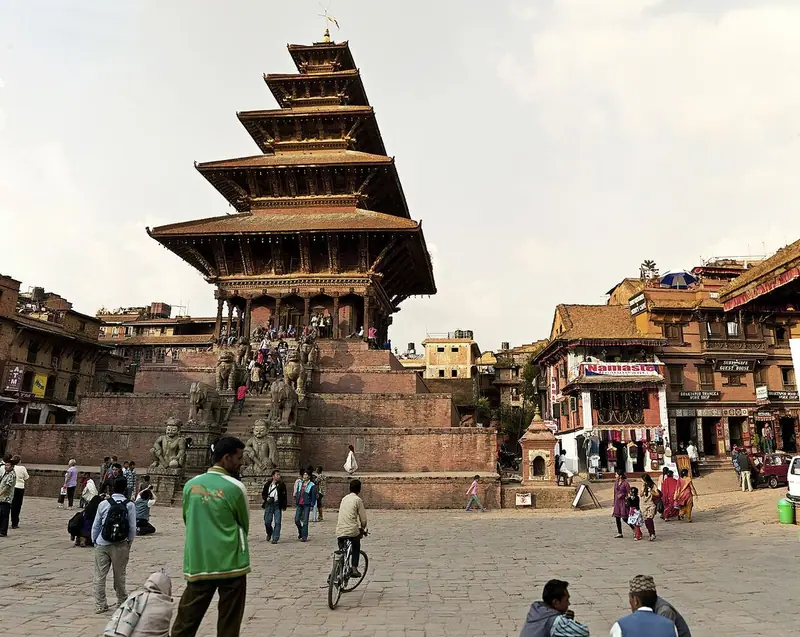 Newar8 stops · 12th–18th century
Bhaktapur audio guide
Brick lanes and temple squares in the best preserved of the Kathmandu Valley’s royal cities, from Durbar Square to the Nyatapola Temple.
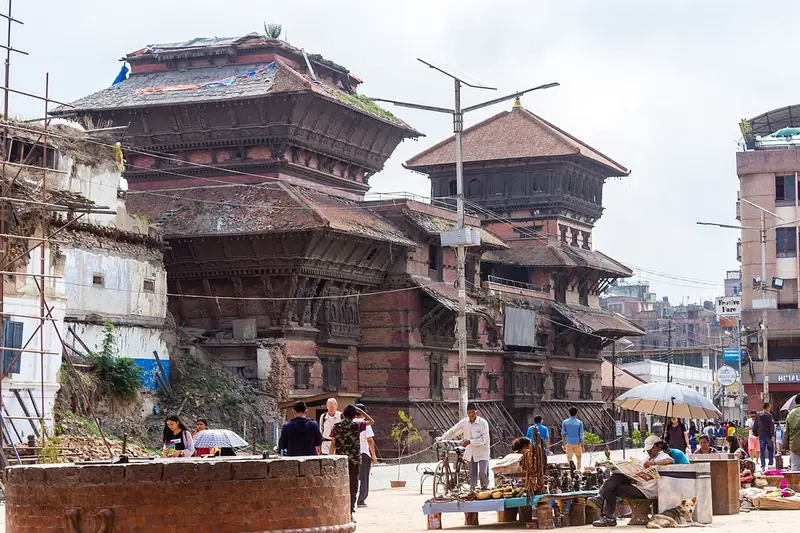 Newar8 stops · c. 7th–18th century
Kathmandu Durbar Square audio guide
Explore the tiered temples and palace courtyards of Kathmandu’s old royal heart, from the Kasthamandap to the house of the living goddess Kumari.
 Maurya8 stops · c. 6th century BCE – 15th century CE
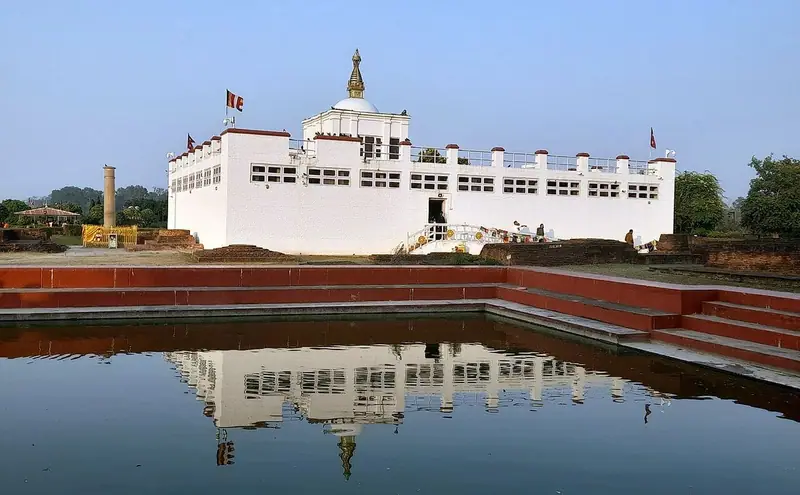
Lumbini audio guide
Stand at the birthplace of the Buddha, beside the Maya Devi Temple, Ashoka’s inscribed pillar and the sacred pool, then follow the canal past monasteries of many nations to the World Peace Pagoda.
 Newar7 stops · 17th–18th century
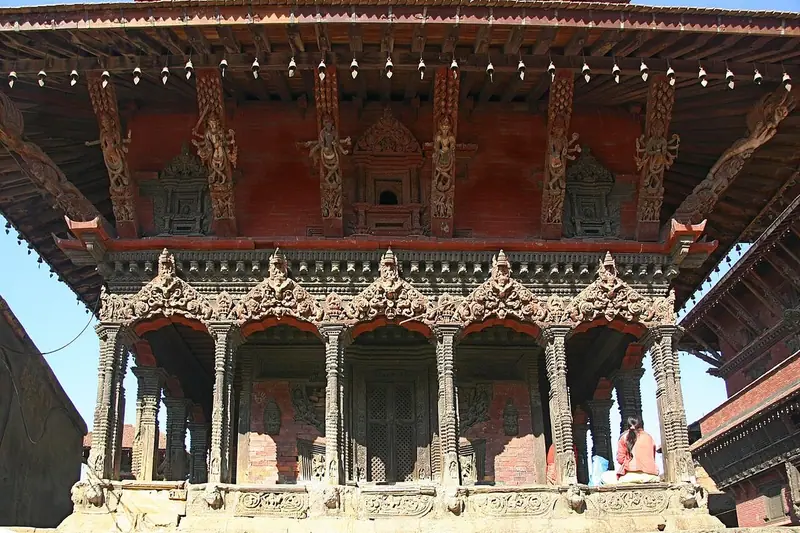
Patan Durbar Square audio guide
The palace square of the Malla kings of Patan, from the stone Krishna Mandir and the royal bath of Sundari Chowk to the bronzes of the Patan Museum and the Golden Temple.
Every guide, in every country
Swayambhunath and Boudhanath and every other guide we publish, including future ones. One payment, no subscription.