Before you start
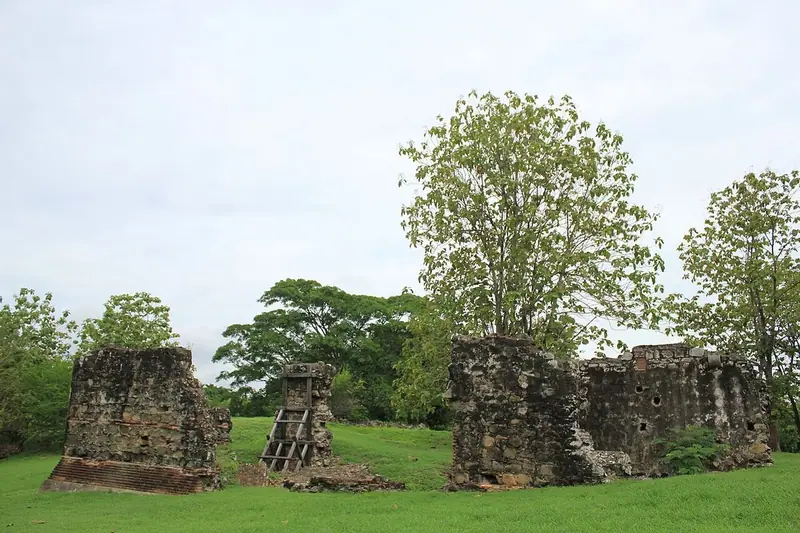
Panamá Viejo, Old Panama, is the ruin of the first Panama City, founded by the Spanish in 1519 on the shore of the Pacific Ocean. For a century and a half it was one of the richest cities in the Americas, until it was destroyed by fire in 1671, when the privateer Henry Morgan attacked it. Today its stone ruins stand among lawns and trees, in the middle of the modern city. This guide begins at the museum, then visits the convent of the Concepción, the main square, the cathedral tower, the royal houses, and ends at the King’s Bridge. The site is spread out over about a kilometre, so wear a hat and comfortable shoes.
Use it as a self-guided tour of Panamá Viejo: 7 stops in visit order, each played when you’re ready, at your own pace.
 Free preview · Stop 1
The Museum
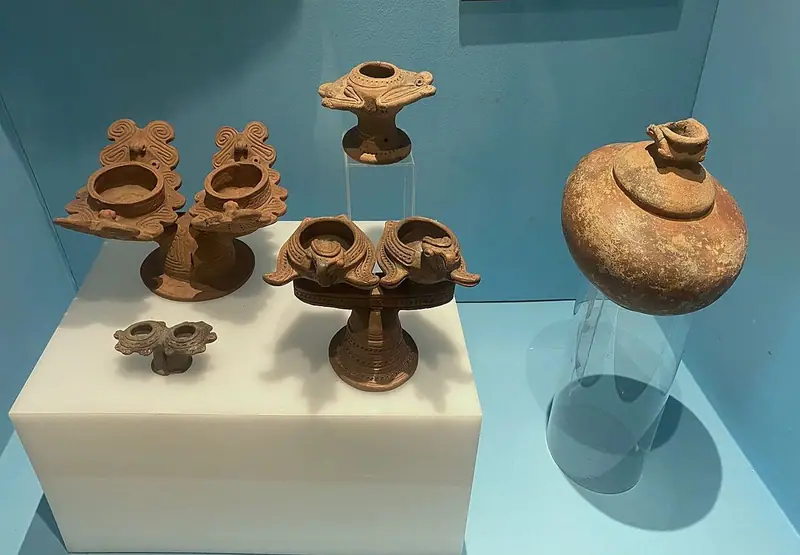
Begin at the visitor centre and the museum, at the entrance to the site. The museum tells the story of this place over some fifteen hundred years. Long before the Spanish arrived, there was a village of fishermen and farmers here, by the shore, and archaeologists have found their burials beneath the later city, some in large pottery urns, with offerings of pottery and stone tools. Look at the models of the old city, which show how it looked at its height, with its churches, convents and houses, and its harbour full of ships. Look at the objects found in the excavations: Spanish pottery, Chinese porcelain that came across the Pacific, coins, keys and tools. In 1610 the city had around five thousand people, and by 1670 perhaps ten thousand. Then walk out onto the path that leads through the site.
Photo: Ismoon · CC BY-SA 4.0 · Wikimedia Commons
What to see at Panamá Viejo: 7 stops, in visit order
- 01
 The MuseumBefore the cityFree preview
- 02
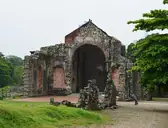 The Concepción ConventThe nuns of PanamaIn the guide
- 03
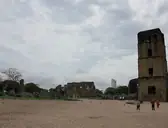 The Plaza MayorThe heart of the cityIn the guide
- 04
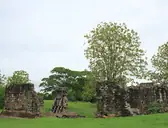 The Royal HousesGold and silverIn the guide
- 05
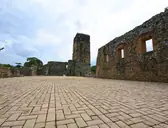 The Cathedral TowerA view of two citiesIn the guide
- 06
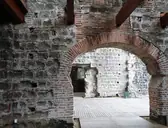 The Fall of the CityMorgan’s attackIn the guide
- 07
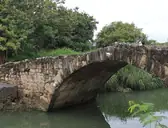 The King’s BridgeThe road to the CaribbeanIn the guide
Site map of Panamá Viejo
History of Panamá Viejo
Long before the Spanish came, Cueva-speaking peoples lived here, in villages of fishermen and farmers by the sea. In 1519 the Spanish governor Pedro Arias Dávila founded a city here, the first permanent European settlement on the Pacific coast of the Americas. It became the starting point for the conquest of Peru, and for more than a century the silver of the Andes passed through it on the way to Spain. After the city was destroyed in 1671, Panama was rebuilt a few kilometres to the west, in what is now the Casco Viejo. Panama remained part of the Spanish Empire until 1821, and became an independent republic in 1903.
Panamá Viejo guide: questions
How many stops does the Panamá Viejo guide have?
7 stops, in visit order: 1. The Museum; 2. The Concepción Convent; 3. The Plaza Mayor; 4. The Royal Houses; 5. The Cathedral Tower; 6. The Fall of the City; 7. The King’s Bridge.
Can I do a self-guided tour of Panamá Viejo with this guide?
Yes. The guide is made for a self-guided tour: 7 stops in visit order, each with a photo, a story and a voice, so you can explore Panamá Viejo at your own pace, without joining a group. Download it before you go and it works offline.
How long is each guide?
The 7 stops add up to about 5 minutes of listening in total. You play each stop when you’re ready, so you can go at your own pace.
Does the guide work offline?
Yes, once it’s downloaded. The guide is a single self-contained web page (about 6.4 MB) with the photos, text and audio built in. Download it to your phone before you go (Wi-Fi is best); after that it opens in any modern browser on iPhone or Android, with no app, account or mobile signal needed.
Does it use GPS or need my location?
No. The guide doesn’t use GPS and doesn’t know where you are: you play each stop when you reach it. It works on iPhone and Android in any modern browser, and it’s in English.
What’s included?
One self-contained HTML guide: 7 stops in visit order, each with a photo, text and a voice, plus the story of who built the site.
Who built Panamá Viejo?
Long before the Spanish came, Cueva-speaking peoples lived here, in villages of fishermen and farmers by the sea. In 1519 the Spanish governor Pedro Arias Dávila founded a city here, the first permanent European settlement on the Pacific coast of the Americas.
Where is Panamá Viejo?
Panamá Viejo, Old Panama, is the ruin of the first Panama City, founded by the Spanish in 1519 on the shore of the Pacific Ocean.
Is there a free audio guide to Panamá Viejo?
The first stop, The Museum, is free to read and hear on this page, so you can try the Panamá Viejo audio tour before you buy. The full guide, with all 7 stops, is a one-off purchase: download it once and it’s yours to keep, working offline.
Is the Panamá Viejo guide worth it?
If you’d like to know what you’re looking at, yes. For $10 you get 7 stops in visit order, each with a photo, a short history and a voice you play when you’re ready, plus a site map of the stops, and about 5 minutes of listening in all. It’s short on purpose, so you spend your time looking, not listening. It’s yours to keep, works offline and needs no app. The first stop is free on this page, so you can try it before you buy. If you’d like hours of detail, a guided tour will go deeper.
Audio guide or guided tour?
It depends how you like to visit. This guide lets you explore Panamá Viejo at your own pace, at any time, for a one-off price. A guided tour gives you a live expert you can ask questions, but at fixed times and usually for a higher price. Many people use both: a tour for the big picture, and the guide to read beforehand or to revisit the stops in their own time.
Is this the official Panamá Viejo guide?
No. It’s an independent guide by The Historian Guide, not affiliated with or endorsed by the operator of Panamá Viejo. For tickets and opening hours, check the official site operator before you go.
Does the guide include entry tickets or opening hours?
No. The guide is a digital companion only. Admission to Panamá Viejo is separate, so check the official site operator for current tickets and opening hours before you go.
- Stop 1 · The Museum: Ismoon (talk) 17:04, 14 February 2025 (UTC) · CC BY-SA 4.0 · Wikimedia Commons · resized
- Stop 2 · The Concepción Convent: Ivo Kruusamägi · CC BY-SA 4.0 · Wikimedia Commons · resized
- Stop 3 · The Plaza Mayor: Ayaita · CC0 · Wikimedia Commons · resized
- Stop 4 · The Royal Houses (also the cover): Ayaita · CC0 · Wikimedia Commons · resized
- Stop 5 · The Cathedral Tower: Gualberto107 · CC BY-SA 3.0 · Wikimedia Commons · resized
- Stop 6 · The Fall of the City: Adam Jones · CC BY-SA 2.0 · Wikimedia Commons · resized
- Stop 7 · The King’s Bridge: Ayaita · CC0 · Wikimedia Commons · resized


All photographs from Wikimedia Commons under the licences shown.
More guides in Panama
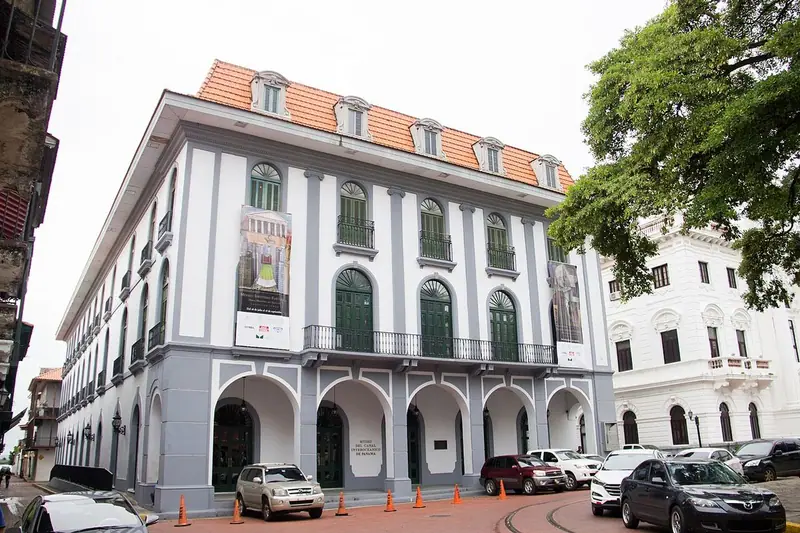 Spanish Colonial8 stops · 1673 – early 20th century
Casco Viejo audio guide
The narrow streets of Panama City’s old quarter on its rocky peninsula, from the Plaza de la Independencia to the Plaza de Francia.
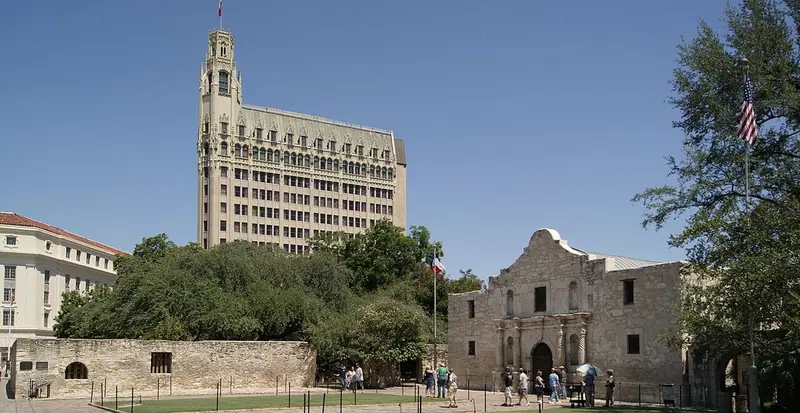 Spanish Colonial7 stops · 1718–1782
Alamo and San Antonio Missions audio guide
From the battle-scarred Alamo to Mission San José and the Espada Aqueduct, the five missions that made San Antonio.
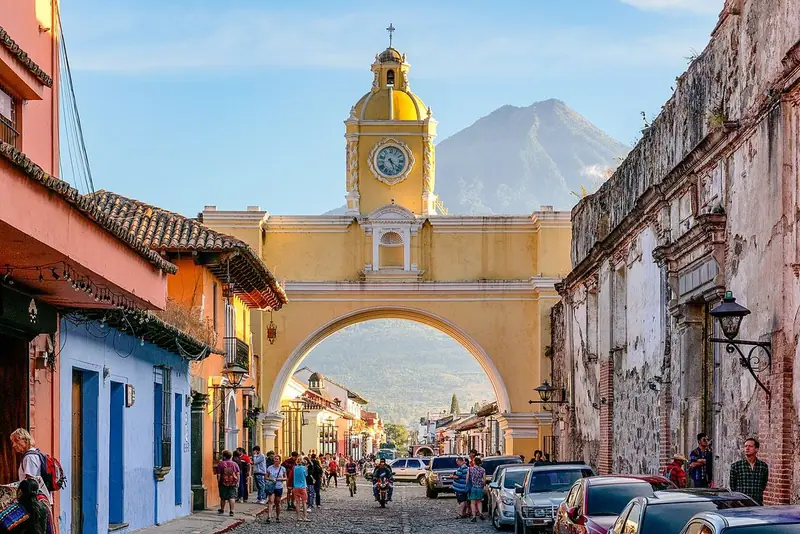 Spanish Colonial7 stops · 1543–1773 CE
Antigua Guatemala audio guide
The grid of Santiago de los Caballeros beneath three volcanoes, from the Central Park and the cathedral to the Santa Catalina Arch, La Merced and the Capuchinas.
Every guide, in every country
Panamá Viejo and every other guide we publish, including future ones. One payment, no subscription.