Before you start
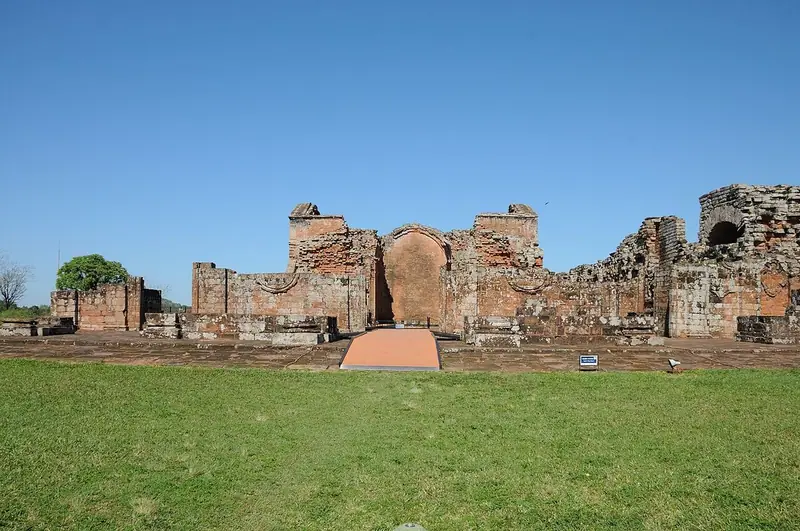
In the green hills of southern Paraguay, not far from the city of Encarnación and the Paraná River, stand the red sandstone ruins of two Jesuit missions. La Santísima Trinidad de Paraná, the Most Holy Trinity, is the best preserved of all the mission towns of the region, and Jesús de Tavarangue, about ten kilometres away, holds the shell of a vast church left unfinished. UNESCO inscribed them together as a World Heritage Site in 1993. They were towns where Guaraní families lived, worked and worshipped under the direction of Jesuit priests, and their ruins still trace the plan of streets, squares and houses. The route explores Trinidad first, from its bell tower to its great square, church and houses, and ends at Jesús.
Use it as a self-guided tour of the Jesuit Missions of Trinidad and Jesús: 9 stops in visit order, each played when you’re ready, at your own pace.
 Free preview · Stop 1
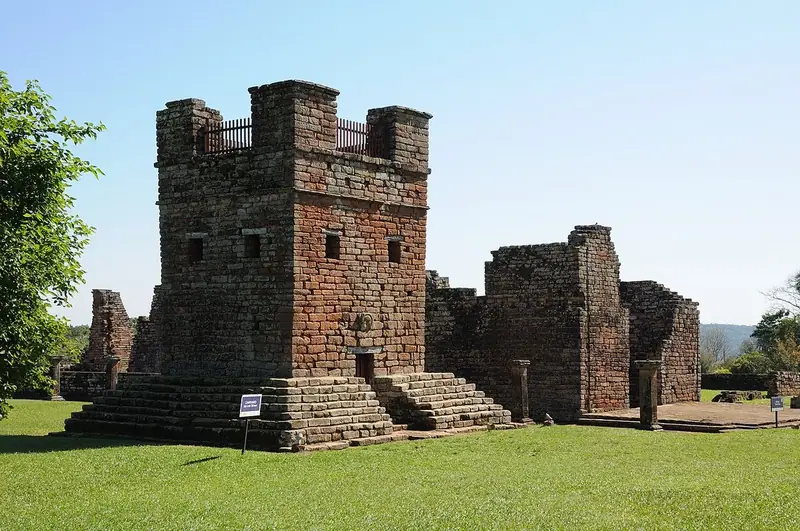
The Bell Tower
Begin at the tower that stands some distance from the great church. It has a square base of solid construction, and it may have been the bell tower of an earlier, temporary church, or a watchtower. Beside it are the remains of a chapel, and nearby stands the small church, the second church of the mission. From around the tower you can take in the full layout of Trinidad: the square, the great church, the rows of houses, the gardens and the cemetery. The ruins of Trinidad were rediscovered and cleared in the twentieth century, nearly two centuries after the mission was abandoned, and they are now the most visited of the mission sites in Paraguay. Trinidad was one of the last missions founded in the Paraná region, and partly because it was built so late, its stone has withstood the weather well.
Photo: Josep M. Gracia · CC BY-SA 4.0 · Wikimedia Commons
What to see at the Jesuit Missions of Trinidad and Jesús: 9 stops, in visit order
- 01
 The Bell TowerBelfry or watchtowerFree preview
- 02
 The Plaza MayorThe heart of the mission townIn the guide
- 03
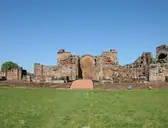 The Great ChurchPrímoli’s masterpiece in stoneIn the guide
- 04
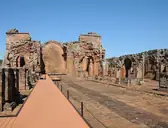 The NaveThe frieze of angel musiciansIn the guide
- 05
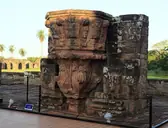 The PulpitA thousand carved stonesIn the guide
- 06
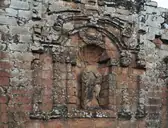 The Statues and the MuseumSaints without headsIn the guide
- 07
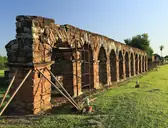 The Houses of the GuaraníArcades of red stoneIn the guide
- 08
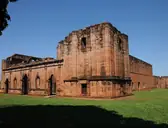 The Church of JesúsAn unfinished giantIn the guide
- 09
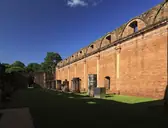 The Nave and the SchoolThe life of a mission townIn the guide
Site map of the Jesuit Missions of Trinidad and Jesús
History of the Jesuit Missions of Trinidad and Jesús
The Jesuits reached the region in the late sixteenth century, and with the permission of King Philip the Second of Spain they set out to convert the Guaraní and to protect them from the encomienda, the colonial labour system that amounted to virtual slavery. They founded about thirty missions, or reductions, in the basin of the Río de la Plata, seven of them in what is now Paraguay and the rest in present-day Argentina and Brazil. The Guaraní were brought together in settled towns and adopted Christianity, but unlike many peoples elsewhere in the Americas they were not forced to give up their own culture; the missionaries learned their language and gave it a written form, and the Guaraní kept many traditions, among them the growing of yerba mate. In 1767 King Charles the Third expelled the Jesuits from the Spanish empire, and the missions fell into decay.
Jesuit Missions of Trinidad and Jesús guide: questions
How many stops does the Jesuit Missions of Trinidad and Jesús guide have?
9 stops, in visit order: 1. The Bell Tower; 2. The Plaza Mayor; 3. The Great Church; 4. The Nave; 5. The Pulpit; 6. The Statues and the Museum; 7. The Houses of the Guaraní; 8. The Church of Jesús; 9. The Nave and the School.
Can I do a self-guided tour of the Jesuit Missions of Trinidad and Jesús with this guide?
Yes. The guide is made for a self-guided tour: 9 stops in visit order, each with a photo, a story and a voice, so you can explore the Jesuit Missions of Trinidad and Jesús at your own pace, without joining a group. Download it before you go and it works offline.
How long do you need at the Jesuit Missions of Trinidad and Jesús?
We suggest allowing half a day. The 9 stops add up to about 6 minutes of listening, and you play each one when you’re ready, so you can linger wherever you like.
How long is each guide?
The 9 stops add up to about 6 minutes of listening in total. You play each stop when you’re ready, so you can go at your own pace.
Does the guide work offline?
Yes, once it’s downloaded. The guide is a single self-contained web page (about 8.0 MB) with the photos, text and audio built in. Download it to your phone before you go (Wi-Fi is best); after that it opens in any modern browser on iPhone or Android, with no app, account or mobile signal needed.
Does it use GPS or need my location?
No. The guide doesn’t use GPS and doesn’t know where you are: you play each stop when you reach it. It works on iPhone and Android in any modern browser, and it’s in English.
What’s included?
One self-contained HTML guide: 9 stops in visit order, each with a photo, text and a voice, plus the story of who built the site.
Who built the Jesuit Missions of Trinidad and Jesús?
The Jesuits reached the region in the late sixteenth century, and with the permission of King Philip the Second of Spain they set out to convert the Guaraní and to protect them from the encomienda, the colonial labour system that amounted to virtual slavery. They founded about thirty missions, or reductions, in the basin of the Río de la Plata, seven of them in what is now Paraguay and the rest in present-day Argentina and Brazil.
Where is the Jesuit Missions of Trinidad and Jesús?
In the green hills of southern Paraguay, not far from the city of Encarnación and the Paraná River, stand the red sandstone ruins of two Jesuit missions.
Is there a free audio guide to the Jesuit Missions of Trinidad and Jesús?
The first stop, The Bell Tower, is free to read and hear on this page, so you can try the Jesuit Missions of Trinidad and Jesús audio tour before you buy. The full guide, with all 9 stops, is a one-off purchase: download it once and it’s yours to keep, working offline.
Is the Jesuit Missions of Trinidad and Jesús guide worth it?
If you’d like to know what you’re looking at, yes. For $10 you get 9 stops in visit order, each with a photo, a short history and a voice you play when you’re ready, plus a site map of the stops, and about 6 minutes of listening in all. It’s short on purpose, so you spend your time looking, not listening. It’s yours to keep, works offline and needs no app. The first stop is free on this page, so you can try it before you buy. If you’d like hours of detail, a guided tour will go deeper.
Audio guide or guided tour?
It depends how you like to visit. This guide lets you explore the Jesuit Missions of Trinidad and Jesús at your own pace, at any time, for a one-off price. A guided tour gives you a live expert you can ask questions, but at fixed times and usually for a higher price. Many people use both: a tour for the big picture, and the guide to read beforehand or to revisit the stops in their own time.
Is this the official Jesuit Missions of Trinidad and Jesús guide?
No. It’s an independent guide by The Historian Guide, not affiliated with or endorsed by the operator of the Jesuit Missions of Trinidad and Jesús. For tickets and opening hours, check the official site operator before you go.
Does the guide include entry tickets or opening hours?
No. The guide is a digital companion only. Admission to the Jesuit Missions of Trinidad and Jesús is separate, so check the official site operator for current tickets and opening hours before you go.
- Stop 1 · The Bell Tower: Josep M. Gracia · CC BY-SA 4.0 · Wikimedia Commons · resized
- Stop 2 · The Plaza Mayor: Falk2 · CC BY-SA 4.0 · Wikimedia Commons · resized
- Stop 3 · The Great Church (also the cover): Josep M. Gracia · CC BY-SA 4.0 · Wikimedia Commons · resized
- Stop 4 · The Nave: Josep M. Gracia · CC BY-SA 4.0 · Wikimedia Commons · resized
- Stop 5 · The Pulpit: Falk2 · CC BY-SA 4.0 · Wikimedia Commons · resized
- Stop 6 · The Statues and the Museum: Falk2 · CC BY-SA 4.0 · Wikimedia Commons · resized
- Stop 7 · The Houses of the Guaraní: Falk2 · CC BY-SA 4.0 · Wikimedia Commons · resized
- Stop 8 · The Church of Jesús: Josep M. Gracia · CC BY-SA 4.0 · Wikimedia Commons · resized
- Stop 9 · The Nave and the School: Falk2 · CC BY-SA 4.0 · Wikimedia Commons · resized


All photographs from Wikimedia Commons under the licences shown.
More guides
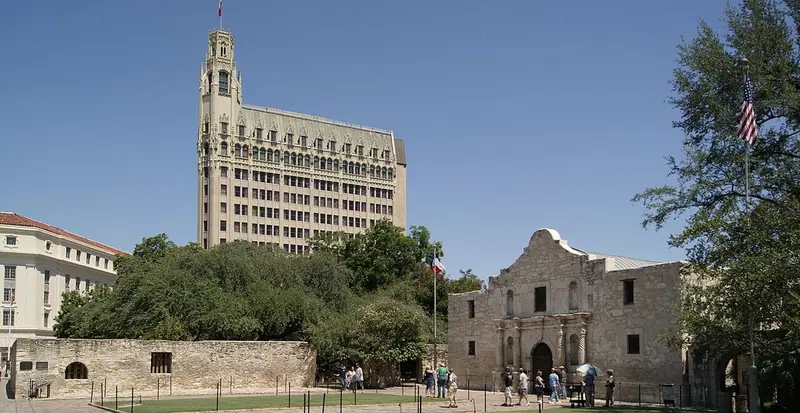 Spanish Colonial7 stops · 1718–1782
Alamo and San Antonio Missions audio guide
From the battle-scarred Alamo to Mission San José and the Espada Aqueduct, the five missions that made San Antonio.
 Spanish Colonial7 stops · 1543–1773 CE
Antigua Guatemala audio guide
The grid of Santiago de los Caballeros beneath three volcanoes, from the Central Park and the cathedral to the Santa Catalina Arch, La Merced and the Capuchinas.
 Spanish Colonial7 stops · 16th–19th century CE
Arequipa audio guide
The White City of volcanic stone: the Santa Catalina Monastery, the cathedral and La Compañía on the Plaza de Armas, the ice maiden Juanita and the Yanahuara viewpoint.
Every guide, in every country
Jesuit Missions of Trinidad and Jesús and every other guide we publish, including future ones. One payment, no subscription.