Before you start
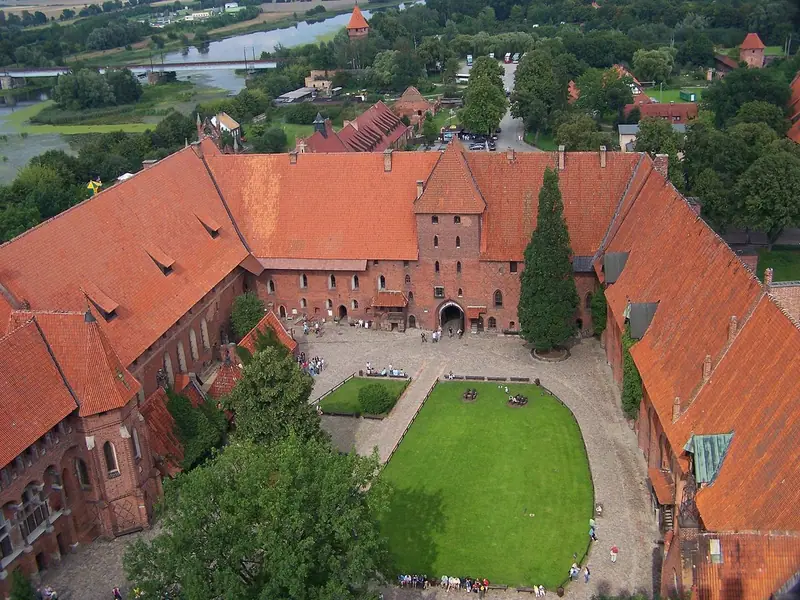
Malbork Castle, on the river Nogat in northern Poland, was the headquarters of the Teutonic Knights, a crusading order of German monks and soldiers who ruled a powerful state on the Baltic coast in the fourteenth century. Built of red brick over more than a century, it is the largest castle in the world by area, a fortress, a monastery and a palace in one. This guide follows the main route through the castle, from the courtyard of the Middle Castle and the halls of the Grand Masters to the church and burial chapel of the High Castle and the great latrine tower over the moat. Much of what you see was restored after heavy damage in 1945, and the guide notes where. Allow at least three hours.
Use it as a self-guided tour of Malbork Castle: 6 stops in visit order, each played when you’re ready, at your own pace.
 Free preview · Stop 1
The Middle Castle
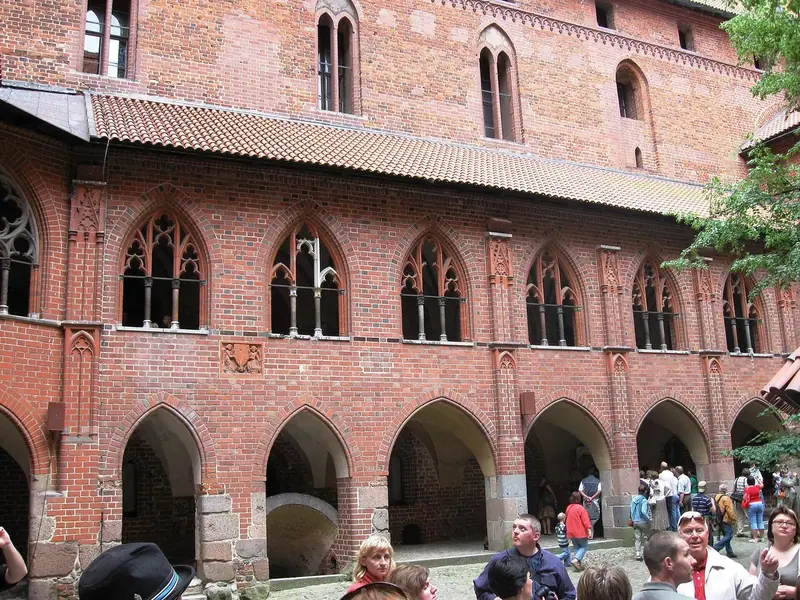
You enter the castle through the outer walls and gates into the wide courtyard of the Middle Castle. When the Grand Master moved here in 1309, this area, once the outer bailey of the first castle, was rebuilt as the centre of government of the Order’s state, with lodgings for important guests, an infirmary for sick and elderly knights, and the great halls on its western side. Look around at the walls of red brick, the material of almost every great building in this stoneless land, laid in patterns and set off with glazed bricks. To the south, beyond a moat, rises the High Castle, the oldest part of the fortress and the home of the knights’ religious community. From the courtyard, the route leads into the western range and the Grand Masters’ Palace.
Photo: Lestat (Jan Mehlich) · CC BY-SA 2.5 · Wikimedia Commons
What to see at Malbork Castle: 6 stops, in visit order
- 01
 The Middle CastleThe courtyard of the Order’s capitalFree preview
- 02
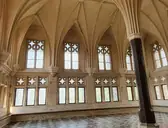 The Grand Masters’ PalaceThe ruler’s residenceIn the guide
- 03
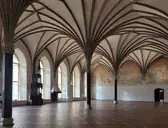 The Great RefectoryThe feasting hallIn the guide
- 04
 The Church of the Virgin Mary and St Anne’s ChapelThe church of the knightsIn the guide
- 05
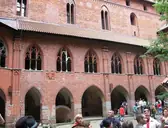 The High CastleThe knights’ monasteryIn the guide
- 06
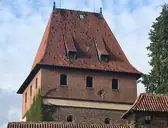 The DanskerThe tower over the moatIn the guide
Site map of Malbork Castle
History of Malbork Castle
The Teutonic Order was founded at Acre in the Holy Land in 1191. In the thirteenth century it was invited to fight the pagan Prussians on the Baltic, and over half a century it conquered their lands and built castles to hold them. Work on a castle here, named Marienburg in honour of the Virgin Mary, the patron of the Order, began in the 1270s. In 1309 the Grand Master moved the Order’s headquarters here from Venice, and the castle was enlarged into the capital of a state that grew rich on the grain and amber trade. In 1410 the Order was crushed by the armies of Poland and Lithuania at the Battle of Grunwald, but the castle held out against a siege. In 1457, during the Thirteen Years’ War, unpaid mercenaries sold it to the King of Poland, and for more than three hundred years it was a royal residence.
The full history continues in the guide.
Malbork Castle guide: questions
How many stops does the Malbork Castle guide have?
6 stops, in visit order: 1. The Middle Castle; 2. The Grand Masters’ Palace; 3. The Great Refectory; 4. The Church of the Virgin Mary and St Anne’s Chapel; 5. The High Castle; 6. The Dansker.
Can I do a self-guided tour of Malbork Castle with this guide?
Yes. The guide is made for a self-guided tour: 6 stops in visit order, each with a photo, a story and a voice, so you can explore Malbork Castle at your own pace, without joining a group. Download it before you go and it works offline.
How long is each guide?
The 6 stops add up to about 4 minutes of listening in total. You play each stop when you’re ready, so you can go at your own pace.
Does the guide work offline?
Yes, once it’s downloaded. The guide is a single self-contained web page (about 6.9 MB) with the photos, text and audio built in. Download it to your phone before you go (Wi-Fi is best); after that it opens in any modern browser on iPhone or Android, with no app, account or mobile signal needed.
Does it use GPS or need my location?
No. The guide doesn’t use GPS and doesn’t know where you are: you play each stop when you reach it. It works on iPhone and Android in any modern browser, and it’s in English.
What’s included?
One self-contained HTML guide: 6 stops in visit order, each with a photo, text and a voice, plus the story of who built the site.
Who built Malbork Castle?
The Teutonic Order was founded at Acre in the Holy Land in 1191. In the thirteenth century it was invited to fight the pagan Prussians on the Baltic, and over half a century it conquered their lands and built castles to hold them.
Where is Malbork Castle?
Malbork Castle, on the river Nogat in northern Poland, was the headquarters of the Teutonic Knights, a crusading order of German monks and soldiers who ruled a powerful state on the Baltic coast in the fourteenth century.
Is there a free audio guide to Malbork Castle?
The first stop, The Middle Castle, is free to read and hear on this page, so you can try the Malbork Castle audio tour before you buy. The full guide, with all 6 stops, is a one-off purchase: download it once and it’s yours to keep, working offline.
Is the Malbork Castle guide worth it?
If you’d like to know what you’re looking at, yes. For $10 you get 6 stops in visit order, each with a photo, a short history and a voice you play when you’re ready, plus a site map of the stops, and about 4 minutes of listening in all. It’s short on purpose, so you spend your time looking, not listening. It’s yours to keep, works offline and needs no app. The first stop is free on this page, so you can try it before you buy. If you’d like hours of detail, a guided tour will go deeper.
Audio guide or guided tour?
It depends how you like to visit. This guide lets you explore Malbork Castle at your own pace, at any time, for a one-off price. A guided tour gives you a live expert you can ask questions, but at fixed times and usually for a higher price. Many people use both: a tour for the big picture, and the guide to read beforehand or to revisit the stops in their own time.
Is this the official Malbork Castle guide?
No. It’s an independent guide by The Historian Guide, not affiliated with or endorsed by the operator of Malbork Castle. For tickets and opening hours, check the official site operator before you go.
Does the guide include entry tickets or opening hours?
No. The guide is a digital companion only. Admission to Malbork Castle is separate, so check the official site operator for current tickets and opening hours before you go.
- Stop 1 · The Middle Castle: Lestat (Jan Mehlich) · CC BY-SA 2.5 · Wikimedia Commons · resized
- Stop 2 · The Grand Masters’ Palace: Qasinka · CC0 · Wikimedia Commons · resized
- Stop 3 · The Great Refectory: Bornholm · CC BY-SA 4.0 · Wikimedia Commons · resized
- Stop 4 · The Church of the Virgin Mary and St Anne’s Chapel: Kapitel · CC BY-SA 4.0 · Wikimedia Commons · resized
- Stop 5 · The High Castle (also the cover): Olerys · CC BY-SA 3.0 · Wikimedia Commons · resized
- Stop 6 · The Dansker: PiotrMig · CC BY-SA 4.0 · Wikimedia Commons · resized


All photographs from Wikimedia Commons under the licences shown.
More guides in Poland
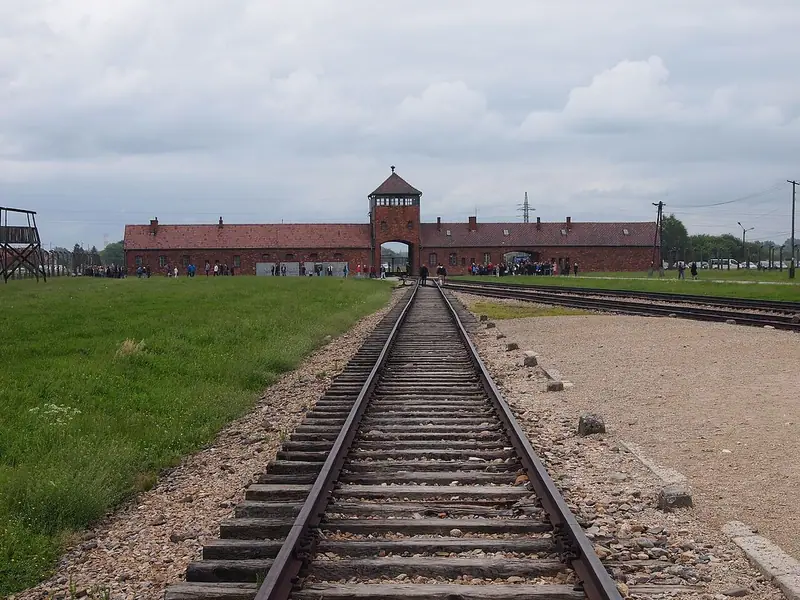 Modern9 stops · 1940–1945 CE
Auschwitz-Birkenau audio guide
A guide for remembrance at the largest of the Nazi camps, from the main gate and the Death Wall to the ramp and barracks of Birkenau.
 Polish–Lithuanian Commonwealth8 stops · Polish Enlightenment
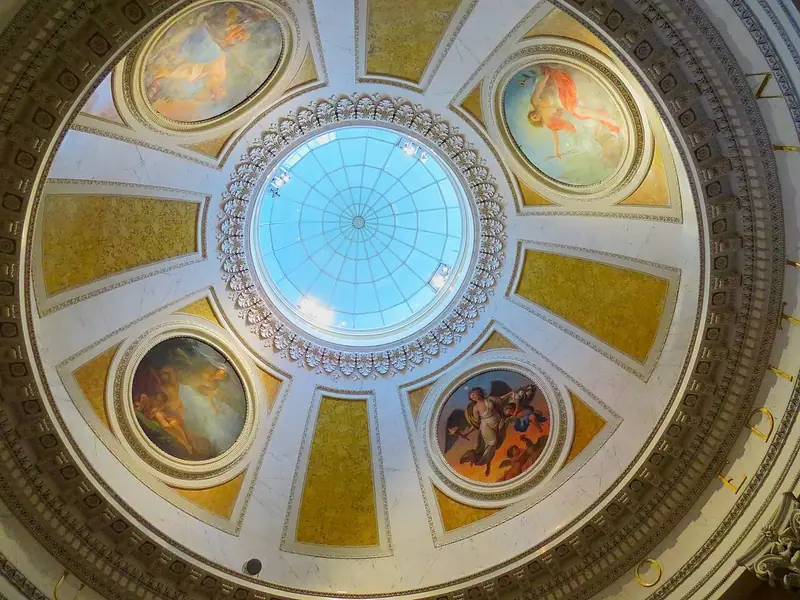
Łazienki Park audio guide
From the Chopin monument past the Old Orangery to the Palace on the Isle, summer retreat of Poland’s last king.
 Hanseatic / Polish7 stops · 1343–1980
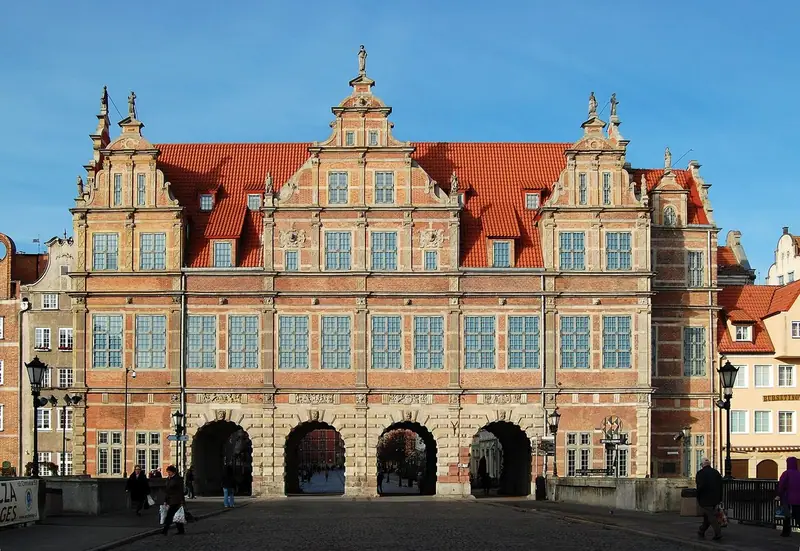
Gdańsk Main Town audio guide
Along the Royal Route from the Golden Gate past the Town Hall, Neptune and the Green Gate to the medieval Crane and St Mary’s Church, ending at the shipyard gates where Solidarity was born.
 Jagiellonian8 stops · 1257–1590s CE
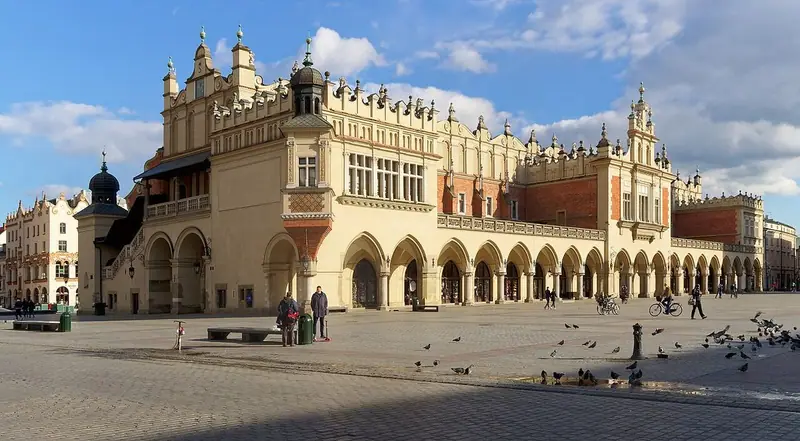
Kraków Old Town audio guide
From the Barbican to the Main Market Square, laid out in the thirteenth century, where the hejnał sounds from St Mary’s tower.
 Polish–Lithuanian Commonwealth8 stops · Early modern Poland
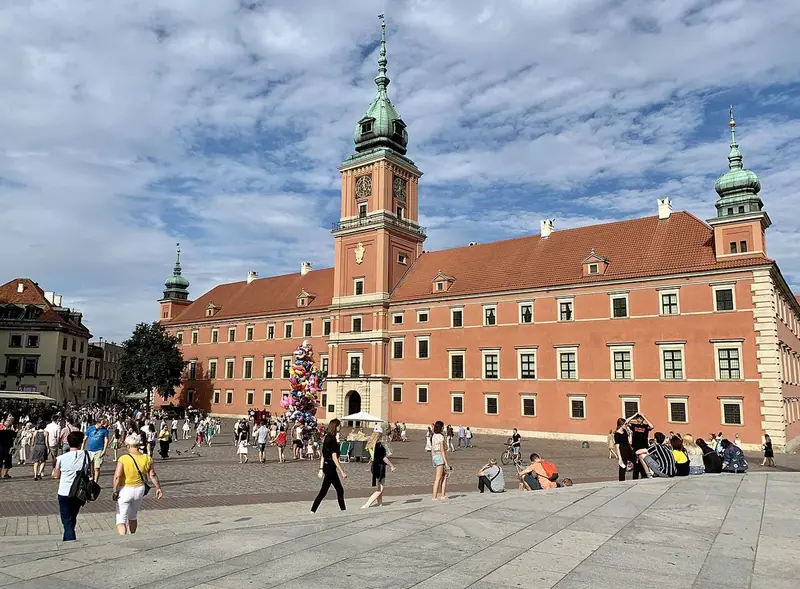
Royal Castle, Warsaw audio guide
From Sigismund’s Column into the rebuilt home of Polish kings, where the Constitution of 3 May 1791 was drafted, to the Canaletto Room and the Ballroom.
 Jagiellonian8 stops · 11th–16th century CE
Wawel Royal Castle audio guide
Climb Wawel Hill to the cathedral, the Sigismund Bell and the royal crypts, then the Renaissance arcaded courtyard of Poland’s kings.
Every guide, in every country
Malbork Castle and every other guide we publish, including future ones. One payment, no subscription.