Before you start
Wat Pho, the Temple of the Reclining Buddha, stands on Rattanakosin Island in the historic heart of Bangkok, directly south of the Grand Palace. The Sanam Chai station on the MRT Blue Line is close by, and river boats stop at Tha Tien pier, a short walk away. Of the temple’s two walled compounds, the northern one, with the main buildings, is open to visitors; the southern one holds the monks’ quarters and a school. There are two public entrances, one on Chetuphon Road and one near the north-west corner. Wat Pho is a working temple: dress modestly, with shoulders and knees covered, take off your shoes where asked, and never point your feet towards a Buddha image. This route starts with the Reclining Buddha, then visits the four great chedis, the cloister and the ordination hall, and finishes among the guardians, rock gardens and medical pavilions.
Use it as a self-guided tour of Wat Pho: 7 stops in visit order, each played when you’re ready, at your own pace.
 Free preview · Stop 1
Reclining Buddha
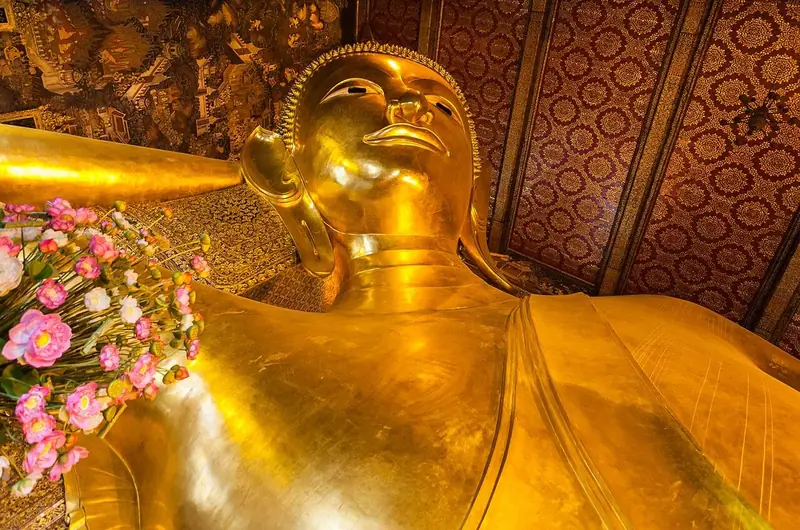
Begin in the hall of the Reclining Buddha, and take off your shoes at the entrance. The vast figure, built in the reign of King Rama III, is about forty-six metres long and fifteen metres high, one of the largest Buddha images in Thailand. It shows the Buddha at the moment of his passing into Nirvana, the end of all rebirths. His right arm supports his head, with its tight curls, which rests on two box-shaped pillows decorated with glass mosaic. The figure has a brick core, shaped with plaster and then gilded. Walk slowly along its length, from the serene face to the feet, and look at the murals on the walls and pillars of the hall. The hall is narrow and the Buddha almost fills it, so it is hard to see the whole figure at once.
Photo: Diego Delso · CC BY-SA 3.0 · Wikimedia Commons
What to see at Wat Pho: 7 stops, in visit order
- 01
 Reclining BuddhaEntering NirvanaFree preview
- 02
 The Buddha’s FeetMother-of-pearl symbolsIn the guide
- 03
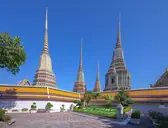 Four Great ChedisA memorial to four kingsIn the guide
- 04
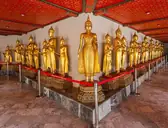 Phra RabiangA cloister of BuddhasIn the guide
- 05
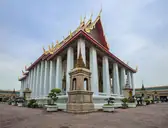 Ordination HallWhere Rama I is honouredIn the guide
- 06
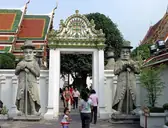 Stone GuardiansBallast from ChinaIn the guide
- 07
 Hermit Hill and MedicineThailand’s first universityIn the guide
Site map of Wat Pho
History of Wat Pho
Wat Pho was rebuilt by the Chakri dynasty, which has reigned over Siam, now Thailand, since 1782. An older temple, Wat Photaram, already stood here in the Ayutthaya period. After King Rama I moved the capital to Bangkok and built the Grand Palace next door, he ordered the dilapidated temple to be rebuilt in 1788, and it became his principal temple. He also brought here Buddha images from abandoned temples in Ayutthaya, Sukhothai and elsewhere. From 1832 King Rama III enlarged and renovated the complex over more than sixteen years, building most of what stands today, including the hall of the Reclining Buddha. He also made the temple a centre of public learning.
Wat Pho guide: questions
How many stops does the Wat Pho guide have?
7 stops, in visit order: 1. Reclining Buddha; 2. The Buddha’s Feet; 3. Four Great Chedis; 4. Phra Rabiang; 5. Ordination Hall; 6. Stone Guardians; 7. Hermit Hill and Medicine.
Can I do a self-guided tour of Wat Pho with this guide?
Yes. The guide is made for a self-guided tour: 7 stops in visit order, each with a photo, a story and a voice, so you can explore Wat Pho at your own pace, without joining a group. Download it before you go and it works offline.
How long is each guide?
The 7 stops add up to about 5 minutes of listening in total. You play each stop when you’re ready, so you can go at your own pace.
Does the guide work offline?
Yes, once it’s downloaded. The guide is a single self-contained web page (about 7.1 MB) with the photos, text and audio built in. Download it to your phone before you go (Wi-Fi is best); after that it opens in any modern browser on iPhone or Android, with no app, account or mobile signal needed.
Does it use GPS or need my location?
No. The guide doesn’t use GPS and doesn’t know where you are: you play each stop when you reach it. It works on iPhone and Android in any modern browser, and it’s in English.
What’s included?
One self-contained HTML guide: 7 stops in visit order, each with a photo, text and a voice, plus the story of who built the site.
Who built Wat Pho?
Wat Pho was rebuilt by the Chakri dynasty, which has reigned over Siam, now Thailand, since 1782. An older temple, Wat Photaram, already stood here in the Ayutthaya period.
Where is Wat Pho?
Wat Pho, the Temple of the Reclining Buddha, stands on Rattanakosin Island in the historic heart of Bangkok, directly south of the Grand Palace.
Is there a free audio guide to Wat Pho?
The first stop, Reclining Buddha, is free to read and hear on this page, so you can try the Wat Pho audio tour before you buy. The full guide, with all 7 stops, is a one-off purchase: download it once and it’s yours to keep, working offline.
Is the Wat Pho guide worth it?
If you’d like to know what you’re looking at, yes. For $10 you get 7 stops in visit order, each with a photo, a short history and a voice you play when you’re ready, plus a site map of the stops, and about 5 minutes of listening in all. It’s short on purpose, so you spend your time looking, not listening. It’s yours to keep, works offline and needs no app. The first stop is free on this page, so you can try it before you buy. If you’d like hours of detail, a guided tour will go deeper.
Audio guide or guided tour?
It depends how you like to visit. This guide lets you explore Wat Pho at your own pace, at any time, for a one-off price. A guided tour gives you a live expert you can ask questions, but at fixed times and usually for a higher price. Many people use both: a tour for the big picture, and the guide to read beforehand or to revisit the stops in their own time.
Is this the official Wat Pho guide?
No. It’s an independent guide by The Historian Guide, not affiliated with or endorsed by the operator of Wat Pho. For tickets and opening hours, check the official site operator before you go.
Does the guide include entry tickets or opening hours?
No. The guide is a digital companion only. Admission to Wat Pho is separate, so check the official site operator for current tickets and opening hours before you go.
- Stop 1 · Reclining Buddha: Diego Delso · CC BY-SA 3.0 · Wikimedia Commons · resized
- Stop 2 · The Buddha’s Feet: Hzh · CC BY-SA 4.0 · Wikimedia Commons · resized
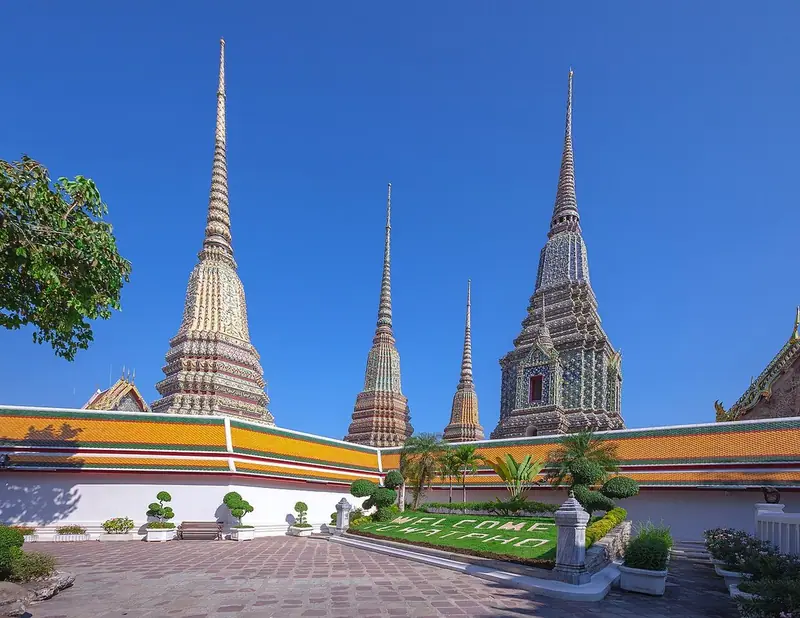
- Stop 3 · Four Great Chedis (also the cover): This Photo was taken by Supanut Arunoprayote. Feel free… · CC BY 4.0 · Wikimedia Commons · resized
- Stop 4 · Phra Rabiang: Diego Delso · CC BY-SA 3.0 · Wikimedia Commons · resized
- Stop 5 · Ordination Hall: This Photo was taken by Supanut Arunoprayote. Feel free… · CC BY 4.0 · Wikimedia Commons · resized
- Stop 6 · Stone Guardians: Michael Gunther · CC BY-SA 4.0 · Wikimedia Commons · resized
- Stop 7 · Hermit Hill and Medicine: Welcome to Thailand · CC0 · Wikimedia Commons · resized


All photographs from Wikimedia Commons under the licences shown.
More guides in Thailand
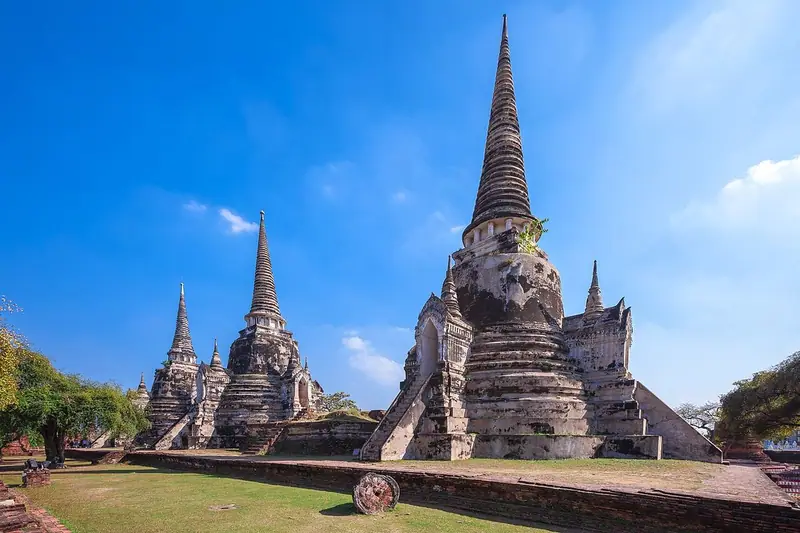 Siamese7 stops · 1351–1767 CE
Ayutthaya Historical Park audio guide
Cycle among the ruined temples of the old royal capital of Siam, from the Buddha head in the tree roots at Wat Mahathat to the towers of Wat Chaiwatthanaram.
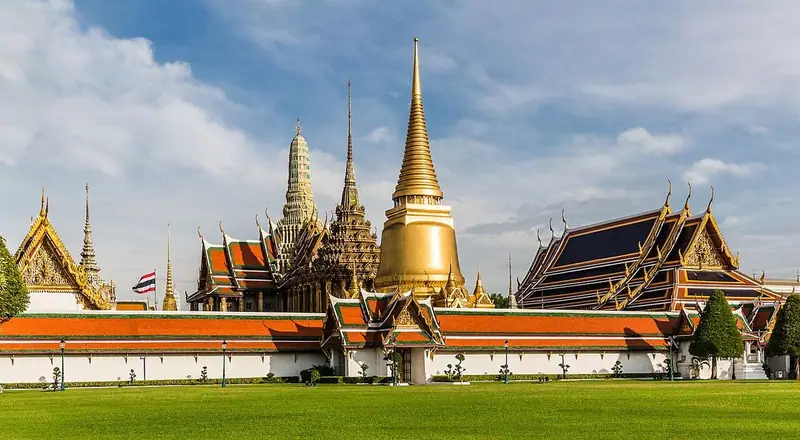 Chakri9 stops · from 1782 CE
Grand Palace audio guide
Pass the yaksha guardians into Bangkok’s royal palace and the Temple of the Emerald Buddha, built from 1782 on the east bank of the Chao Phraya.
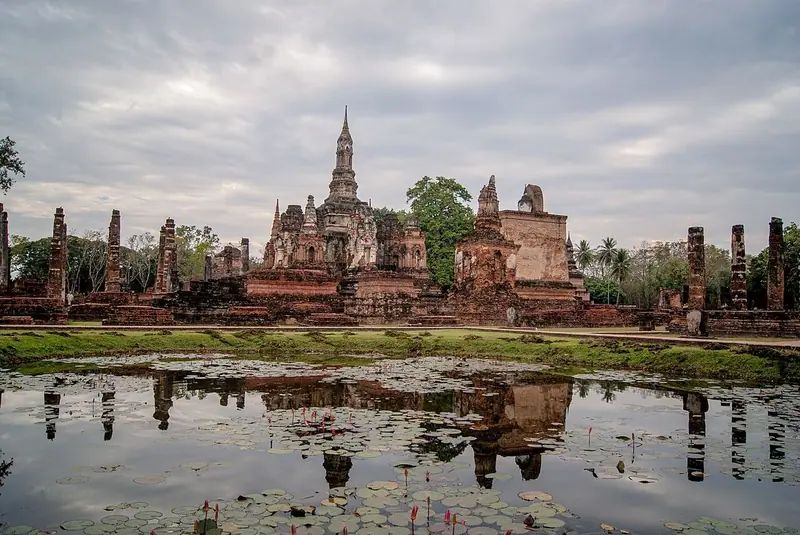 Sukhothai7 stops · c. 1238–1378 CE
Sukhothai Historical Park audio guide
Cycle the walled old city of Sukhothai, from the lotus-bud towers of Wat Mahathat to the great seated Buddha of Wat Si Chum.
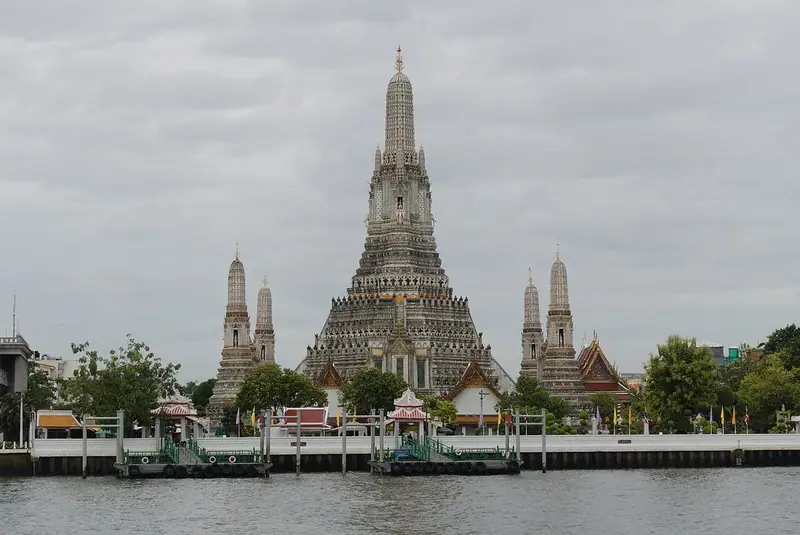 Chakri6 stops · from the Ayutthaya period; rebuilt 19th century
Wat Arun audio guide
Cross the Chao Phraya to the Temple of Dawn and climb its central prang, encrusted with porcelain and statues.
Every guide, in every country
Wat Pho and every other guide we publish, including future ones. One payment, no subscription.