Before you start
Stonehenge stands on Salisbury Plain in Wiltshire, about fifteen kilometres north of Salisbury, which has the nearest railway station. It is cared for by English Heritage, and the landscape around it belongs largely to the National Trust. Together with Avebury and the sites around them, it has been a UNESCO World Heritage Site since 1986. Your visit begins at the visitor centre, about two and a half kilometres west of the stones, where there is an exhibition and a group of reconstructed houses. From there a shuttle bus runs to the stones, or you can walk across the fields. A path loops around the circle, and visitors normally stay outside the stones. This guide follows the visitor centre first, then the path around the monument, before suggesting a return on foot across the landscape.
Use it as a self-guided tour of Stonehenge: 8 stops in visit order, each played when you’re ready, at your own pace.
 Free preview · Stop 1
The Visitor Centre Exhibition
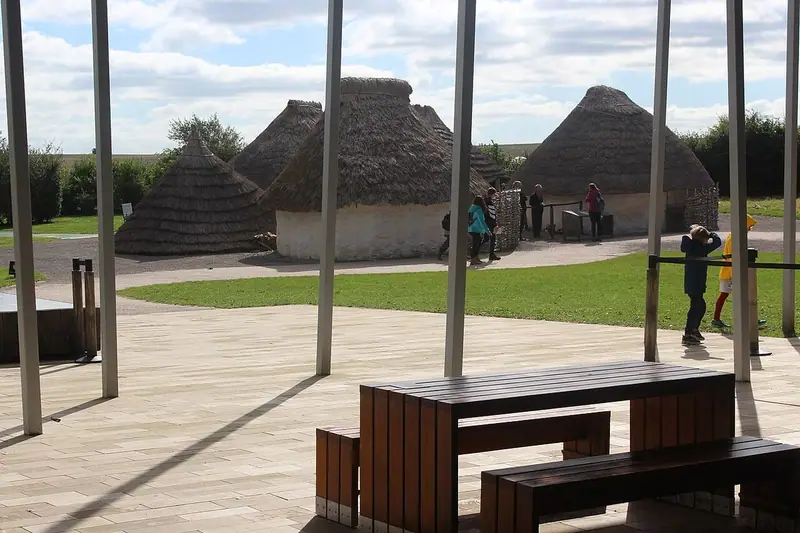
Start in the exhibition at the visitor centre, which sets the scene before you reach the monument. A large screen places you in the middle of the stones and shows how they have changed over thousands of years, as well as how the sun rises and sets along the monument’s axis at the solstices. The displays include objects found in the landscape around Stonehenge, such as tools, pottery and jewellery, and a facial reconstruction based on the skeleton of a Neolithic man buried nearby. Outside, look at the reconstructed Neolithic houses, based on the remains of houses excavated at Durrington Walls, a huge settlement about three kilometres north-east of Stonehenge. Nearby you can try pulling a replica sarsen on a wooden sledge, which helps you understand how much effort the builders needed to move the stones.
Photo: M J Roscoe · CC BY-SA 2.0 · Wikimedia Commons
What to see at Stonehenge: 8 stops, in visit order
- 01
 The Visitor Centre ExhibitionBefore you see the stonesFree preview
- 02
 The Heel Stone and the AvenueThe approach from the north-eastIn the guide
- 03
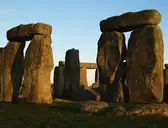 The Sarsen CircleStones and lintelsIn the guide
- 04
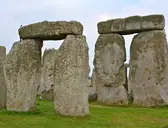 The TrilithonsThe giant horseshoeIn the guide
- 05
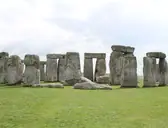 The BluestonesStones from WalesIn the guide
- 06
 The Bank, Ditch and Station StonesThe first StonehengeIn the guide
- 07
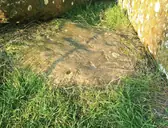 The Altar StoneA traveller from the far northIn the guide
- 08
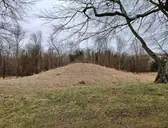 The Burial Mounds and the LandscapeThe sacred landscapeIn the guide
Site map of Stonehenge
History of Stonehenge
Stonehenge was built by the people of Neolithic and early Bronze Age Britain. The Neolithic, or New Stone Age, began in Britain around 4000 BCE, when farming communities arrived from continental Europe, bringing crops, cattle and pottery; it gave way to the Bronze Age from around 2500 to 2200 BCE, which lasted until about 800 BCE. Stonehenge was built in stages over more than a thousand years. Around 3000 BCE a circular ditch and bank were dug, and some of the bluestones may have been set up early on. The great sarsen circle and trilithons were raised around 2500 BCE, and the stones were rearranged several times afterwards, with the last major work around 1600 BCE. The first builders had no metal tools, and there is no evidence that they used wheels; they shaped the stones with stone hammers.
The full history continues in the guide.
Stonehenge guide: questions
How many stops does the Stonehenge guide have?
8 stops, in visit order: 1. The Visitor Centre Exhibition; 2. The Heel Stone and the Avenue; 3. The Sarsen Circle; 4. The Trilithons; 5. The Bluestones; 6. The Bank, Ditch and Station Stones; 7. The Altar Stone; 8. The Burial Mounds and the Landscape.
Can I do a self-guided tour of Stonehenge with this guide?
Yes. The guide is made for a self-guided tour: 8 stops in visit order, each with a photo, a story and a voice, so you can explore Stonehenge at your own pace, without joining a group. Download it before you go and it works offline.
How long is each guide?
The 8 stops add up to about 6 minutes of listening in total. You play each stop when you’re ready, so you can go at your own pace.
Does the guide work offline?
Yes, once it’s downloaded. The guide is a single self-contained web page (about 7.6 MB) with the photos, text and audio built in. Download it to your phone before you go (Wi-Fi is best); after that it opens in any modern browser on iPhone or Android, with no app, account or mobile signal needed.
Does it use GPS or need my location?
No. The guide doesn’t use GPS and doesn’t know where you are: you play each stop when you reach it. It works on iPhone and Android in any modern browser, and it’s in English.
What’s included?
One self-contained HTML guide: 8 stops in visit order, each with a photo, text and a voice, plus the story of who built the site.
Who built Stonehenge?
Stonehenge was built by the people of Neolithic and early Bronze Age Britain. The Neolithic, or New Stone Age, began in Britain around 4000 BCE, when farming communities arrived from continental Europe, bringing crops, cattle and pottery; it gave way to the Bronze Age from around 2500 to 2200 BCE, which lasted until about 800 BCE.
Where is Stonehenge?
Stonehenge stands on Salisbury Plain in Wiltshire, about fifteen kilometres north of Salisbury, which has the nearest railway station.
Is there a free audio guide to Stonehenge?
The first stop, The Visitor Centre Exhibition, is free to read and hear on this page, so you can try the Stonehenge audio tour before you buy. The full guide, with all 8 stops, is a one-off purchase: download it once and it’s yours to keep, working offline.
Is the Stonehenge guide worth it?
If you’d like to know what you’re looking at, yes. For $10 you get 8 stops in visit order, each with a photo, a short history and a voice you play when you’re ready, plus a site map of the stops, and about 6 minutes of listening in all. It’s short on purpose, so you spend your time looking, not listening. It’s yours to keep, works offline and needs no app. The first stop is free on this page, so you can try it before you buy. If you’d like hours of detail, a guided tour will go deeper.
Audio guide or guided tour?
It depends how you like to visit. This guide lets you explore Stonehenge at your own pace, at any time, for a one-off price. A guided tour gives you a live expert you can ask questions, but at fixed times and usually for a higher price. Many people use both: a tour for the big picture, and the guide to read beforehand or to revisit the stops in their own time.
Is this the official Stonehenge guide?
No. It’s an independent guide by The Historian Guide, not affiliated with or endorsed by the operator of Stonehenge. For tickets and opening hours, check the official site operator before you go.
Does the guide include entry tickets or opening hours?
No. The guide is a digital companion only. Admission to Stonehenge is separate, so check the official site operator for current tickets and opening hours before you go.
- Stop 1 · The Visitor Centre Exhibition: Neolithic replica houses, Stonehenge Visitor Centre by M J Roscoe · CC BY-SA 2.0 · Wikimedia Commons · resized
- Stop 2 · The Heel Stone and the Avenue: Andy Li · CC0 · Wikimedia Commons · resized
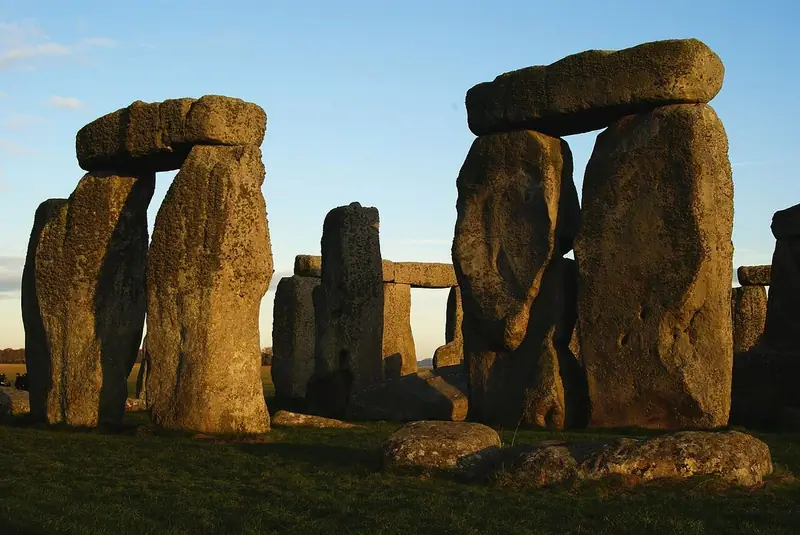
- Stop 3 · The Sarsen Circle (also the cover): Peter Trimming · CC BY-SA 2.0 · Wikimedia Commons · resized
- Stop 4 · The Trilithons: TobyEditor · CC BY 4.0 · Wikimedia Commons · resized
- Stop 5 · The Bluestones: Arian Zwegers from Brussels, Belgium · CC BY 2.0 · Wikimedia Commons · resized
- Stop 6 · The Bank, Ditch and Station Stones: Station stone, Stonehenge by Alan Hunt · CC BY-SA 2.0 · Wikimedia Commons · resized
- Stop 7 · The Altar Stone: The Stones of Stonehenge · CC BY 4.0 · Wikimedia Commons · resized
- Stop 8 · The Burial Mounds and the Landscape: Simon Burchell · CC BY-SA 4.0 · Wikimedia Commons · resized


All photographs from Wikimedia Commons under the licences shown.
More guides in United Kingdom
 Edwardian8 stops · 1295–1330
Beaumaris audio guide
Explore Edward I’s never-finished castle at the entrance to the Menai Strait, one of the most perfectly planned in Europe, then the old gaol and pier.
 Stuart and Georgian England9 stops · 1705 – 1722 (construction)
Blenheim Palace audio guide
The Baroque palace built for the Duke of Marlborough after the Battle of Blenheim, birthplace of Winston Churchill, set in a landscape park by Capability Brown.
 Georgian and Victorian Britain8 stops · Georgian and Victorian
The British Museum audio guide
Pass the portico and the Great Court to the Rosetta Stone, the winged bulls of Assyria, the Parthenon Sculptures and the Lewis Chessmen.
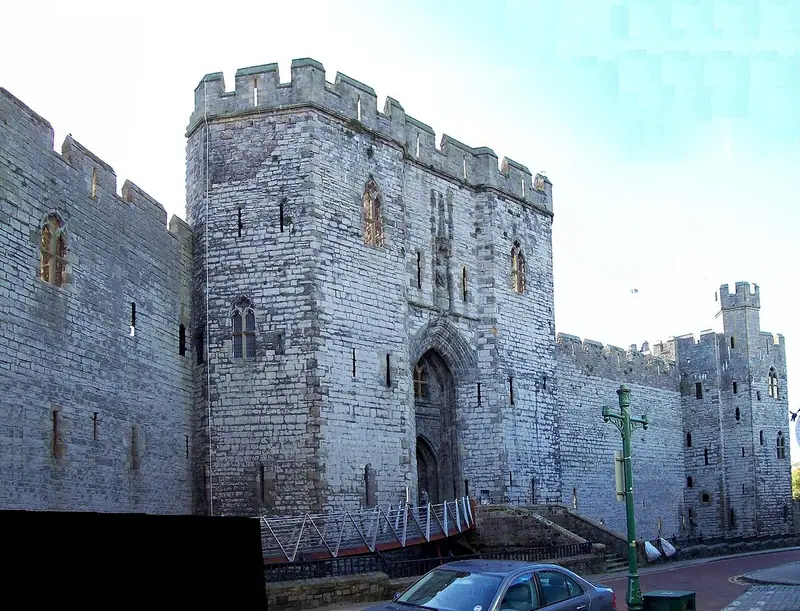 Plantagenet7 stops · 1283–1330
Caernarfon Castle audio guide
Edward I’s fortress-palace on the Menai Strait, with its banded walls and the Eagle Tower.
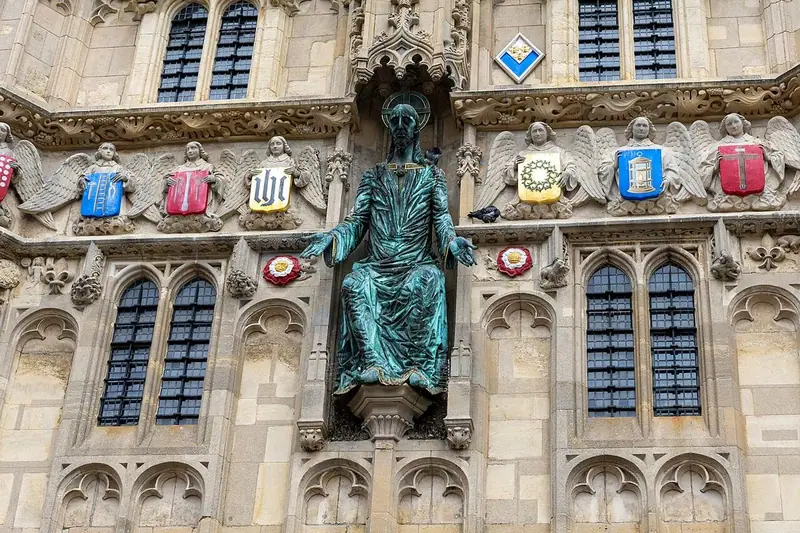 Gothic8 stops · 1070–1503
Canterbury Cathedral audio guide
Stand where Thomas Becket was murdered, then descend to the crypt and rise to the Trinity Chapel.
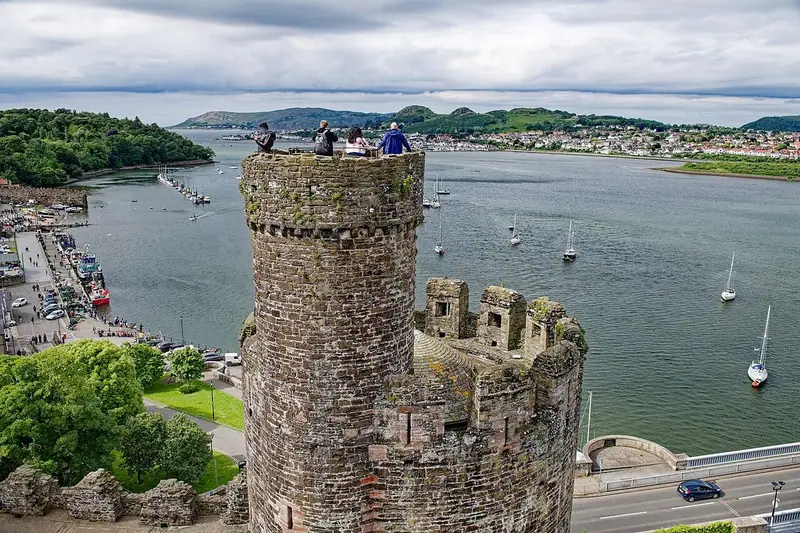 Plantagenet8 stops · 1283–1289
Conwy Castle and Town Walls audio guide
The walls of one of Europe’s finest medieval walled towns, and the mighty castle of Edward I above the River Conwy.
Every guide, in every country
Stonehenge and every other guide we publish, including future ones. One payment, no subscription.