Before you start
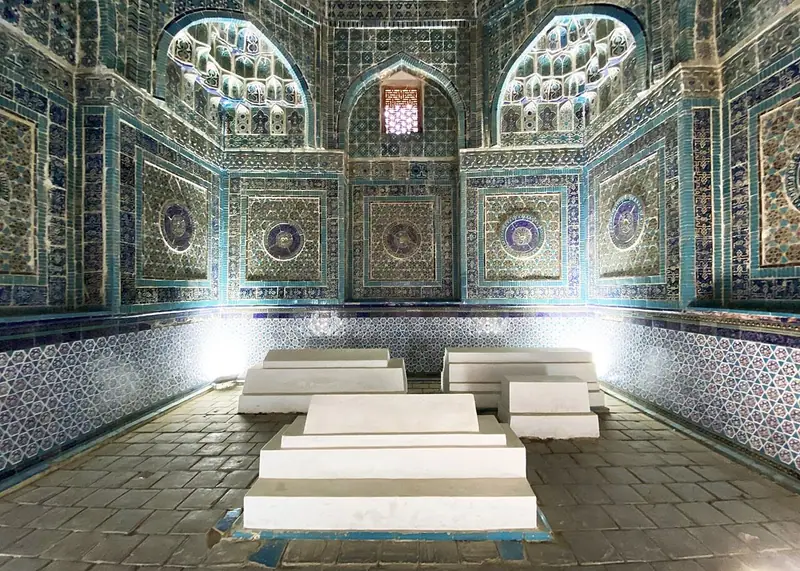
Shah-i-Zinda, the Living King, is a necropolis on the northeastern edge of Samarkand, where a narrow street of mausoleums climbs the slope of the ancient city of Afrasiab. Its tombs, built mostly in the fourteenth and fifteenth centuries for members of Timur’s family and court, are covered with some of the most beautiful glazed tilework in the Islamic world, in every shade of blue and turquoise. This guide climbs from the entrance gate, up the stairway and along the street of tombs to the shrine of Qusam ibn Abbas at the top. It is a place of pilgrimage as well as a monument, so dress modestly, speak quietly, and women may wish to cover their heads in the shrine.
Use it as a self-guided tour of Shah-i-Zinda: 7 stops in visit order, each played when you’re ready, at your own pace.
 Free preview · Stop 1
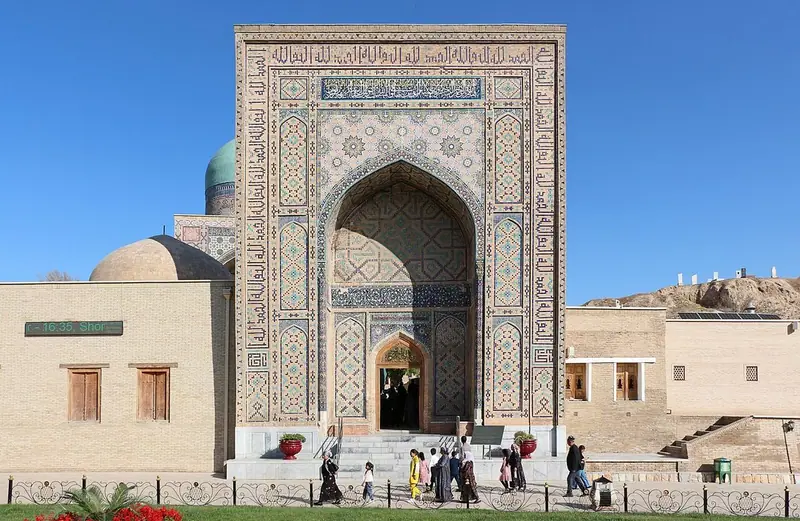
The Entrance Gate
Begin at the entrance gate at the foot of the slope, a tall portal decorated with glazed tilework and inscriptions. It was built in 1434 and 1435 under Ulugh Beg, Timur’s grandson and the ruler of Samarkand, and marks the start of the ensemble. Look at the tile panels on its facade, with their blue, white and turquoise patterns. Before you enter, look up at the slope ahead, which is the edge of Afrasiab, the ancient city of Samarkand that stood here before the Mongols destroyed it in 1220. The tombs were built against its old walls. The name of the ensemble, the Living King, comes from the legend of Qusam ibn Abbas, who, it was said, did not die but still lives in his tomb at the top. Walk through the gate and up to the stairway.
Photo: Bgag · CC0 · Wikimedia Commons
What to see at Shah-i-Zinda: 7 stops, in visit order
- 01
 The Entrance GateUlugh Beg’s PortalFree preview
- 02
 The StairwayThe Climb of PilgrimsIn the guide
- 03
 Qazi Zada RumiThe Astronomer’s TombIn the guide
- 04
 Shadi Mulk AkaTimur’s NieceIn the guide
- 05
 Shirin Bika AkaThe Sister’s TombIn the guide
- 06
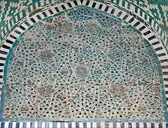 The Upper GroupThe Oldest TombsIn the guide
- 07
 Qusam ibn AbbasThe Living KingIn the guide
Site map of Shah-i-Zinda
History of Shah-i-Zinda
Shah-i-Zinda grew around the grave of Qusam ibn Abbas, a cousin of the Prophet Muhammad, who is said to have come to Samarkand in the seventh century to preach Islam. Its earliest buildings date from the eleventh and twelfth centuries, but most of its finest tombs were built by the Timurid Empire, the dynasty founded in 1370 by Timur, who made Samarkand his capital and ruled until his death in 1405. His descendants ruled Samarkand until the Uzbeks under Muhammad Shaybani conquered the city in the early sixteenth century, and the last Timurid states fell by 1507. Later centuries added little to the ensemble, which was restored in the Soviet period and again in recent years.
Shah-i-Zinda guide: questions
How many stops does the Shah-i-Zinda guide have?
7 stops, in visit order: 1. The Entrance Gate; 2. The Stairway; 3. Qazi Zada Rumi; 4. Shadi Mulk Aka; 5. Shirin Bika Aka; 6. The Upper Group; 7. Qusam ibn Abbas.
Can I do a self-guided tour of Shah-i-Zinda with this guide?
Yes. The guide is made for a self-guided tour: 7 stops in visit order, each with a photo, a story and a voice, so you can explore Shah-i-Zinda at your own pace, without joining a group. Download it before you go and it works offline.
How long is each guide?
The 7 stops add up to about 5 minutes of listening in total. You play each stop when you’re ready, so you can go at your own pace.
Does the guide work offline?
Yes, once it’s downloaded. The guide is a single self-contained web page (about 6.8 MB) with the photos, text and audio built in. Download it to your phone before you go (Wi-Fi is best); after that it opens in any modern browser on iPhone or Android, with no app, account or mobile signal needed.
Does it use GPS or need my location?
No. The guide doesn’t use GPS and doesn’t know where you are: you play each stop when you reach it. It works on iPhone and Android in any modern browser, and it’s in English.
What’s included?
One self-contained HTML guide: 7 stops in visit order, each with a photo, text and a voice, plus the story of who built the site.
Who built Shah-i-Zinda?
Shah-i-Zinda grew around the grave of Qusam ibn Abbas, a cousin of the Prophet Muhammad, who is said to have come to Samarkand in the seventh century to preach Islam. Its earliest buildings date from the eleventh and twelfth centuries, but most of its finest tombs were built by the Timurid Empire, the dynasty founded in 1370 by Timur, who made Samarkand his capital and ruled until his death in 1405.
Where is Shah-i-Zinda?
Shah-i-Zinda, the Living King, is a necropolis on the northeastern edge of Samarkand, where a narrow street of mausoleums climbs the slope of the ancient city of Afrasiab.
Is there a free audio guide to Shah-i-Zinda?
The first stop, The Entrance Gate, is free to read and hear on this page, so you can try the Shah-i-Zinda audio tour before you buy. The full guide, with all 7 stops, is a one-off purchase: download it once and it’s yours to keep, working offline.
Is the Shah-i-Zinda guide worth it?
If you’d like to know what you’re looking at, yes. For $10 you get 7 stops in visit order, each with a photo, a short history and a voice you play when you’re ready, plus a site map of the stops, and about 5 minutes of listening in all. It’s short on purpose, so you spend your time looking, not listening. It’s yours to keep, works offline and needs no app. The first stop is free on this page, so you can try it before you buy. If you’d like hours of detail, a guided tour will go deeper.
Audio guide or guided tour?
It depends how you like to visit. This guide lets you explore Shah-i-Zinda at your own pace, at any time, for a one-off price. A guided tour gives you a live expert you can ask questions, but at fixed times and usually for a higher price. Many people use both: a tour for the big picture, and the guide to read beforehand or to revisit the stops in their own time.
Is this the official Shah-i-Zinda guide?
No. It’s an independent guide by The Historian Guide, not affiliated with or endorsed by the operator of Shah-i-Zinda. For tickets and opening hours, check the official site operator before you go.
Does the guide include entry tickets or opening hours?
No. The guide is a digital companion only. Admission to Shah-i-Zinda is separate, so check the official site operator for current tickets and opening hours before you go.
- Stop 1 · The Entrance Gate: Bgag · CC0 · Wikimedia Commons · resized
- Stop 2 · The Stairway: David Revelj · CC BY-SA 3.0 · Wikimedia Commons · resized
- Stop 3 · Qazi Zada Rumi: Bgag · CC0 · Wikimedia Commons · resized
- Stop 4 · Shadi Mulk Aka (also the cover): Bgag · CC0 · Wikimedia Commons · resized
- Stop 5 · Shirin Bika Aka: Jean-Pierre Dalbéra from Paris, France · CC BY 2.0 · Wikimedia Commons · resized
- Stop 6 · The Upper Group: Jean-Pierre Dalbéra from Paris, France · CC BY 2.0 · Wikimedia Commons · resized
- Stop 7 · Qusam ibn Abbas: Davide Mauro · CC BY-SA 4.0 · Wikimedia Commons · resized


All photographs from Wikimedia Commons under the licences shown.
More guides in Uzbekistan
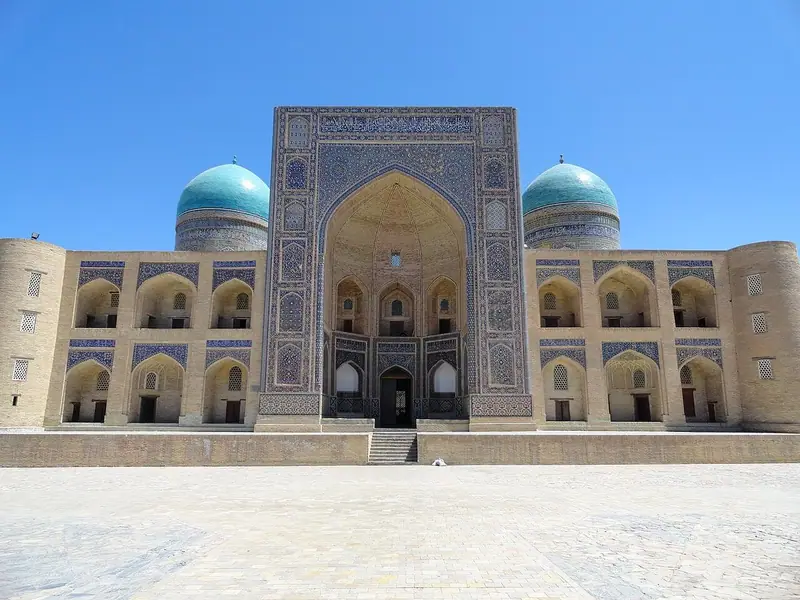 Shaybanid8 stops · 10th–19th century CE
Bukhara audio guide
A living Silk Road city of mosques, madrasas, bazaars and pools, from the Samanid Mausoleum and the Kalan Minaret to Lyab-i Hauz.
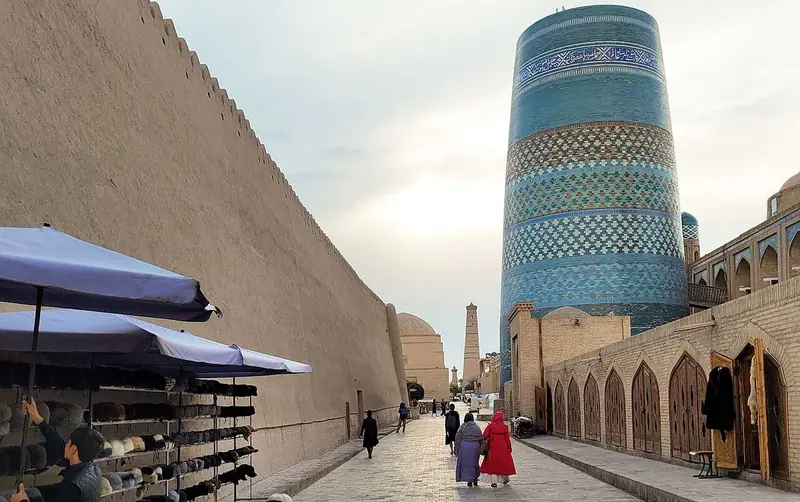 Khanate of Khiva7 stops · 17th–19th century CE
Khiva audio guide
Enter Itchan Kala, a walled mud-brick town rising from the Khorezm desert, through a maze of mosques, madrasas, minarets and palaces.
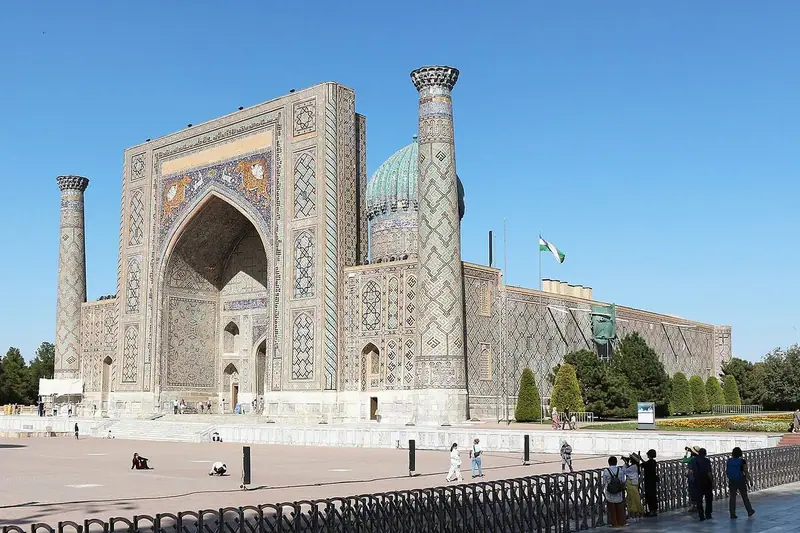 Timurid7 stops · 1370–17th century CE
Samarkand audio guide
From Timur’s tomb, the Gur-e-Amir, to the three madrasas of the Registan and the Bibi-Khanym Mosque.
Every guide, in every country
Shah-i-Zinda and every other guide we publish, including future ones. One payment, no subscription.