Before you start
Hội An Ancient Town is the old quarter of a historic trading port on the Thu Bồn River, near the coast of central Vietnam, about twenty-eight kilometres south of Đà Nẵng. From the sixteenth to the nineteenth centuries merchants from China, Japan and further afield traded and settled here, and their houses, assembly halls, temples and bridge still line its narrow streets. In 1999 UNESCO inscribed the town as a World Heritage Site, an exceptionally well-preserved Southeast Asian trading port. The compact streets are easy to explore on foot, and much of the centre is closed to cars and motorbikes at certain times. Many historic buildings are entered with the town’s heritage ticket, so check the current arrangements when you arrive. This route starts at the Japanese Covered Bridge, follows Trần Phú Street east past old houses, a museum, an assembly hall and a temple, and ends on the riverside.
Use it as a self-guided tour of Hội An Ancient Town: 6 stops in visit order, each played when you’re ready, at your own pace.
 Free preview · Stop 1
The Japanese Covered Bridge
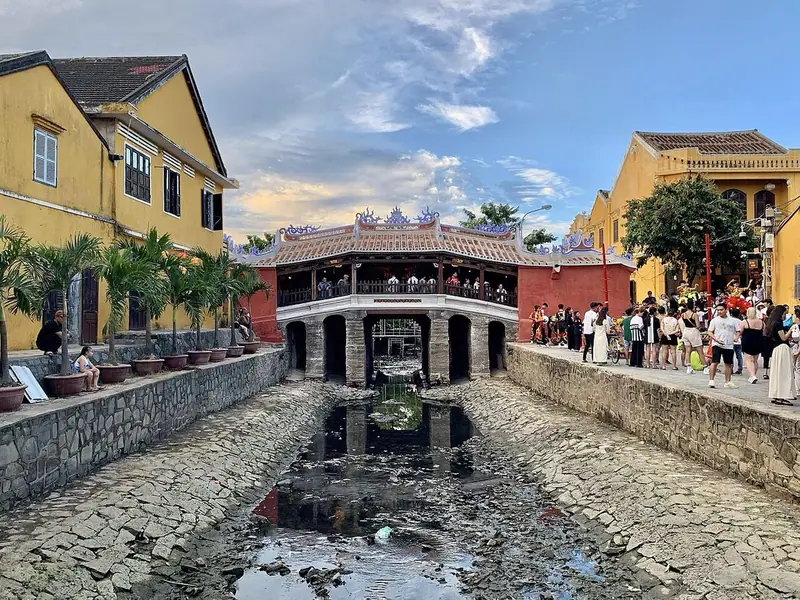
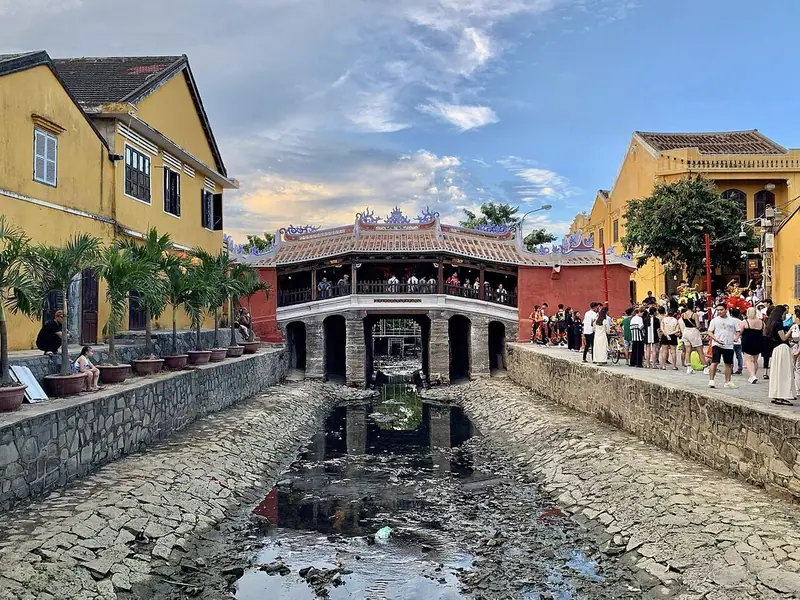
Begin at the western end of the old town, at the Japanese Covered Bridge, the symbol of Hội An. It crosses a small stream flowing into the Thu Bồn River, linking Trần Phú Street with Nguyễn Thị Minh Khai Street, and is about eighteen metres long, with a curved wooden roof. Tradition says it was built by Japanese merchants in the 1590s, though the evidence is not conclusive. A small temple, dedicated to a guardian god of the north, was added on the upstream side about half a century later. In 1719 the Nguyễn lord Nguyễn Phúc Chu named it Lai Viễn Kiều, the Bridge for Travellers from Afar; look for the plaque above the temple entrance. At the ends of the bridge stand carved statues of monkeys and dogs. The bridge has been repaired many times, and after a major restoration it reopened in August 2024.
Photo: Chainwit · CC BY 4.0 · Wikimedia Commons
What to see at Hội An Ancient Town: 6 stops, in visit order
- 01
 The Japanese Covered BridgeChùa CầuFree preview
- 02
 The Houses of Trần Phú StreetShops and homes of the merchantsIn the guide
- 03
 The Museum of Trade CeramicsTreasures of a trading portIn the guide
- 04
 The Fujian Assembly HallThe hall of the Fujian merchantsIn the guide
- 05
 The Quan Công TempleA temple of loyaltyIn the guide
- 06
 The RiversideThe old waterfrontIn the guide
Site map of Hội An Ancient Town
History of Hội An Ancient Town
Hội An was built by many peoples over many centuries. From around the second century the area belonged to the kingdom of Champa, whose ports traded along the maritime Silk Road. After the Vietnamese kingdom of Đại Việt conquered Champa in 1471, the region came under Vietnamese rule, and from the late sixteenth century the Nguyễn lords, who governed the south, encouraged foreign trade. Japanese merchants formed a quarter here in the early seventeenth century, and Chinese merchants, many of them from Fujian, settled in growing numbers, especially after the fall of the Ming dynasty in China. From the nineteenth century the silting of the river and the rise of Đà Nẵng ended Hội An’s great days as a port. Its decline spared the old town from modern redevelopment, and most of the houses seen today took their present form in the nineteenth century.
Hội An Ancient Town guide: questions
How many stops does the Hội An Ancient Town guide have?
6 stops, in visit order: 1. The Japanese Covered Bridge; 2. The Houses of Trần Phú Street; 3. The Museum of Trade Ceramics; 4. The Fujian Assembly Hall; 5. The Quan Công Temple; 6. The Riverside.
Can I do a self-guided tour of Hội An Ancient Town with this guide?
Yes. The guide is made for a self-guided tour: 6 stops in visit order, each with a photo, a story and a voice, so you can explore Hội An Ancient Town at your own pace, without joining a group. Download it before you go and it works offline.
How long is each guide?
The 6 stops add up to about 4 minutes of listening in total. You play each stop when you’re ready, so you can go at your own pace.
Does the guide work offline?
Yes, once it’s downloaded. The guide is a single self-contained web page (about 6.4 MB) with the photos, text and audio built in. Download it to your phone before you go (Wi-Fi is best); after that it opens in any modern browser on iPhone or Android, with no app, account or mobile signal needed.
Does it use GPS or need my location?
No. The guide doesn’t use GPS and doesn’t know where you are: you play each stop when you reach it. It works on iPhone and Android in any modern browser, and it’s in English.
What’s included?
One self-contained HTML guide: 6 stops in visit order, each with a photo, text and a voice, plus the story of who built the site.
Who built Hội An Ancient Town?
Hội An was built by many peoples over many centuries. From around the second century the area belonged to the kingdom of Champa, whose ports traded along the maritime Silk Road.
Where is Hội An Ancient Town?
Hội An Ancient Town is the old quarter of a historic trading port on the Thu Bồn River, near the coast of central Vietnam, about twenty-eight kilometres south of Đà Nẵng.
Is there a free audio guide to Hội An Ancient Town?
The first stop, The Japanese Covered Bridge, is free to read and hear on this page, so you can try the Hội An Ancient Town audio tour before you buy. The full guide, with all 6 stops, is a one-off purchase: download it once and it’s yours to keep, working offline.
Is the Hội An Ancient Town guide worth it?
If you’d like to know what you’re looking at, yes. For $10 you get 6 stops in visit order, each with a photo, a short history and a voice you play when you’re ready, plus a site map of the stops, and about 4 minutes of listening in all. It’s short on purpose, so you spend your time looking, not listening. It’s yours to keep, works offline and needs no app. The first stop is free on this page, so you can try it before you buy. If you’d like hours of detail, a guided tour will go deeper.
Audio guide or guided tour?
It depends how you like to visit. This guide lets you explore Hội An Ancient Town at your own pace, at any time, for a one-off price. A guided tour gives you a live expert you can ask questions, but at fixed times and usually for a higher price. Many people use both: a tour for the big picture, and the guide to read beforehand or to revisit the stops in their own time.
Is this the official Hội An Ancient Town guide?
No. It’s an independent guide by The Historian Guide, not affiliated with or endorsed by the operator of Hội An Ancient Town. For tickets and opening hours, check the official site operator before you go.
Does the guide include entry tickets or opening hours?
No. The guide is a digital companion only. Admission to Hội An Ancient Town is separate, so check the official site operator for current tickets and opening hours before you go.
- Stop 1 · The Japanese Covered Bridge (also the cover): Chainwit. · CC BY 4.0 · Wikimedia Commons · resized
- Stop 2 · The Houses of Trần Phú Street: David McKelvey from Brisbane, Australia · CC BY 2.0 · Wikimedia Commons · resized
- Stop 3 · The Museum of Trade Ceramics: © Steffen Schmitz (Carschten) / Wikimedia Commons · CC BY-SA 4.0 · Wikimedia Commons · resized
- Stop 4 · The Fujian Assembly Hall: Suicasmo · CC BY-SA 4.0 · Wikimedia Commons · resized
- Stop 5 · The Quan Công Temple: P. Hughes · CC BY 4.0 · Wikimedia Commons · resized
- Stop 6 · The Riverside: Alexkom000 · CC BY 4.0 · Wikimedia Commons · resized


All photographs from Wikimedia Commons under the licences shown.
More guides in Vietnam
 Vietnamese7 stops · 1010–1802 CE
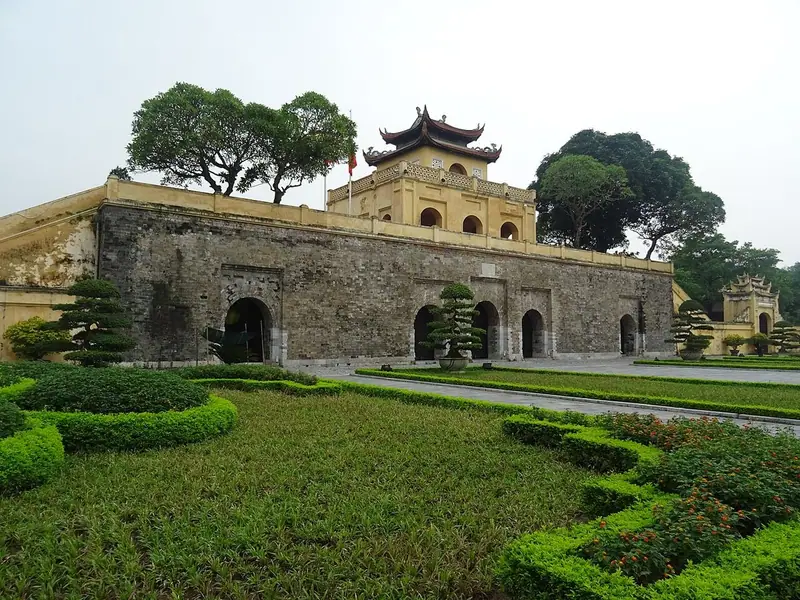
Imperial Citadel of Thăng Long audio guide
Explore the seat of Vietnamese kings for almost eight centuries in central Hà Nội, from the Flag Tower and Đoan Môn to the Dragon Steps.
 Nguyễn7 stops · 1802–1945 CE
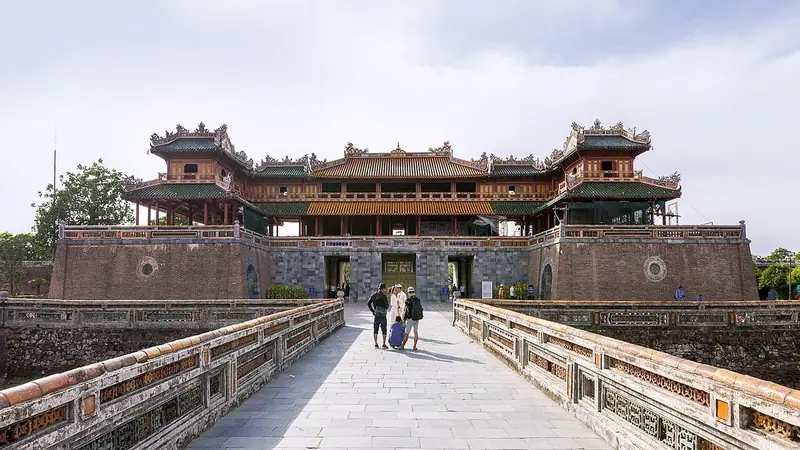
Imperial City of Huế audio guide
Pass the Meridian Gate into the walled palace of Vietnam’s last emperors, to the Hall of Supreme Harmony and the Purple Forbidden City.
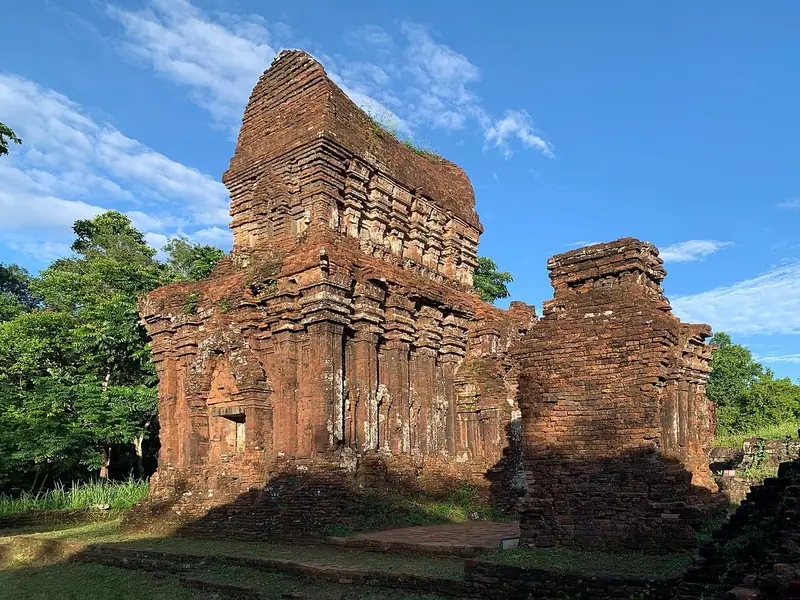 Champa7 stops · c. 400–1243 CE
Mỹ Sơn Sanctuary audio guide
Explore the ruined brick Hindu temples of Champa’s holiest valley, ringed by mountains in central Vietnam.
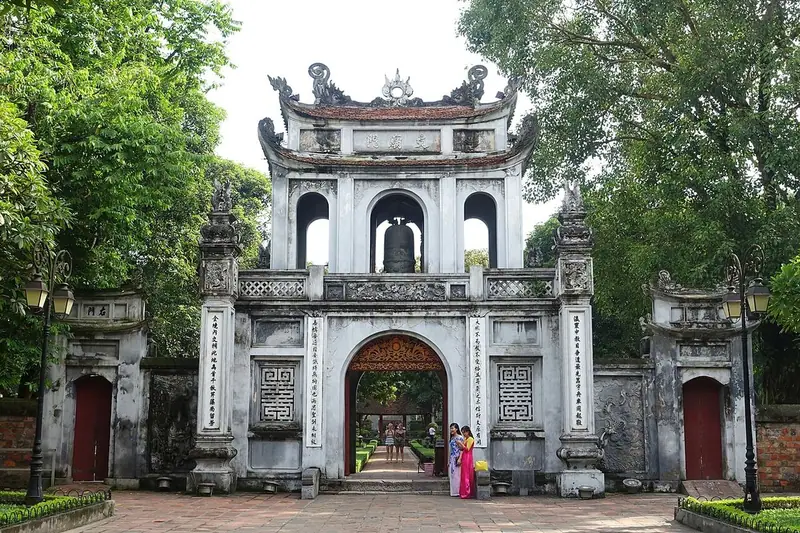 Vietnamese6 stops · 1070–1779 CE
Temple of Literature audio guide
Pass through the courtyards of Vietnam’s first university to the Constellation of Literature Pavilion and the stelae of the doctors.
Every guide, in every country
Hội An Ancient Town and every other guide we publish, including future ones. One payment, no subscription.