Before you start
For four years during the First World War, the old Flemish cloth town of Ypres, known in Dutch as Ieper, stood at the heart of a bulge in the Allied front line called the Ypres Salient. Hundreds of thousands of soldiers from Britain, the Commonwealth, France, Belgium and Germany died in the fields around it, and the town itself was reduced to rubble. This guide begins at the Menin Gate in Ypres and circles through the battlefields to the north and east, by the dressing station where John McCrae wrote In Flanders Fields, the German cemetery at Langemark, the Canadian memorial at St Julien, Tyne Cot, Polygon Wood and Hill 60. The route is about forty kilometres and is best followed by car or bicycle; allow a full day, and return to the Menin Gate for the Last Post at eight in the evening.
Use it as a self-guided tour of Ypres and Flanders Fields: 7 stops in visit order, each played when you’re ready, at your own pace.
 Free preview · Stop 1
The Menin Gate
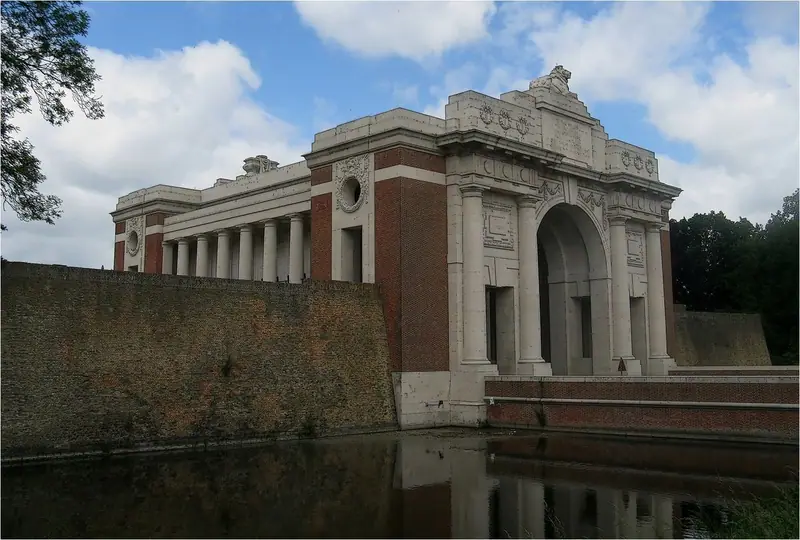
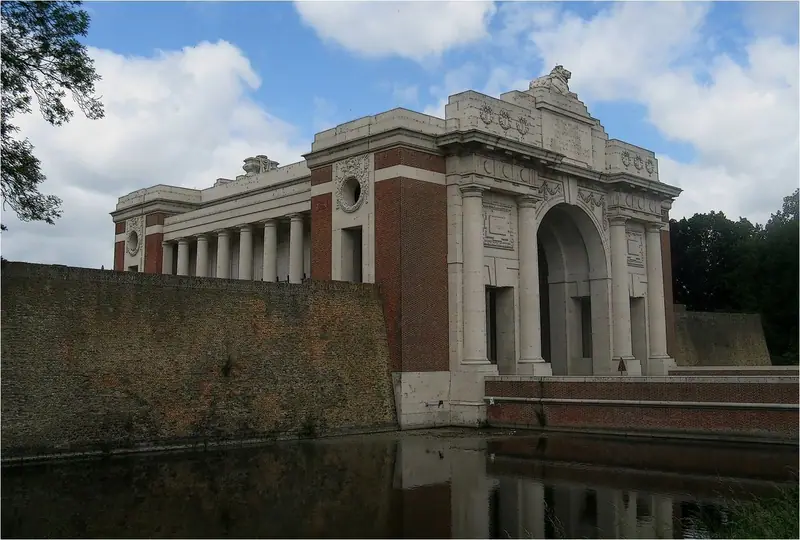
The road east from Ypres to the town of Menen passed through a gap in the old ramparts here, and hundreds of thousands of soldiers marched through it on their way to the front. After the war, a great memorial arch was built on the spot, designed by Sir Reginald Blomfield and unveiled on 24 July 1927. Its Hall of Memory is carved with the names of more than fifty-four thousand soldiers of the British Empire who died in the Salient and have no known grave. Even so, it proved too small, and the names of many of the missing who died after mid-August 1917 were carved instead at Tyne Cot. Every evening at eight o’clock, the road beneath the arch is closed and buglers sound the Last Post, a ceremony held since 1928 and interrupted only during the German occupation of the Second World War. Nearby, in the market square, stands the Cloth Hall, rebuilt after the war and now home to the In Flanders Fields Museum. From the Menin Gate, drive north along the canal towards Boezinge to Essex Farm.
Photo: agracier · CC BY-SA 3.0 · Wikimedia Commons
What to see at Ypres and Flanders Fields: 7 stops, in visit order
- 01
 The Menin GateThe memorial to the missingFree preview
- 02
 Essex FarmIn Flanders FieldsIn the guide
- 03
 The German Cemetery at LangemarkThe fallen of the other sideIn the guide
- 04
 The St Julien MemorialThe Brooding SoldierIn the guide
- 05
 Tyne CotThe largest Commonwealth war cemeteryIn the guide
- 06
 Polygon WoodThe Australian battlefieldIn the guide
- 07
 Hill 60The underground warIn the guide
Site map of Ypres and Flanders Fields
History of Ypres and Flanders Fields
In the Middle Ages, Ypres was one of the great cloth-making cities of Flanders, and its vast Cloth Hall was built between about 1200 and 1304. In the seventeenth century the French engineer Vauban surrounded it with ramparts. When Germany invaded Belgium in August 1914, Ypres lay in the path of its armies heading for the Channel ports. In the First Battle of Ypres, in October and November 1914, the Allies held the town, and the front settled into a salient curving around it to the east. In April 1915, at the start of the Second Battle of Ypres, the German army released poison gas for the first time on the Western Front. In 1917 came the Third Battle of Ypres, also called Passchendaele, fought from July to November in deep mud, in which the Allies advanced only a few miles at a terrible cost.
The full history continues in the guide.
Ypres and Flanders Fields guide: questions
How many stops does the Ypres and Flanders Fields guide have?
7 stops, in visit order: 1. The Menin Gate; 2. Essex Farm; 3. The German Cemetery at Langemark; 4. The St Julien Memorial; 5. Tyne Cot; 6. Polygon Wood; 7. Hill 60.
Can I do a self-guided tour of Ypres and Flanders Fields with this guide?
Yes. The guide is made for a self-guided tour: 7 stops in visit order, each with a photo, a story and a voice, so you can explore Ypres and Flanders Fields at your own pace, without joining a group. Download it before you go and it works offline.
How long is each guide?
The 7 stops add up to about 5 minutes of listening in total. You play each stop when you’re ready, so you can go at your own pace.
Does the guide work offline?
Yes, once it’s downloaded. The guide is a single self-contained web page (about 6.9 MB) with the photos, text and audio built in. Download it to your phone before you go (Wi-Fi is best); after that it opens in any modern browser on iPhone or Android, with no app, account or mobile signal needed.
Does it use GPS or need my location?
No. The guide doesn’t use GPS and doesn’t know where you are: you play each stop when you reach it. It works on iPhone and Android in any modern browser, and it’s in English.
What’s included?
One self-contained HTML guide: 7 stops in visit order, each with a photo, text and a voice, plus the story of who built the site.
Who built Ypres and Flanders Fields?
In the Middle Ages, Ypres was one of the great cloth-making cities of Flanders, and its vast Cloth Hall was built between about 1200 and 1304. In the seventeenth century the French engineer Vauban surrounded it with ramparts.
Where is Ypres and Flanders Fields?
For four years during the First World War, the old Flemish cloth town of Ypres, known in Dutch as Ieper, stood at the heart of a bulge in the Allied front line called the Ypres Salient.
Is there a free audio guide to Ypres and Flanders Fields?
The first stop, The Menin Gate, is free to read and hear on this page, so you can try the Ypres and Flanders Fields audio tour before you buy. The full guide, with all 7 stops, is a one-off purchase: download it once and it’s yours to keep, working offline.
Is the Ypres and Flanders Fields guide worth it?
If you’d like to know what you’re looking at, yes. For $10 you get 7 stops in visit order, each with a photo, a short history and a voice you play when you’re ready, plus a site map of the stops, and about 5 minutes of listening in all. It’s short on purpose, so you spend your time looking, not listening. It’s yours to keep, works offline and needs no app. The first stop is free on this page, so you can try it before you buy. If you’d like hours of detail, a guided tour will go deeper.
Audio guide or guided tour?
It depends how you like to visit. This guide lets you explore Ypres and Flanders Fields at your own pace, at any time, for a one-off price. A guided tour gives you a live expert you can ask questions, but at fixed times and usually for a higher price. Many people use both: a tour for the big picture, and the guide to read beforehand or to revisit the stops in their own time.
Is this the official Ypres and Flanders Fields guide?
No. It’s an independent guide by The Historian Guide, not affiliated with or endorsed by the operator of Ypres and Flanders Fields. For tickets and opening hours, check the official site operator before you go.
Does the guide include entry tickets or opening hours?
No. The guide is a digital companion only. Admission to Ypres and Flanders Fields is separate, so check the official site operator for current tickets and opening hours before you go.
- Stop 1 · The Menin Gate (also the cover): agracier · CC BY-SA 3.0 · Wikimedia Commons · resized
- Stop 2 · Essex Farm: Wernervc · CC BY-SA 3.0 · Wikimedia Commons · resized
- Stop 3 · The German Cemetery at Langemark: Davidh820 · CC BY-SA 3.0 · Wikimedia Commons · resized
- Stop 4 · The St Julien Memorial: Zeisterre · CC BY-SA 3.0 · Wikimedia Commons · resized
- Stop 5 · Tyne Cot: Tony Grist · Public domain · Wikimedia Commons · resized
- Stop 6 · Polygon Wood: Nenea hartia · CC BY-SA 4.0 · Wikimedia Commons · resized
- Stop 7 · Hill 60: Pierre André Leclercq · CC BY-SA 4.0 · Wikimedia Commons · resized


All photographs from Wikimedia Commons under the licences shown.
More guides in Belgium
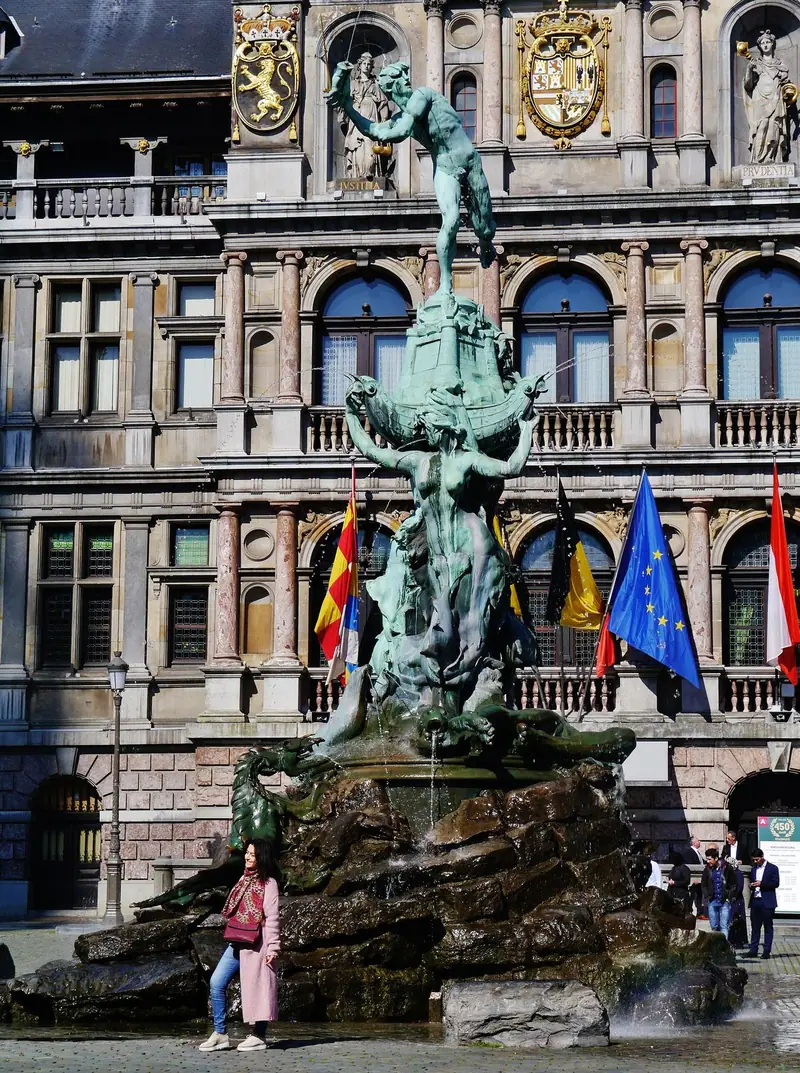 Flemish6 stops · 1200–1640
Antwerp Old City audio guide
From the railway cathedral of Central Station to the house and garden of Rubens, the Plantin-Moretus printing house, the Cathedral of Our Lady, the Grote Markt and the riverside castle of Het Steen.
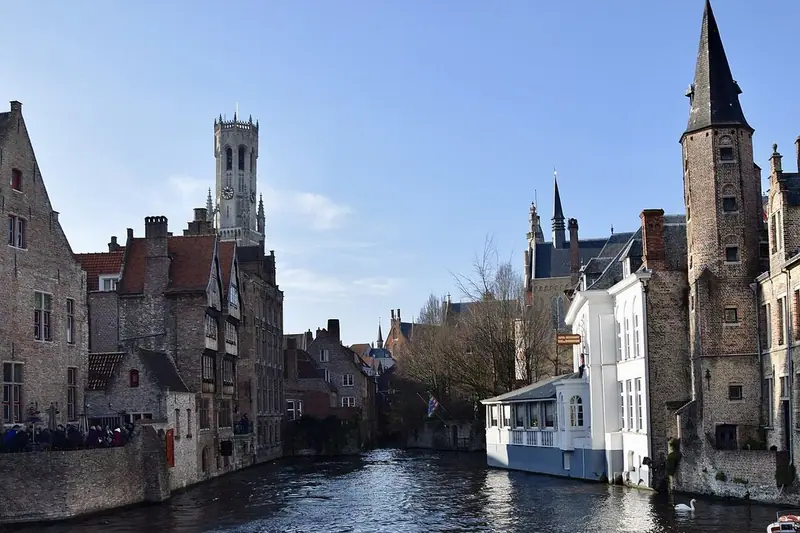 Medieval9 stops · 12th–15th century
Bruges audio guide
A web of canals, cobbled lanes and brick gables, from the Markt and the Belfry to the beguinage by the Minnewater.
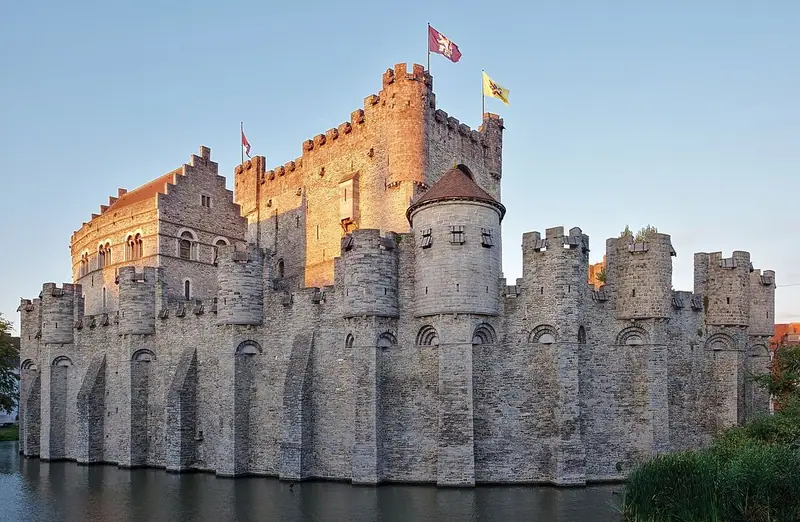 Medieval8 stops · 12th–15th century
Ghent audio guide
Ghent’s medieval heart, from St Bavo’s Cathedral and the Belfry to the Graslei and Korenlei quays and the castle of the Gravensteen.
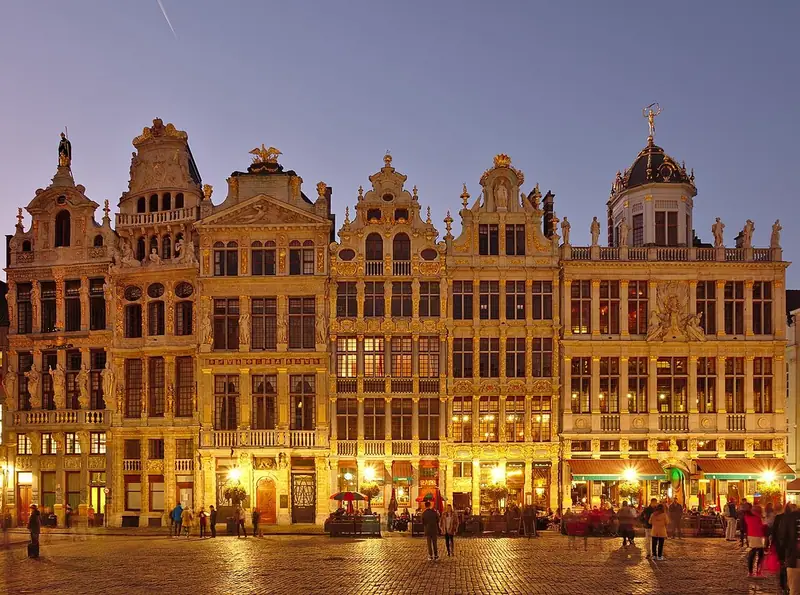 Gothic8 stops · 15th–17th century
Grand-Place, Brussels audio guide
Stand in one of Europe’s most beautiful squares, framed by the Gothic Town Hall and gilded guild houses, then seek out the Manneken Pis.
Every guide, in every country
Ypres and Flanders Fields and every other guide we publish, including future ones. One payment, no subscription.