Before you start
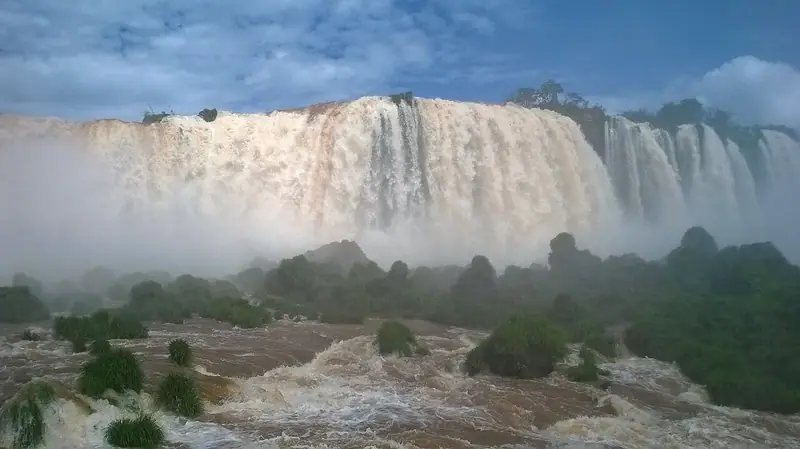
On the border between Brazil and Argentina, the Iguaçu River plunges over a great curving cliff, in hundreds of separate falls, to form the largest waterfall system in the world. The falls lie within two national parks, Iguaçu in Brazil and Iguazú in Argentina, both World Heritage Sites, surrounded by subtropical Atlantic Forest. Most of the falls are on the Argentine side, so the Brazilian side offers the best panoramic views. This guide follows the Falls Trail on the Brazilian side, a route of a little over a kilometre along the canyon, ending on the walkway at the Devil’s Throat. Expect to get wet near the falls, so bring a waterproof jacket and protect your camera and phone.
Use it as a self-guided tour of the Iguaçu Falls: 7 stops in visit order, each played when you’re ready, at your own pace.
 Free preview · Stop 1
Into the National Park
Begin as the park bus carries you through the forest towards the start of the Falls Trail. Private vehicles are not allowed in the park, to protect it. Iguaçu National Park covers more than one hundred and eighty thousand hectares, and together with the Argentine park, it protects one of the largest surviving areas of Atlantic Forest, a habitat that once covered much of the Brazilian coast and interior. Look out for wildlife. Rare animals such as the jaguar and the tapir live deep in the forest, though you are unlikely to see them. You are more likely to meet the South American coati, a long-nosed relative of the raccoon, with a striped tail, which often wanders near the paths. Do not feed the coatis, and keep your food out of sight; they can scratch and bite. Look too for colourful butterflies.
Photo: TontiTonti · CC BY-SA 3.0 · Wikimedia Commons
What to see at the Iguaçu Falls: 7 stops, in visit order
- 01
 Into the National ParkThe Atlantic ForestFree preview
- 02
 The First ViewA Wall of WaterIn the guide
- 03
 The Lower CanyonThe River BelowIn the guide
- 04
 The Shape of the FallsBasalt StepsIn the guide
- 05
 Salto FlorianoClose to the FallsIn the guide
- 06
 The WalkwayOver the RiverIn the guide
- 07
 The Devil’s ThroatThe Heart of the FallsIn the guide
Site map of the Iguaçu Falls
History of the Iguaçu Falls
Iguaçu means big water, from the Guarani or Tupi language. A Guarani legend tells how a god planned to marry a beautiful woman named Naipí, but she fled in a canoe with her mortal lover, Tarobá; in his rage, the god split the river, creating the falls and condemning the lovers to fall for ever. In 1541 the Spanish conquistador Álvar Núñez Cabeza de Vaca became the first European to write about the falls. In 1876, the Brazilian engineer André Rebouças proposed protecting the falls in a national park, and Iguaçu National Park was finally created in 1939.
Iguaçu Falls guide: questions
How many stops does the Iguaçu Falls guide have?
7 stops, in visit order: 1. Into the National Park; 2. The First View; 3. The Lower Canyon; 4. The Shape of the Falls; 5. Salto Floriano; 6. The Walkway; 7. The Devil’s Throat.
Can I do a self-guided tour of the Iguaçu Falls with this guide?
Yes. The guide is made for a self-guided tour: 7 stops in visit order, each with a photo, a story and a voice, so you can explore the Iguaçu Falls at your own pace, without joining a group. Download it before you go and it works offline.
How long is each guide?
The 7 stops add up to about 5 minutes of listening in total. You play each stop when you’re ready, so you can go at your own pace.
Does the guide work offline?
Yes, once it’s downloaded. The guide is a single self-contained web page (about 6.0 MB) with the photos, text and audio built in. Download it to your phone before you go (Wi-Fi is best); after that it opens in any modern browser on iPhone or Android, with no app, account or mobile signal needed.
Does it use GPS or need my location?
No. The guide doesn’t use GPS and doesn’t know where you are: you play each stop when you reach it. It works on iPhone and Android in any modern browser, and it’s in English.
What’s included?
One self-contained HTML guide: 7 stops in visit order, each with a photo, text and a voice, plus the story of who built the site.
Who built the Iguaçu Falls?
Iguaçu means big water, from the Guarani or Tupi language. A Guarani legend tells how a god planned to marry a beautiful woman named Naipí, but she fled in a canoe with her mortal lover, Tarobá; in his rage, the god split the river, creating the falls and condemning the lovers to fall for ever.
Where is the Iguaçu Falls?
On the border between Brazil and Argentina, the Iguaçu River plunges over a great curving cliff, in hundreds of separate falls, to form the largest waterfall system in the world.
Is there a free audio guide to the Iguaçu Falls?
The first stop, Into the National Park, is free to read and hear on this page, so you can try the Iguaçu Falls audio tour before you buy. The full guide, with all 7 stops, is a one-off purchase: download it once and it’s yours to keep, working offline.
Is the Iguaçu Falls guide worth it?
If you’d like to know what you’re looking at, yes. For $10 you get 7 stops in visit order, each with a photo, a short history and a voice you play when you’re ready, plus a site map of the stops, and about 5 minutes of listening in all. It’s short on purpose, so you spend your time looking, not listening. It’s yours to keep, works offline and needs no app. The first stop is free on this page, so you can try it before you buy. If you’d like hours of detail, a guided tour will go deeper.
Audio guide or guided tour?
It depends how you like to visit. This guide lets you explore the Iguaçu Falls at your own pace, at any time, for a one-off price. A guided tour gives you a live expert you can ask questions, but at fixed times and usually for a higher price. Many people use both: a tour for the big picture, and the guide to read beforehand or to revisit the stops in their own time.
Is this the official Iguaçu Falls guide?
No. It’s an independent guide by The Historian Guide, not affiliated with or endorsed by the operator of the Iguaçu Falls. For tickets and opening hours, check the official site operator before you go.
Does the guide include entry tickets or opening hours?
No. The guide is a digital companion only. Admission to the Iguaçu Falls is separate, so check the official site operator for current tickets and opening hours before you go.
- Stop 1 · Into the National Park: TontiTonti · CC BY-SA 3.0 · Wikimedia Commons · resized
- Stop 2 · The First View: Martin St-Amant (S23678) · CC BY-SA 3.0 · Wikimedia Commons · resized
- Stop 3 · The Lower Canyon: Leo Vitoriano Rolim · CC BY-SA 4.0 · Wikimedia Commons · resized
- Stop 4 · The Shape of the Falls: Aerial Foz de Iguaçu 26 Nov 2005.jpg: Mario Roberto Durán Ortiz (Mariordo) · CC BY 3.0 · Wikimedia Commons · resized
- Stop 5 · Salto Floriano: Falk2 · CC BY-SA 4.0 · Wikimedia Commons · resized
- Stop 6 · The Walkway: Aalcino · CC BY-SA 4.0 · Wikimedia Commons · resized
- Stop 7 · The Devil’s Throat (also the cover): Luciana Lange Bassani · CC BY-SA 3.0 · Wikimedia Commons · resized


All photographs from Wikimedia Commons under the licences shown.
More guides in Brazil
 Modern7 stops · 1922–1931 CE
Christ the Redeemer audio guide
Ride up through the Tijuca Forest to the soapstone-clad statue on Corcovado, with Sugarloaf and Guanabara Bay spread out below.
 Portuguese Colonial9 stops · 1698 – 1897
Ouro Preto audio guide
Brazil’s gold-rush capital: Praça Tiradentes, the Inconfidência museum, Aleijadinho’s São Francisco, Ataíde’s painted ceiling and the gilded churches of the Pilar and Rosário.
 Portuguese Colonial8 stops · 1549–1763 CE
Pelourinho, Salvador audio guide
Ride the Lacerda Elevator up to Salvador’s cobbled old town, with its painted houses and some of the richest Baroque churches in the Americas.
 Natural wonder7 stops
Sugarloaf Mountain audio guide
Ride Brazil’s first cable car from Praia Vermelha via Morro da Urca to the granite summit above the mouth of Guanabara Bay.
Every guide, in every country
Iguaçu Falls and every other guide we publish, including future ones. One payment, no subscription.