Before you start
Gondar, north of Lake Tana in the Ethiopian highlands, was the capital of the Ethiopian emperors from the seventeenth century, and its battlemented castles have earned it the nickname of the Camelot of Africa. The royal enclosure, Fasil Ghebbi, with the bath of Fasilides and other monuments of the city, has been a World Heritage Site since 1979. This guide leads through the royal enclosure, from the first castle to the palace of an empress, then visits the bath of Fasilides and ends at the painted church of Debre Berhan Selassie. The bath and the church are a short drive from the enclosure. Dress modestly and remove your shoes in the church.
Use it as a self-guided tour of Gondar: 8 stops in visit order, each played when you’re ready, at your own pace.
 Free preview · Stop 1
Fasilides’ Castle
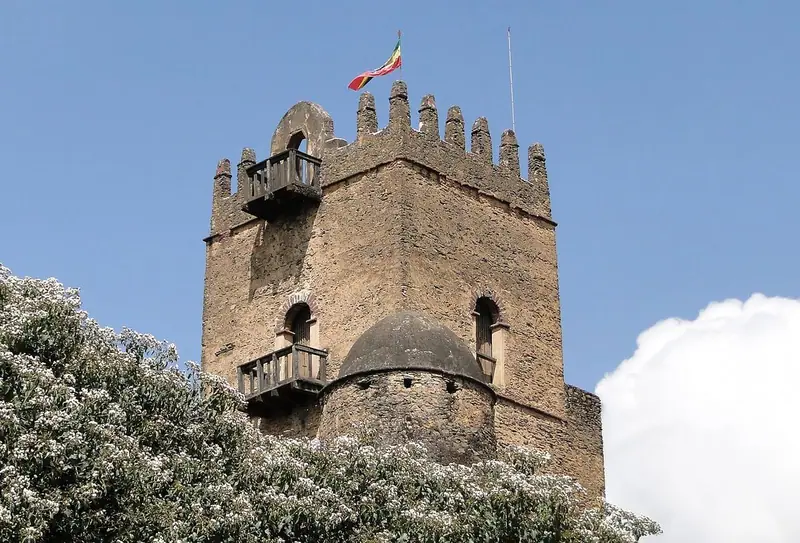
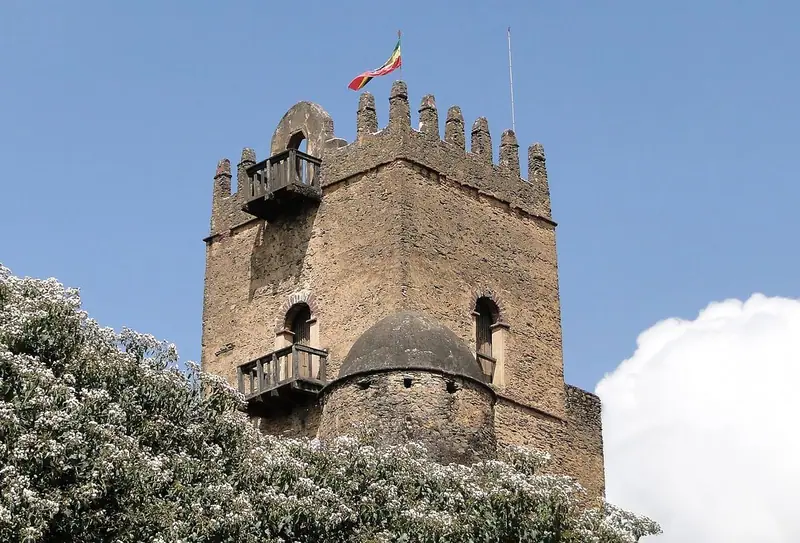
Begin at the castle of Fasilides, the oldest and grandest building in the royal enclosure, built for the emperor who founded Gondar as his capital. Look at its high walls of brown stone, its battlements, and its towers, the tallest rising above the rest, with domed turrets at the corners. According to a Yemeni ambassador who visited in 1648, when the castle was only a few years old, its builder was an Indian named Abdal Kerim. The ambassador called it one of the most marvellous of buildings, and admired its beds from Constantinople and its furnishings glittering with gold. Notice the decorative details picked out in reddish volcanic stone, and the wooden balconies. The castle was restored in the twentieth century, including during the Italian occupation of the late 1930s.
Photo: Bernard Gagnon · CC BY-SA 3.0 · Wikimedia Commons
What to see at Gondar: 8 stops, in visit order
- 01
 Fasilides’ CastleThe First CastleFree preview
- 02
 The Library of Yohannes IBooks and GovernmentIn the guide
- 03
 Iyasu’s PalaceA Palace of SplendourIn the guide
- 04
 Bakaffa’s Banqueting HallFeasts and CeremoniesIn the guide
- 05
 Mentewab’s CastleThe EmpressIn the guide
- 06
 The Bath of FasilidesA Pool for EpiphanyIn the guide
- 07
 Debre Berhan SelassieThe Mountain of LightIn the guide
- 08
 The Painted CeilingAngels of GondarIn the guide
Site map of Gondar
History of Gondar
Before the seventeenth century, Ethiopian emperors had no fixed capital, and moved around their lands with a great camp of tents. Emperor Fasilides broke with this custom and chose Gondar as his capital in 1636. His successors, among them Yohannes I, Iyasu I, Dawit III, Bakaffa and Empress Mentewab, each added their own buildings to the royal enclosure, which grew to cover about seven hectares. The buildings mix local traditions with Indian, Arab and Portuguese influences, and much of the work was done by skilled craftsmen of the Beta Israel, the Ethiopian Jewish community. Gondar declined in the nineteenth century, and was sacked by Sudanese Mahdist forces in 1888.
Gondar guide: questions
How many stops does the Gondar guide have?
8 stops, in visit order: 1. Fasilides’ Castle; 2. The Library of Yohannes I; 3. Iyasu’s Palace; 4. Bakaffa’s Banqueting Hall; 5. Mentewab’s Castle; 6. The Bath of Fasilides; 7. Debre Berhan Selassie; 8. The Painted Ceiling.
Can I do a self-guided tour of Gondar with this guide?
Yes. The guide is made for a self-guided tour: 8 stops in visit order, each with a photo, a story and a voice, so you can explore Gondar at your own pace, without joining a group. Download it before you go and it works offline.
How long is each guide?
The 8 stops add up to about 6 minutes of listening in total. You play each stop when you’re ready, so you can go at your own pace.
Does the guide work offline?
Yes, once it’s downloaded. The guide is a single self-contained web page (about 7.9 MB) with the photos, text and audio built in. Download it to your phone before you go (Wi-Fi is best); after that it opens in any modern browser on iPhone or Android, with no app, account or mobile signal needed.
Does it use GPS or need my location?
No. The guide doesn’t use GPS and doesn’t know where you are: you play each stop when you reach it. It works on iPhone and Android in any modern browser, and it’s in English.
What’s included?
One self-contained HTML guide: 8 stops in visit order, each with a photo, text and a voice, plus the story of who built the site.
Who built Gondar?
Before the seventeenth century, Ethiopian emperors had no fixed capital, and moved around their lands with a great camp of tents. Emperor Fasilides broke with this custom and chose Gondar as his capital in 1636.
Where is Gondar?
Gondar, north of Lake Tana in the Ethiopian highlands, was the capital of the Ethiopian emperors from the seventeenth century, and its battlemented castles have earned it the nickname of the Camelot of Africa.
Is there a free audio guide to Gondar?
The first stop, Fasilides’ Castle, is free to read and hear on this page, so you can try the Gondar audio tour before you buy. The full guide, with all 8 stops, is a one-off purchase: download it once and it’s yours to keep, working offline.
Is the Gondar guide worth it?
If you’d like to know what you’re looking at, yes. For $10 you get 8 stops in visit order, each with a photo, a short history and a voice you play when you’re ready, plus a site map of the stops, and about 6 minutes of listening in all. It’s short on purpose, so you spend your time looking, not listening. It’s yours to keep, works offline and needs no app. The first stop is free on this page, so you can try it before you buy. If you’d like hours of detail, a guided tour will go deeper.
Audio guide or guided tour?
It depends how you like to visit. This guide lets you explore Gondar at your own pace, at any time, for a one-off price. A guided tour gives you a live expert you can ask questions, but at fixed times and usually for a higher price. Many people use both: a tour for the big picture, and the guide to read beforehand or to revisit the stops in their own time.
Is this the official Gondar guide?
No. It’s an independent guide by The Historian Guide, not affiliated with or endorsed by the operator of Gondar. For tickets and opening hours, check the official site operator before you go.
Does the guide include entry tickets or opening hours?
No. The guide is a digital companion only. Admission to Gondar is separate, so check the official site operator for current tickets and opening hours before you go.
- Stop 1 · Fasilides’ Castle (also the cover): Bernard Gagnon · CC BY-SA 3.0 · Wikimedia Commons · resized
- Stop 2 · The Library of Yohannes I: Bernard Gagnon · CC BY-SA 3.0 · Wikimedia Commons · resized
- Stop 3 · Iyasu’s Palace: Bernard Gagnon · CC BY-SA 3.0 · Wikimedia Commons · resized
- Stop 4 · Bakaffa’s Banqueting Hall: Bernard Gagnon · CC BY-SA 3.0 · Wikimedia Commons · resized
- Stop 5 · Mentewab’s Castle: Bernard Gagnon · CC BY-SA 3.0 · Wikimedia Commons · resized
- Stop 6 · The Bath of Fasilides: Bernard Gagnon · CC BY-SA 3.0 · Wikimedia Commons · resized
- Stop 7 · Debre Berhan Selassie: Bernard Gagnon · CC BY-SA 3.0 · Wikimedia Commons · resized
- Stop 8 · The Painted Ceiling: Sailko · CC BY 3.0 · Wikimedia Commons · resized


All photographs from Wikimedia Commons under the licences shown.
More guides in Ethiopia
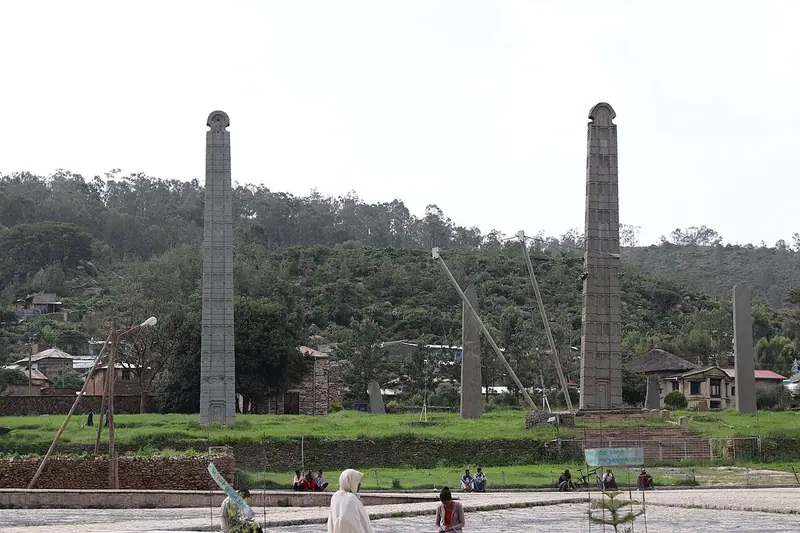 Aksumite8 stops · 1st–7th century CE
Aksum audio guide
The giant carved stelae of Aksum, capital of an ancient kingdom that traded with Rome, Arabia and India, and the Church of Saint Mary of Zion.
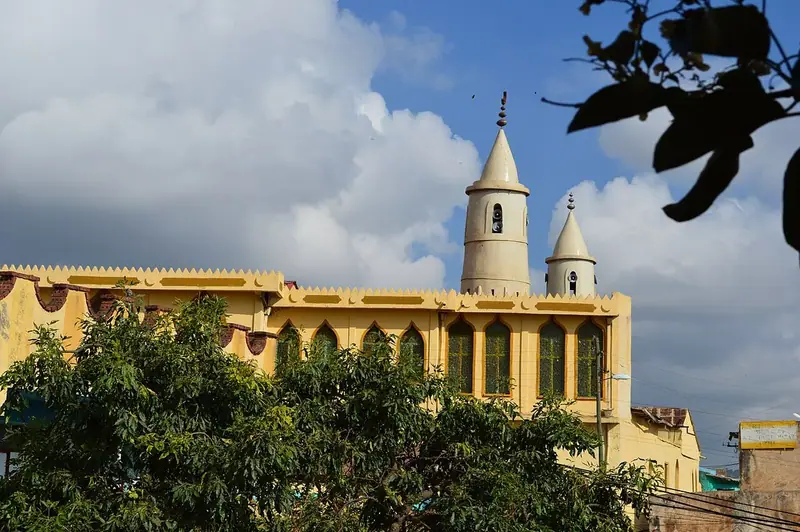 Adal Sultanate8 stops · from the 13th century CE
Harar audio guide
The walled lanes of the City of Saints, past whitewashed houses, mosques and the market, to the hyena men.
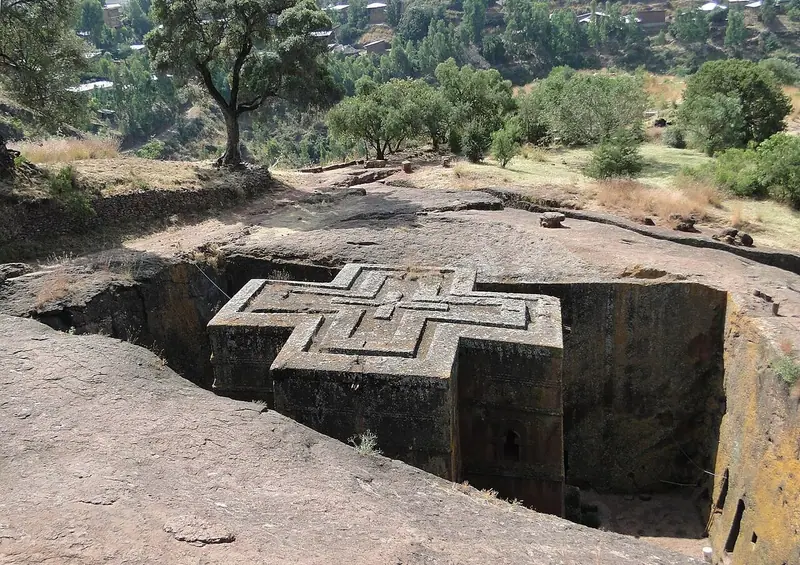 Zagwe8 stops · late 12th – early 13th century CE
Lalibela audio guide
Descend into trenches cut in the living rock to the medieval churches of Lalibela, still a working place of daily prayer and pilgrimage.
Every guide, in every country
Gondar and every other guide we publish, including future ones. One payment, no subscription.