Before you start
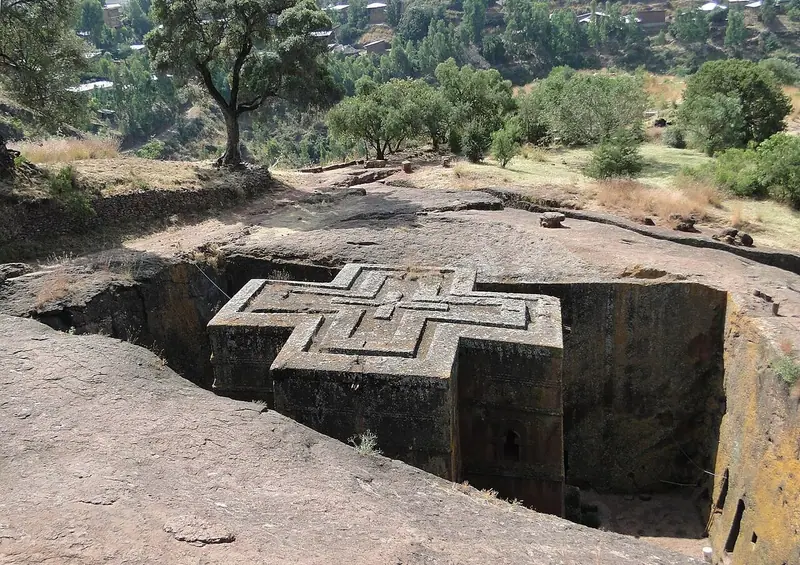
High in the mountains of northern Ethiopia, at about two thousand five hundred metres, eleven medieval churches were carved downwards into the living rock. Lalibela is one of the holiest places of the Ethiopian Orthodox Church, a working site of daily prayer and a great centre of pilgrimage, and has been a World Heritage Site since 1978. This guide visits the northern group of churches, crosses to the eastern group, and ends at the famous Church of Saint George, standing alone in its trench. These are living churches, so remove your shoes before entering, dress modestly, and respect the priests, worshippers and services. Ask before photographing people, and take a torch for the dark passages.
Use it as a self-guided tour of Lalibela: 8 stops in visit order, each played when you’re ready, at your own pace.
 Free preview · Stop 1
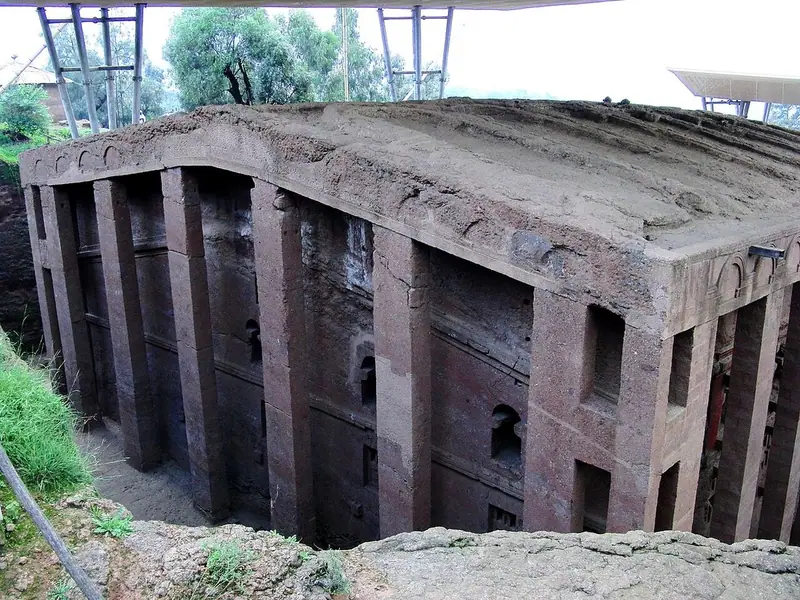
Biete Medhane Alem
Begin in the northern group at Biete Medhane Alem, the House of the Saviour of the World, believed to be the largest monolithic church in the world. Look at how the whole building stands free in its trench, cut from a single block of rock, and surrounded by a colonnade of massive square pillars that support the edges of the roof. Inside, the church is divided into five aisles by rows of pillars. Notice the large modern shelter above you, one of several put up in 2008 to protect the churches from rain while a longer-term solution is found. The church is home to the Lalibela Cross, a precious processional cross, which a priest may show to visitors. Pause to consider the effort involved: every pillar, wall and window here was created by taking rock away, with no stone added.
Photo: Jens Klinzing · CC BY-SA 3.0 · Wikimedia Commons
What to see at Lalibela: 8 stops, in visit order
- 01
 Biete Medhane AlemHouse of the Saviour of the WorldFree preview
- 02
 Biete MaryamHouse of MaryIn the guide
- 03
 Biete Golgotha MikaelGolgotha and the TombIn the guide
- 04
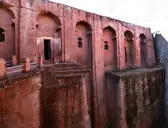 Biete Gabriel-RufaelA Palace or a ChurchIn the guide
- 05
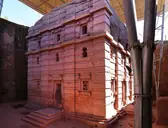 Biete AmanuelHouse of EmmanuelIn the guide
- 06
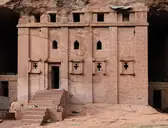 Biete Abba LibanosHouse of Abbot LibanosIn the guide
- 07
 Biete GiyorgisThe Cross in the RockIn the guide
- 08
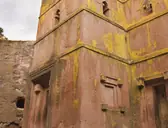 Into the TrenchThe Path of the PilgrimsIn the guide
Site map of Lalibela
History of Lalibela
The churches are traditionally credited to King Gebre Meskel Lalibela of the Zagwe dynasty, who reigned in the late twelfth and early thirteenth centuries. Tradition says he was shown Jerusalem in a vision and told to build a new Jerusalem in Ethiopia, at a time when Muslim conquests made pilgrimage to the Holy Land difficult. Scholars think the churches more probably took shape over several phases, and some may have begun as earlier buildings, perhaps even palaces or fortifications. Each was made by removing rock rather than adding it: workers cut trenches around a block of soft volcanic stone, then hollowed it out, from top to bottom, with hammers and chisels.
Lalibela guide: questions
How many stops does the Lalibela guide have?
8 stops, in visit order: 1. Biete Medhane Alem; 2. Biete Maryam; 3. Biete Golgotha Mikael; 4. Biete Gabriel-Rufael; 5. Biete Amanuel; 6. Biete Abba Libanos; 7. Biete Giyorgis; 8. Into the Trench.
Can I do a self-guided tour of Lalibela with this guide?
Yes. The guide is made for a self-guided tour: 8 stops in visit order, each with a photo, a story and a voice, so you can explore Lalibela at your own pace, without joining a group. Download it before you go and it works offline.
How long is each guide?
The 8 stops add up to about 6 minutes of listening in total. You play each stop when you’re ready, so you can go at your own pace.
Does the guide work offline?
Yes, once it’s downloaded. The guide is a single self-contained web page (about 8.1 MB) with the photos, text and audio built in. Download it to your phone before you go (Wi-Fi is best); after that it opens in any modern browser on iPhone or Android, with no app, account or mobile signal needed.
Does it use GPS or need my location?
No. The guide doesn’t use GPS and doesn’t know where you are: you play each stop when you reach it. It works on iPhone and Android in any modern browser, and it’s in English.
What’s included?
One self-contained HTML guide: 8 stops in visit order, each with a photo, text and a voice, plus the story of who built the site.
Who built Lalibela?
The churches are traditionally credited to King Gebre Meskel Lalibela of the Zagwe dynasty, who reigned in the late twelfth and early thirteenth centuries. Tradition says he was shown Jerusalem in a vision and told to build a new Jerusalem in Ethiopia, at a time when Muslim conquests made pilgrimage to the Holy Land difficult.
Where is Lalibela?
High in the mountains of northern Ethiopia, at about two thousand five hundred metres, eleven medieval churches were carved downwards into the living rock.
Is there a free audio guide to Lalibela?
The first stop, Biete Medhane Alem, is free to read and hear on this page, so you can try the Lalibela audio tour before you buy. The full guide, with all 8 stops, is a one-off purchase: download it once and it’s yours to keep, working offline.
Is the Lalibela guide worth it?
If you’d like to know what you’re looking at, yes. For $10 you get 8 stops in visit order, each with a photo, a short history and a voice you play when you’re ready, plus a site map of the stops, and about 6 minutes of listening in all. It’s short on purpose, so you spend your time looking, not listening. It’s yours to keep, works offline and needs no app. The first stop is free on this page, so you can try it before you buy. If you’d like hours of detail, a guided tour will go deeper.
Audio guide or guided tour?
It depends how you like to visit. This guide lets you explore Lalibela at your own pace, at any time, for a one-off price. A guided tour gives you a live expert you can ask questions, but at fixed times and usually for a higher price. Many people use both: a tour for the big picture, and the guide to read beforehand or to revisit the stops in their own time.
Is this the official Lalibela guide?
No. It’s an independent guide by The Historian Guide, not affiliated with or endorsed by the operator of Lalibela. For tickets and opening hours, check the official site operator before you go.
Does the guide include entry tickets or opening hours?
No. The guide is a digital companion only. Admission to Lalibela is separate, so check the official site operator for current tickets and opening hours before you go.
- Stop 1 · Biete Medhane Alem: Jens Klinzing · CC BY-SA 3.0 · Wikimedia Commons · resized
- Stop 2 · Biete Maryam: Bernard Gagnon · CC BY-SA 3.0 · Wikimedia Commons · resized
- Stop 3 · Biete Golgotha Mikael: Chuck Moravec · CC BY 2.0 · Wikimedia Commons · resized
- Stop 4 · Biete Gabriel-Rufael: Sailko · CC BY 3.0 · Wikimedia Commons · resized
- Stop 5 · Biete Amanuel: Sailko · CC BY 3.0 · Wikimedia Commons · resized
- Stop 6 · Biete Abba Libanos: Bernard Gagnon · CC BY-SA 3.0 · Wikimedia Commons · resized
- Stop 7 · Biete Giyorgis (also the cover): Bernard Gagnon · CC BY-SA 3.0 · Wikimedia Commons · resized
- Stop 8 · Into the Trench: A. Davey from Where I Live Now: Pacific Northwest · CC BY 2.0 · Wikimedia Commons · resized


All photographs from Wikimedia Commons under the licences shown.
More guides in Ethiopia
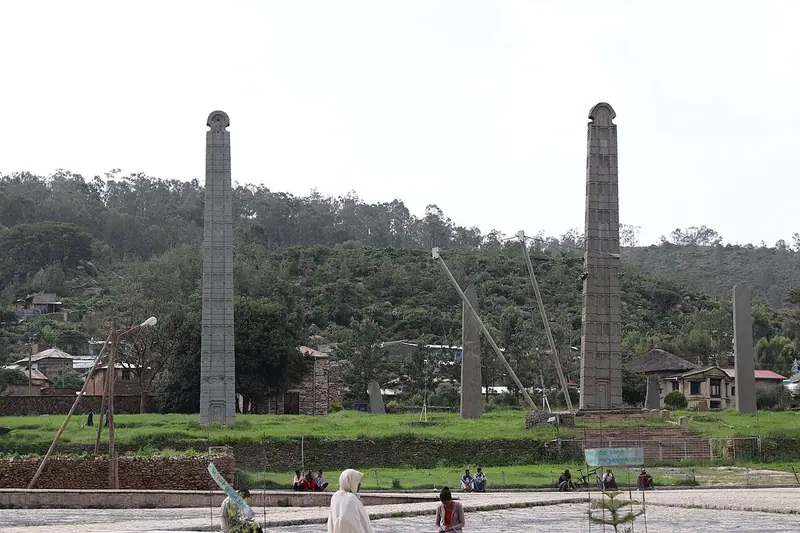 Aksumite8 stops · 1st–7th century CE
Aksum audio guide
The giant carved stelae of Aksum, capital of an ancient kingdom that traded with Rome, Arabia and India, and the Church of Saint Mary of Zion.
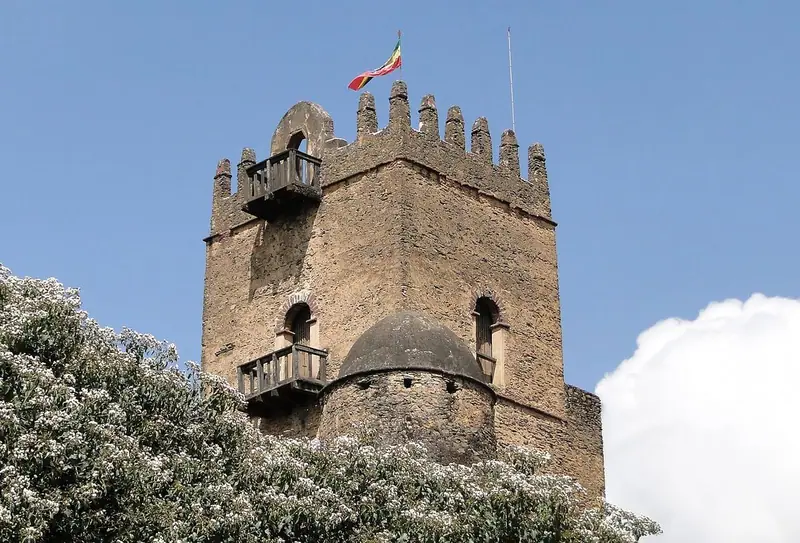 Solomonic Ethiopia8 stops · from 1636 CE
Gondar audio guide
The battlemented castles of Fasil Ghebbi, royal enclosure of Ethiopia’s emperors, and the bath of Fasilides with its painted church.
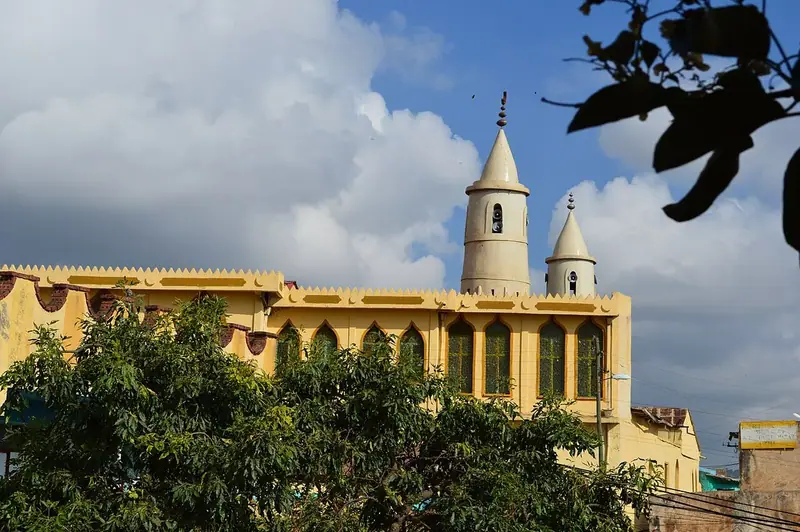 Adal Sultanate8 stops · from the 13th century CE
Harar audio guide
The walled lanes of the City of Saints, past whitewashed houses, mosques and the market, to the hyena men.
Every guide, in every country
Lalibela and every other guide we publish, including future ones. One payment, no subscription.