Before you start
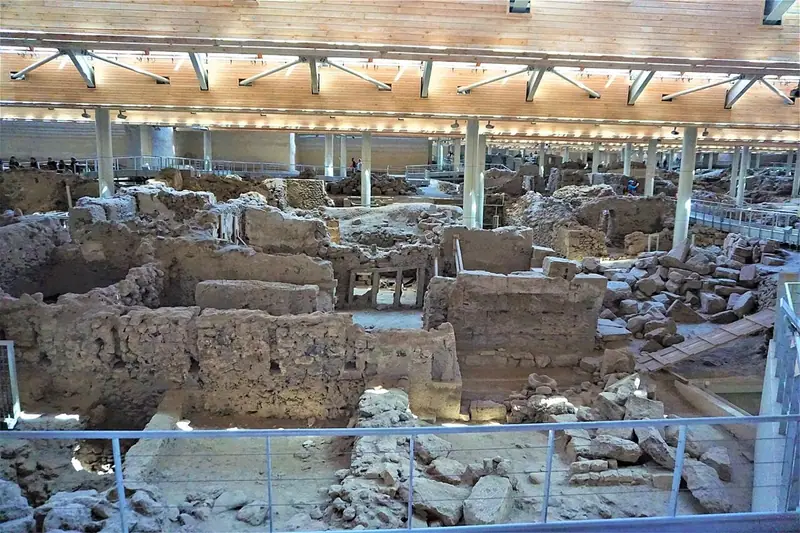
Akrotiri lies near the southern tip of Santorini, the ancient Thera, about 15 kilometres south-west of Fira, close to the modern village of the same name and the Red Beach. Here a prosperous Bronze Age town was buried by a colossal volcanic eruption in the late seventeenth century BCE, and the ash preserved streets and houses two and three storeys high. Akrotiri is not a UNESCO World Heritage Site in its own right, but it is one of the most important prehistoric sites in the Aegean and is managed by the Hellenic Ministry of Culture. The excavation is protected under a vast roof, and a walkway leads through it. This guide follows that walkway from the entrance along Telchines Street, past Xeste 3, the Square of the Mills, the House of the Ladies and the West House, then ends at the Museum of Prehistoric Thera in Fira, where the finds are displayed.
Use it as a self-guided tour of Akrotiri: 7 stops in visit order, each played when you’re ready, at your own pace.
 Free preview · Stop 1
Under the Great Roof
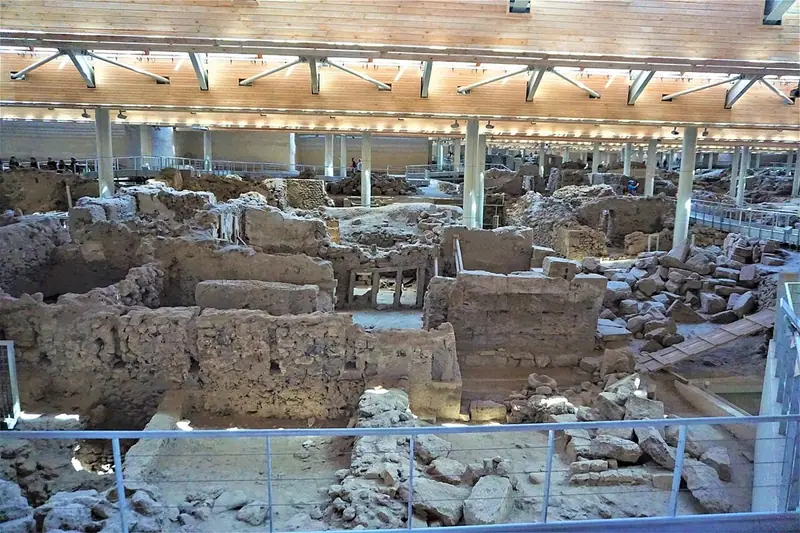
As you step inside, pause on the walkway and let your eyes adjust. Below you spreads an entire Bronze Age town, frozen in the late seventeenth century BCE, when the volcano at the heart of Santorini erupted and buried it under metres of pumice and ash. The protective roof above you, completed in 2012, shields the fragile walls from sun and rain, and its design keeps the air inside surprisingly cool. What makes Akrotiri special is height: houses still stand two and even three storeys tall, with doors, windows and staircases intact. Archaeologists have uncovered only a part of the town, perhaps a small fraction, so much of it still lies beneath your feet. Before walking on, take a moment to picture it busy with traders, sailors and craftsmen, the sea lapping just to the south.
Photo: Joyofmuseums · CC BY-SA 4.0 · Wikimedia Commons
What to see at Akrotiri: 7 stops, in visit order
- 01
 Under the Great RoofAkrotíriFree preview
- 02
 Telchines StreetOdós TelchínonIn the guide
- 03
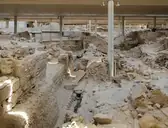 Xeste 3Xestí 3In the guide
- 04
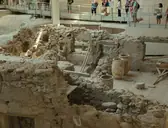 The Square of the MillsPlateía ton MýlonIn the guide
- 05
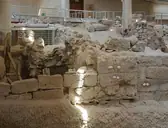 The House of the LadiesOikía ton KyriónIn the guide
- 06
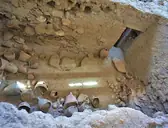 The West HouseDytikí OikíaIn the guide
- 07
 Museum of Prehistoric TheraMouseío Proistorikís ThírasIn the guide
History of Akrotiri
Akrotiri was built by the Bronze Age islanders of the Cyclades, a seafaring people whose culture was deeply shaped by the Minoans of Crete. The Minoan civilisation flourished from about 3000 to 1100 BCE, and the Cycladic Bronze Age spans much the same long stretch, from around 3200 BCE until about 1100 BCE, when the Mycenaean palaces collapsed. People lived on this spot from the Late Neolithic, around 4500 BCE, and by the seventeenth century BCE Akrotiri had become a busy, wealthy harbour town, trading with Crete, mainland Greece and beyond. Then, after warning earthquakes, the volcano erupted and buried it completely. No human remains and few valuables have been found, so the people seem to have escaped in time. Excavation began in 1967 under Spyridon Marinatos and continued under Christos Doumas.
The full history continues in the guide.
Akrotiri guide: questions
How many stops does the Akrotiri guide have?
7 stops, in visit order: 1. Under the Great Roof; 2. Telchines Street; 3. Xeste 3; 4. The Square of the Mills; 5. The House of the Ladies; 6. The West House; 7. Museum of Prehistoric Thera.
Can I do a self-guided tour of Akrotiri with this guide?
Yes. The guide is made for a self-guided tour: 7 stops in visit order, each with a photo, a story and a voice, so you can explore Akrotiri at your own pace, without joining a group. Download it before you go and it works offline.
How long is each guide?
The 7 stops add up to about 7 minutes of listening in total. You play each stop when you’re ready, so you can go at your own pace.
Does the guide work offline?
Yes, once it’s downloaded. The guide is a single self-contained web page (about 7.6 MB) with the photos, text and audio built in. Download it to your phone before you go (Wi-Fi is best); after that it opens in any modern browser on iPhone or Android, with no app, account or mobile signal needed.
Does it use GPS or need my location?
No. The guide doesn’t use GPS and doesn’t know where you are: you play each stop when you reach it. It works on iPhone and Android in any modern browser, and it’s in English.
What’s included?
One self-contained HTML guide: 7 stops in visit order, each with a photo, text and a voice, plus the story of who built the site.
Who built Akrotiri?
Akrotiri was built by the Bronze Age islanders of the Cyclades, a seafaring people whose culture was deeply shaped by the Minoans of Crete. The Minoan civilisation flourished from about 3000 to 1100 BCE, and the Cycladic Bronze Age spans much the same long stretch, from around 3200 BCE until about 1100 BCE, when the Mycenaean palaces collapsed.
Where is Akrotiri?
Akrotiri lies near the southern tip of Santorini, the ancient Thera, about 15 kilometres south-west of Fira, close to the modern village of the same name and the Red Beach.
Is there a free audio guide to Akrotiri?
The first stop, Under the Great Roof, is free to read and hear on this page, so you can try the Akrotiri audio tour before you buy. The full guide, with all 7 stops, is a one-off purchase: download it once and it’s yours to keep, working offline.
Is the Akrotiri guide worth it?
If you’d like to know what you’re looking at, yes. For $10 you get 7 stops in visit order, each with a photo, a short history and a voice you play when you’re ready, about 7 minutes of listening in all. It’s short on purpose, so you spend your time looking, not listening. It’s yours to keep, works offline and needs no app. The first stop is free on this page, so you can try it before you buy. If you’d like hours of detail, a guided tour will go deeper.
Audio guide or guided tour?
It depends how you like to visit. This guide lets you explore Akrotiri at your own pace, at any time, for a one-off price. A guided tour gives you a live expert you can ask questions, but at fixed times and usually for a higher price. Many people use both: a tour for the big picture, and the guide to read beforehand or to revisit the stops in their own time.
Is this the official Akrotiri guide?
No. It’s an independent guide by The Historian Guide, not affiliated with or endorsed by the operator of Akrotiri. For tickets and opening hours, check the official site operator before you go.
Does the guide include entry tickets or opening hours?
No. The guide is a digital companion only. Admission to Akrotiri is separate, so check the official site operator for current tickets and opening hours before you go.
- Stop 1 · Under the Great Roof (also the cover): Joyofmuseums · CC BY-SA 4.0 · Wikimedia Commons · resized
- Stop 2 · Telchines Street: Joyofmuseums · CC BY-SA 4.0 · Wikimedia Commons · resized
- Stop 3 · Xeste 3: Norbert Nagel · CC BY-SA 3.0 · Wikimedia Commons · resized
- Stop 4 · The Square of the Mills: Zde · CC BY-SA 4.0 · Wikimedia Commons · resized
- Stop 5 · The House of the Ladies: Norbert Nagel · CC BY-SA 3.0 · Wikimedia Commons · resized
- Stop 6 · The West House: Joyofmuseums · CC BY-SA 4.0 · Wikimedia Commons · resized
- Stop 7 · Museum of Prehistoric Thera: Norbert Nagel · CC BY-SA 3.0 · Wikimedia Commons · resized


All photographs from Wikimedia Commons under the licences shown.
More guides in Greece
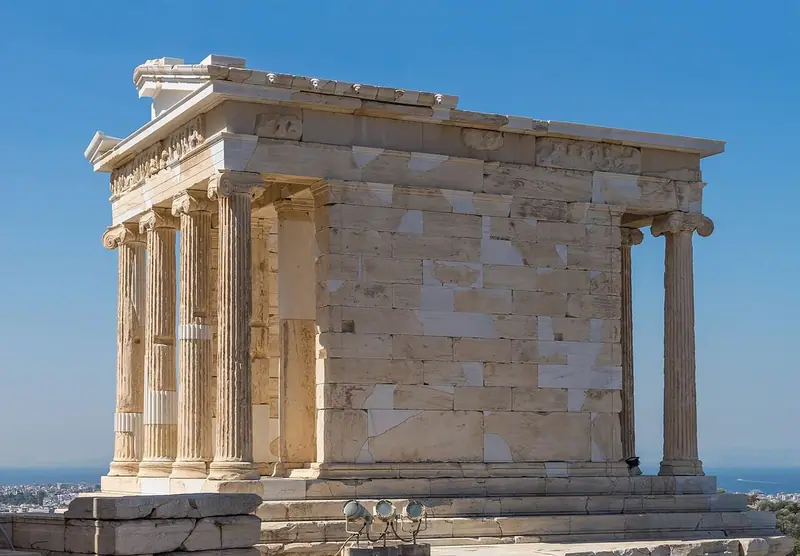 Greek7 stops · 5th century BCE
Acropolis of Athens audio guide
Climb through the Propylaia to the Parthenon and the Erechtheion, on the rock that has crowned Athens for three thousand years.
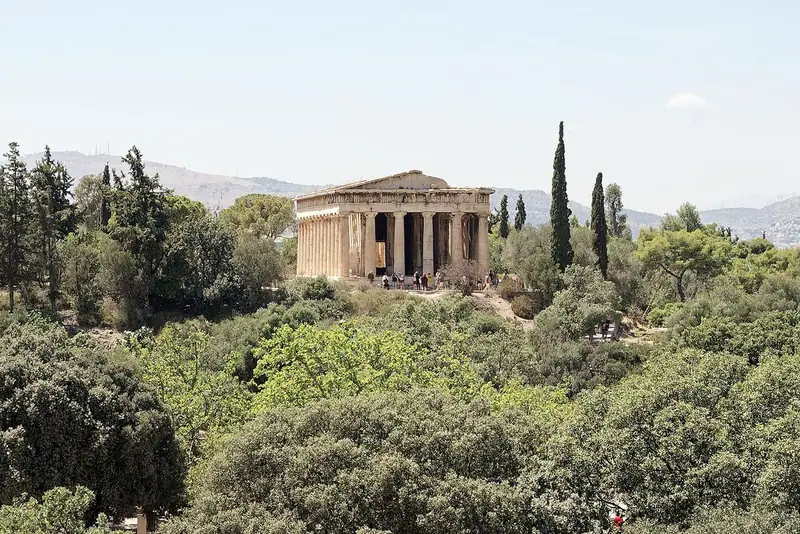 Greek7 stops · 6th century BCE – 2nd century CE
Ancient Agora of Athens audio guide
The market square where Athenians shopped, voted and argued, overlooked by the Temple of Hephaestus.
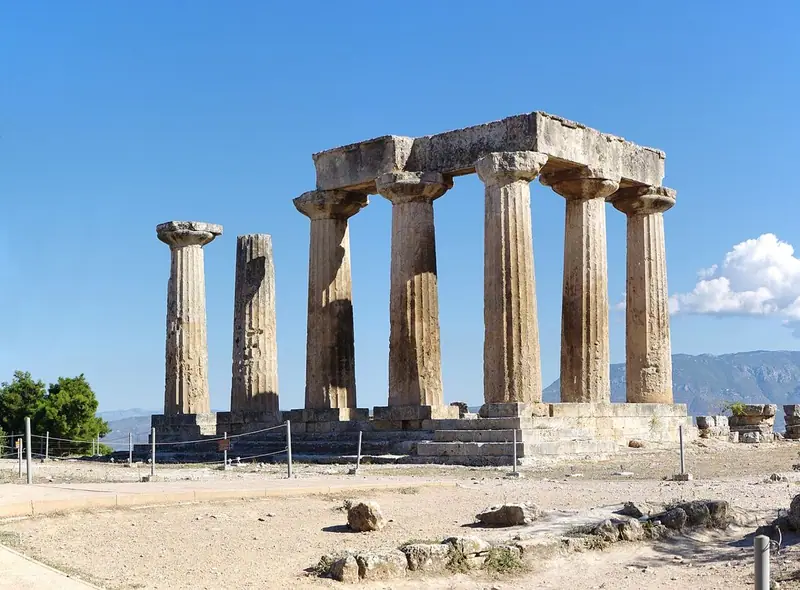 Roman7 stops · 6th century BCE – 4th century CE
Ancient Corinth audio guide
The Temple of Apollo, the Roman forum and the Bema, with the great rock of Acrocorinth above.
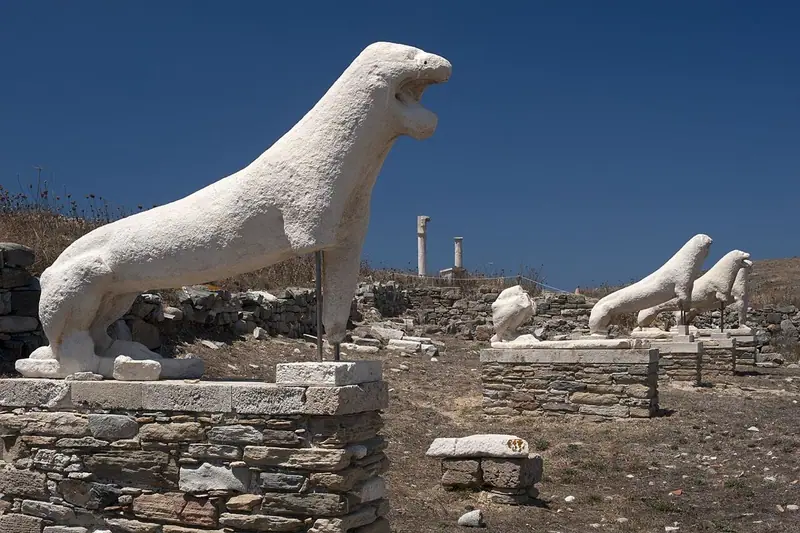 Greek7 stops · c. 800 BCE – 1st century BCE
Delos audio guide
The sacred island of Apollo: the Terrace of the Lions, mosaic-floored houses and the climb up Mount Kynthos.
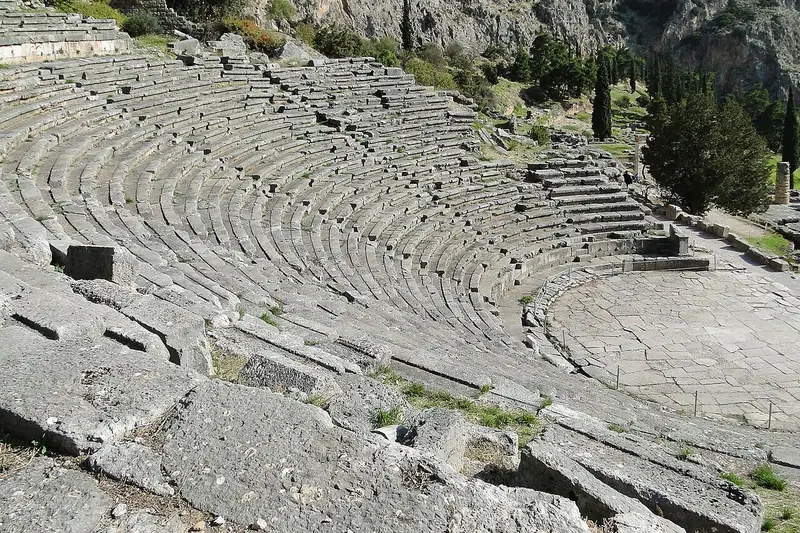 Greek8 stops · 8th century BCE – 4th century CE
Delphi audio guide
Up the Sacred Way past the treasuries to Apollo’s temple, the theatre and the stadium, high on the slopes of Parnassus.
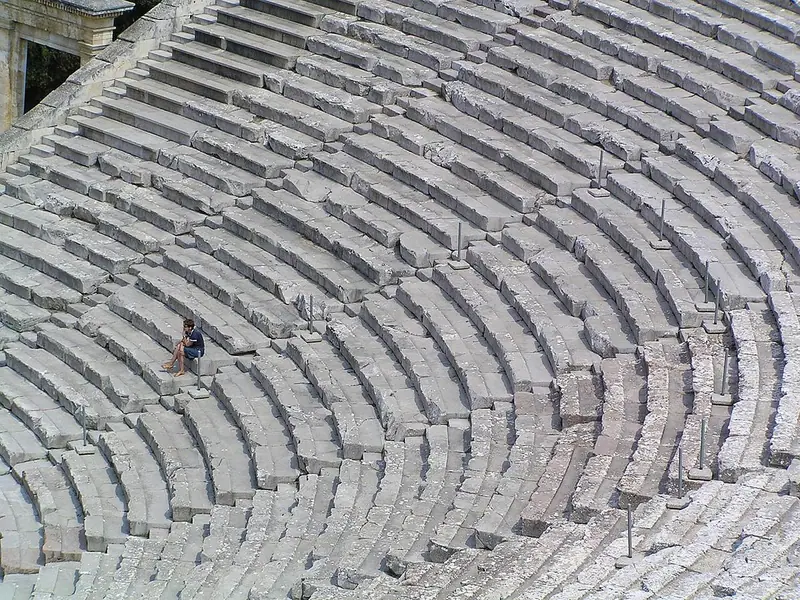 Greek7 stops · 4th century BCE
Epidaurus audio guide
The healing sanctuary of Asklepios, with its celebrated theatre, stadium and the mysterious Tholos.
Every guide, in every country
Akrotiri and every other guide we publish, including future ones. One payment, no subscription.