Before you start
Skellig Michael, Sceilg Mhichíl in Irish, is a pyramid of rock in the Atlantic, about twelve kilometres off the coast of County Kerry. For some six hundred years a small community of monks lived on its upper terrace, in stone huts that still stand, in one of the most remote monasteries in the Christian world. The island was inscribed as a World Heritage Site in 1996. This guide follows the only visitor path, from the boat landing and the lower terrace, along the lighthouse road, up the south steps to Christ’s Saddle, and into the monastic village, the oratory and the old walls and crosses. It is not a stroll. The climb to the monastery is 618 steep, uneven steps, rising about 180 metres, without handrails on the ancient sections, and it is exposed to wind and rain. You will have only a few hours on the island, and only if the sea allows a landing.
Use it as a self-guided tour of Skellig Michael: 6 stops in visit order, each played when you’re ready, at your own pace.
 Free preview · Stop 1
The boat landing and the lower terrace
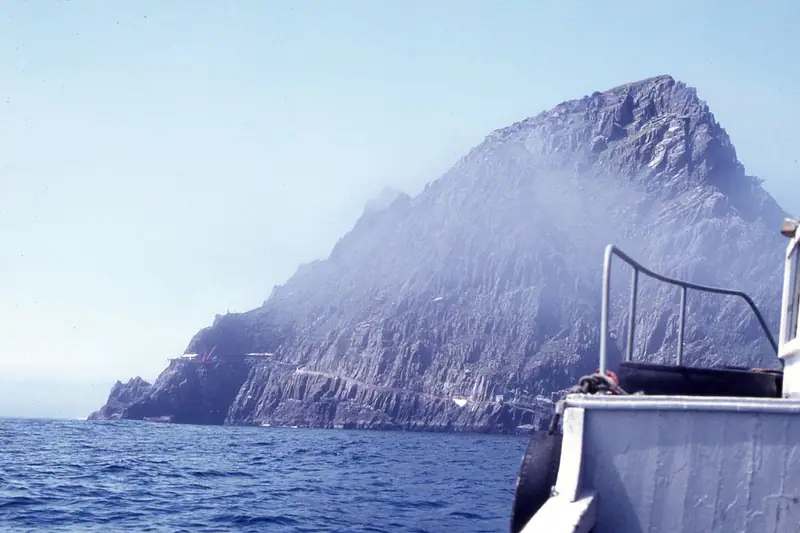
You reach Skellig Michael only by boat, and only in the summer landing season, which is usually from May to September and is often interrupted by weather. Most boats leave from Portmagee, on the mainland, with a crossing of about three-quarters of an hour, and a few leave from other harbours on this coast; only operators with a permit may land visitors, and the number of places each day is strictly limited. The landing itself can be awkward, as the boat has to come alongside a small pier on the north-eastern side in a swell. Once ashore you are on the lower terrace, a narrow shelf above the water, where Office of Public Works guides give a safety briefing before anyone begins the climb. There is no shelter to speak of, no shop and no ordinary path: from here the island rises in rock and grass, and the old monastic steps start after a walk along the ledge. Wait for the briefing, keep to the marked way, and do not rush the first minutes ashore.
Photo: Colin Park · CC BY-SA 2.0 · Wikimedia Commons
What to see at Skellig Michael: 6 stops, in visit order
- 01
 The boat landing and the lower terraceComing ashoreFree preview
- 02
 The lighthouse roadThe southern ledgeIn the guide
- 03
 The south steps and Christ’s SaddleSix hundred and eighteen stepsIn the guide
- 04
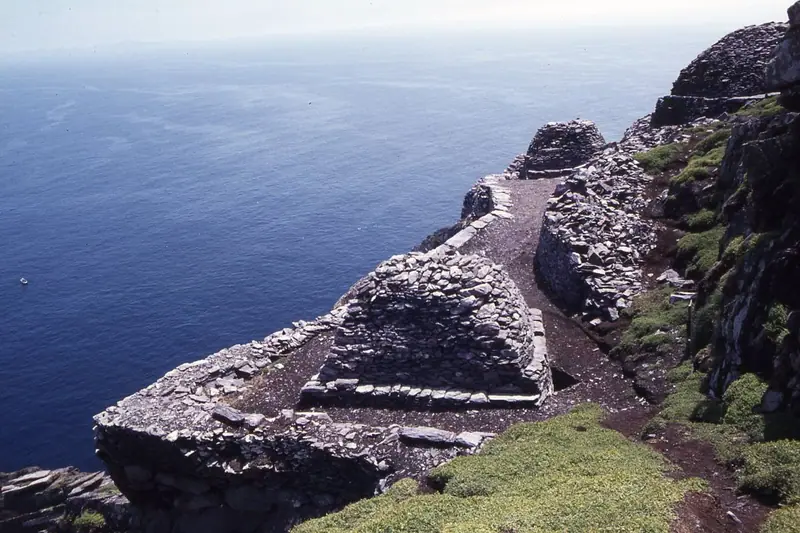
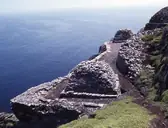 The monastic villageThe beehive cellsIn the guide
- 05
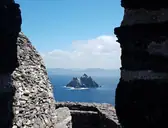 St Michael’s OratoryThe monks’ churchIn the guide
- 06
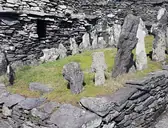 Crosses and retaining wallsThe work that holds the monastery upIn the guide
Site map of Skellig Michael
History of Skellig Michael
Monks settled on Skellig Michael in the early Middle Ages, probably in the sixth or seventh century, in the same movement that founded other remote Irish monasteries of the time. The first written records appear later: the Annals of Ulster note a Viking raid on the Skellig in 824, and the community is mentioned in other Irish annals through the first millennium. The monks lived by the Rule of the early Irish church, in dry-stone clocháns, or beehive cells, on a terraced shelf high above the sea, and they built oratories, a church, stone crosses and a remarkable system of retaining walls and steps. In the twelfth or thirteenth century, as the Irish church was reorganised on diocesan lines, the community left the island for a priory on the mainland at Ballinskelligs. The rock later served as a place of pilgrimage. In the 1820s two lighthouses were built on the west side, and a road was cut along the southern ledge to serve them.
The full history continues in the guide.
Skellig Michael guide: questions
How many stops does the Skellig Michael guide have?
6 stops, in visit order: 1. The boat landing and the lower terrace; 2. The lighthouse road; 3. The south steps and Christ’s Saddle; 4. The monastic village; 5. St Michael’s Oratory; 6. Crosses and retaining walls.
Can I do a self-guided tour of Skellig Michael with this guide?
Yes. The guide is made for a self-guided tour: 6 stops in visit order, each with a photo, a story and a voice, so you can explore Skellig Michael at your own pace, without joining a group. Download it before you go and it works offline.
How long is each guide?
The 6 stops add up to about 5 minutes of listening in total. You play each stop when you’re ready, so you can go at your own pace.
Does the guide work offline?
Yes, once it’s downloaded. The guide is a single self-contained web page (about 7.5 MB) with the photos, text and audio built in. Download it to your phone before you go (Wi-Fi is best); after that it opens in any modern browser on iPhone or Android, with no app, account or mobile signal needed.
Does it use GPS or need my location?
No. The guide doesn’t use GPS and doesn’t know where you are: you play each stop when you reach it. It works on iPhone and Android in any modern browser, and it’s in English.
What’s included?
One self-contained HTML guide: 6 stops in visit order, each with a photo, text and a voice, plus the story of who built the site.
Who built Skellig Michael?
Monks settled on Skellig Michael in the early Middle Ages, probably in the sixth or seventh century, in the same movement that founded other remote Irish monasteries of the time. The first written records appear later: the Annals of Ulster note a Viking raid on the Skellig in 824, and the community is mentioned in other Irish annals through the first millennium.
Where is Skellig Michael?
Skellig Michael, Sceilg Mhichíl in Irish, is a pyramid of rock in the Atlantic, about twelve kilometres off the coast of County Kerry.
Is there a free audio guide to Skellig Michael?
The first stop, The boat landing and the lower terrace, is free to read and hear on this page, so you can try the Skellig Michael audio tour before you buy. The full guide, with all 6 stops, is a one-off purchase: download it once and it’s yours to keep, working offline.
Is the Skellig Michael guide worth it?
If you’d like to know what you’re looking at, yes. For $10 you get 6 stops in visit order, each with a photo, a short history and a voice you play when you’re ready, plus a site map of the stops, and about 5 minutes of listening in all. It’s short on purpose, so you spend your time looking, not listening. It’s yours to keep, works offline and needs no app. The first stop is free on this page, so you can try it before you buy. If you’d like hours of detail, a guided tour will go deeper.
Audio guide or guided tour?
It depends how you like to visit. This guide lets you explore Skellig Michael at your own pace, at any time, for a one-off price. A guided tour gives you a live expert you can ask questions, but at fixed times and usually for a higher price. Many people use both: a tour for the big picture, and the guide to read beforehand or to revisit the stops in their own time.
Is this the official Skellig Michael guide?
No. It’s an independent guide by The Historian Guide, not affiliated with or endorsed by the operator of Skellig Michael. For tickets and opening hours, check the official site operator before you go.
Does the guide include entry tickets or opening hours?
No. The guide is a digital companion only. Admission to Skellig Michael is separate, so check the official site operator for current tickets and opening hours before you go.
- Stop 1 · The boat landing and the lower terrace: Colin Park · CC BY-SA 2.0 · Wikimedia Commons · resized
- Stop 2 · The lighthouse road: Stinglehammer · CC BY-SA 4.0 · Wikimedia Commons · resized
- Stop 3 · The south steps and Christ’s Saddle: Stinglehammer · CC BY-SA 4.0 · Wikimedia Commons · resized
- Stop 4 · The monastic village (also the cover): Colin Park · CC BY-SA 2.0 · Wikimedia Commons · resized
- Stop 5 · St Michael’s Oratory: Stinglehammer · CC BY-SA 4.0 · Wikimedia Commons · resized
- Stop 6 · Crosses and retaining walls: Stinglehammer · CC BY-SA 4.0 · Wikimedia Commons · resized


All photographs from Wikimedia Commons under the licences shown.
More guides in Ireland
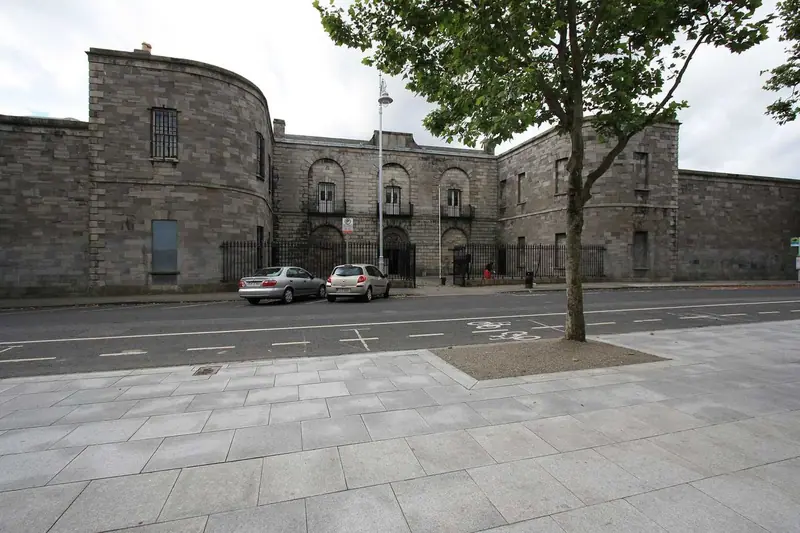 Irish6 stops · 1030–1916
Dublin and Kilmainham Gaol audio guide
From the General Post Office and O’Connell Street, south to Trinity College and the Book of Kells, then Dublin Castle, Christ Church and St Patrick’s, and west by a short transit to Kilmainham Gaol.
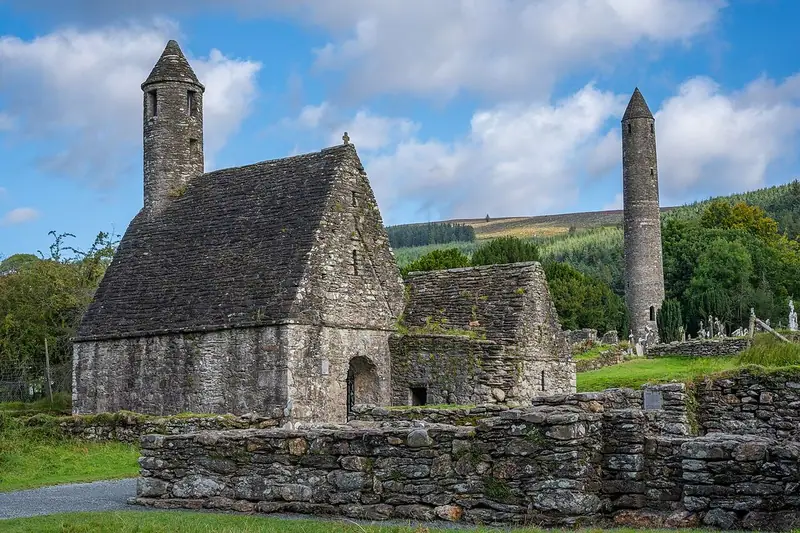 Early Christian Irish8 stops · 6th–14th century CE
Glendalough audio guide
Saint Kevin’s valley of the two lakes in the Wicklow Mountains, with the round tower, stone churches and crosses of his monastery.
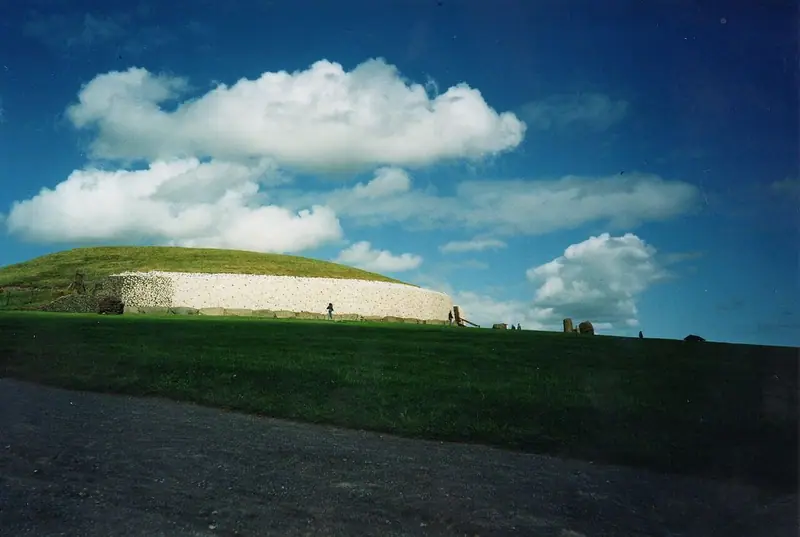 Neolithic8 stops · c. 3100 BCE
Newgrange audio guide
A great Neolithic tomb above the Boyne, older than Stonehenge: its quartz façade, carved entrance stone and passage to the chamber.
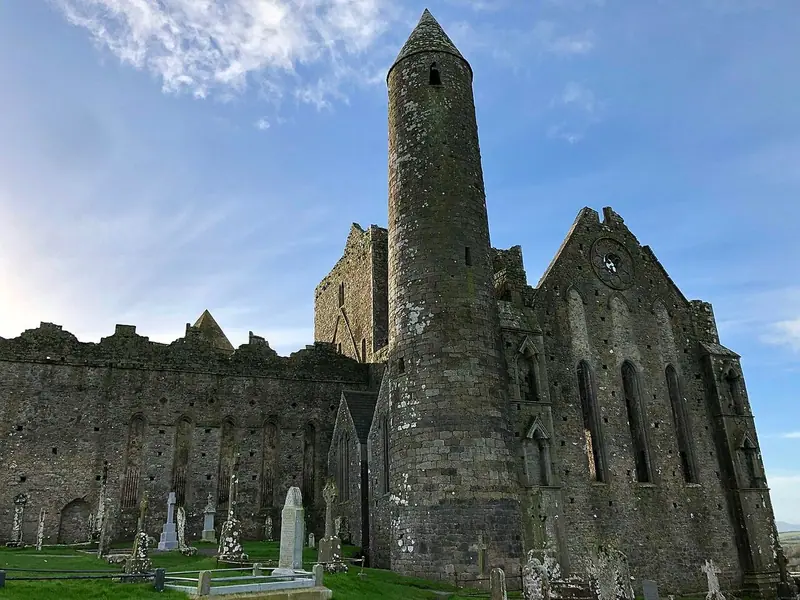 Medieval7 stops · 12th–13th century CE
Rock of Cashel audio guide
Climb to the seat of the kings of Munster, crowned by a round tower, Cormac’s Romanesque chapel and a roofless Gothic cathedral.
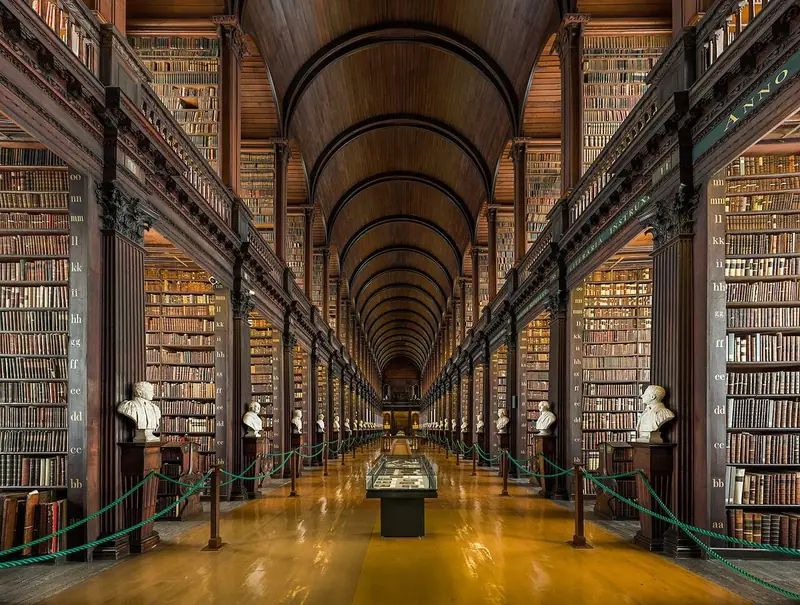 Tudor8 stops · 1592–18th century CE
Trinity College Dublin audio guide
Cross the cobbled squares of Ireland’s oldest university to the Book of Kells and the Long Room of the Old Library.
Every guide, in every country
Skellig Michael and every other guide we publish, including future ones. One payment, no subscription.