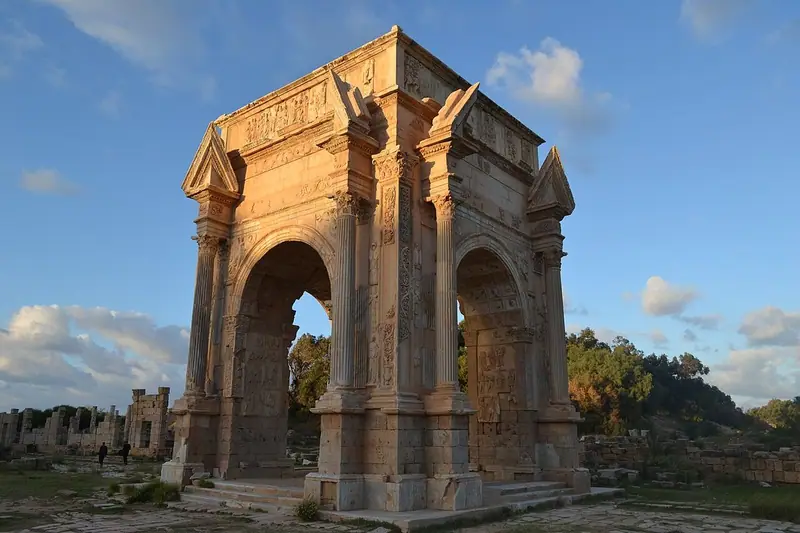
Before you start
Leptis Magna lies on the Mediterranean shore beside the town of Al-Khums, about 130 kilometres east of Tripoli, where the Wadi Lebda meets the sea. It was inscribed as a World Heritage Site in 1982, and UNESCO notes its reputation for having the most complete and impressive Roman ruins in North Africa; wind-blown sand buried much of the city for centuries and helped to preserve it. Since 2016 the site has been on UNESCO’s List of World Heritage in Danger. In 2026 the World Heritage Committee welcomed continuing conservation work with international partners, while noting concerns about coastal flooding, sea and sand encroachment and pressure from development nearby. The ruins are vast, open and largely unshaded, so bring water, a hat and sun cream, and wear sturdy shoes for the uneven paving. Please do not climb on walls or columns. The route begins at the great arch, crosses the Severan city to the market and theatre, and ends at the amphitheatre beside the sea.
Use it as a self-guided tour of Leptis Magna: 8 stops in visit order, each played when you’re ready, at your own pace.
 Free preview · Stop 1
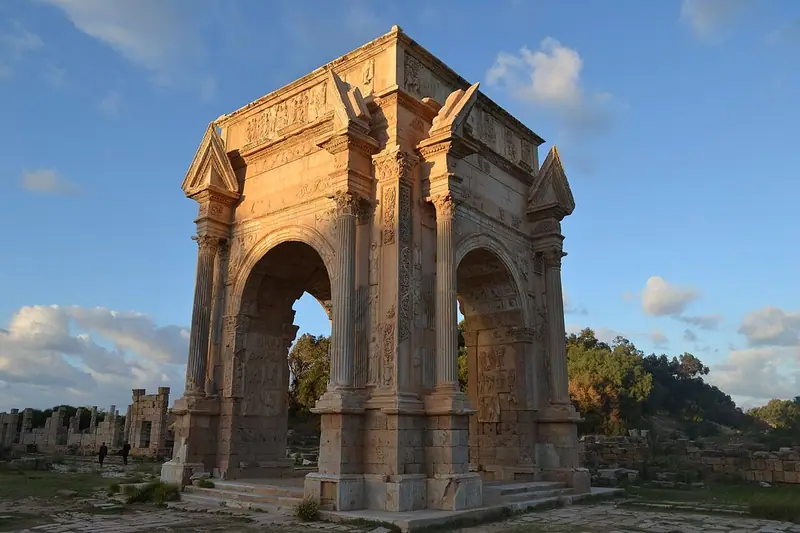
The Arch of Septimius Severus
Begin at the great four-way arch that marks the crossing of the city’s two main streets, the north–south cardo and the east–west decumanus. It honours Septimius Severus, the emperor who was born in Leptis Magna, and is generally thought to have been raised for his visit to Africa in about 203 CE. Its core is limestone, and it was faced in carved marble. On each side Corinthian columns carry a broken pediment, a form drawn from the eastern Mediterranean rather than from Rome. Look up at the relief panels of the attic. They show the imperial family in triumph, in procession, at sacrifice, and joining hands in harmony, with Severus beside his sons Caracalla and Geta. The arch collapsed after the city was abandoned and was found in pieces in 1928. Archaeologists have since pieced it back together, stone by stone.
Photo: Aymen Aiblu · CC BY-SA 4.0 · Wikimedia Commons
What to see at Leptis Magna: 8 stops, in visit order
- 01
 The Arch of Septimius SeverusA gateway for an emperorFree preview
- 02
 The Hadrianic BathsMarble halls for bathingIn the guide
- 03
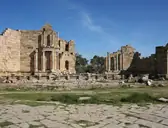 The Severan NymphaeumA fountain at a turning pointIn the guide
- 04
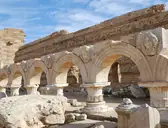 The Severan ForumMedusa watches the squareIn the guide
- 05
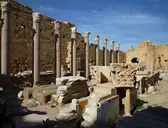 The Severan BasilicaHall of Hercules and BacchusIn the guide
- 06
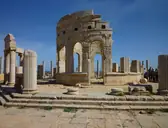 The MarketShopping under AugustusIn the guide
- 07
 The TheatreA gift with a sea viewIn the guide
- 08
 The AmphitheatreAn arena carved from a quarryIn the guide
Site map of Leptis Magna
History of Leptis Magna
Leptis Magna was founded by the Phoenicians and grew into a great city under the Romans. Phoenician seafarers from the Levant founded trading posts across the Mediterranean from the early first millennium BCE, and their western colonies, led by Carthage, formed the Punic world until Rome destroyed Carthage in 146 BCE. Leptis was founded as a Punic port in the second half of the seventh century BCE and prospered on olive oil and trade with the African interior; by 46 BCE it could pay Julius Caesar a yearly tax of three million pounds of oil. Its Punic-speaking leading families kept their own magistrates, the sufetes, well into the Roman period. Trajan made it a Roman colony, and the emperor Septimius Severus, born here in 145 CE, lavished it with new buildings. Roman civilisation lasted in the West until 476 CE.
The full history continues in the guide.
Leptis Magna guide: questions
How many stops does the Leptis Magna guide have?
8 stops, in visit order: 1. The Arch of Septimius Severus; 2. The Hadrianic Baths; 3. The Severan Nymphaeum; 4. The Severan Forum; 5. The Severan Basilica; 6. The Market; 7. The Theatre; 8. The Amphitheatre.
Can I do a self-guided tour of Leptis Magna with this guide?
Yes. The guide is made for a self-guided tour: 8 stops in visit order, each with a photo, a story and a voice, so you can explore Leptis Magna at your own pace, without joining a group. Download it before you go and it works offline.
How long do you need at Leptis Magna?
We suggest allowing half a day. The 8 stops add up to about 6 minutes of listening, and you play each one when you’re ready, so you can linger wherever you like.
How long is each guide?
The 8 stops add up to about 6 minutes of listening in total. You play each stop when you’re ready, so you can go at your own pace.
Does the guide work offline?
Yes, once it’s downloaded. The guide is a single self-contained web page (about 7.2 MB) with the photos, text and audio built in. Download it to your phone before you go (Wi-Fi is best); after that it opens in any modern browser on iPhone or Android, with no app, account or mobile signal needed.
Does it use GPS or need my location?
No. The guide doesn’t use GPS and doesn’t know where you are: you play each stop when you reach it. It works on iPhone and Android in any modern browser, and it’s in English.
What’s included?
One self-contained HTML guide: 8 stops in visit order, each with a photo, text and a voice, plus the story of who built the site.
Who built Leptis Magna?
Leptis Magna was founded by the Phoenicians and grew into a great city under the Romans. Phoenician seafarers from the Levant founded trading posts across the Mediterranean from the early first millennium BCE, and their western colonies, led by Carthage, formed the Punic world until Rome destroyed Carthage in 146 BCE.
Where is Leptis Magna?
Leptis Magna lies on the Mediterranean shore beside the town of Al-Khums, about 130 kilometres east of Tripoli, where the Wadi Lebda meets the sea.
Is there a free audio guide to Leptis Magna?
The first stop, The Arch of Septimius Severus, is free to read and hear on this page, so you can try the Leptis Magna audio tour before you buy. The full guide, with all 8 stops, is a one-off purchase: download it once and it’s yours to keep, working offline.
Is the Leptis Magna guide worth it?
If you’d like to know what you’re looking at, yes. For $10 you get 8 stops in visit order, each with a photo, a short history and a voice you play when you’re ready, plus a site map of the stops, and about 6 minutes of listening in all. It’s short on purpose, so you spend your time looking, not listening. It’s yours to keep, works offline and needs no app. The first stop is free on this page, so you can try it before you buy. If you’d like hours of detail, a guided tour will go deeper.
Audio guide or guided tour?
It depends how you like to visit. This guide lets you explore Leptis Magna at your own pace, at any time, for a one-off price. A guided tour gives you a live expert you can ask questions, but at fixed times and usually for a higher price. Many people use both: a tour for the big picture, and the guide to read beforehand or to revisit the stops in their own time.
Is this the official Leptis Magna guide?
No. It’s an independent guide by The Historian Guide, not affiliated with or endorsed by the operator of Leptis Magna. For tickets and opening hours, check the official site operator before you go.
Does the guide include entry tickets or opening hours?
No. The guide is a digital companion only. Admission to Leptis Magna is separate, so check the official site operator for current tickets and opening hours before you go.
- Stop 1 · The Arch of Septimius Severus (also the cover): Aymen Aiblu · CC BY-SA 4.0 · Wikimedia Commons · resized
- Stop 2 · The Hadrianic Baths: Franzfoto · CC BY-SA 3.0 · Wikimedia Commons · resized
- Stop 3 · The Severan Nymphaeum: slsphotolibrary · CC BY-SA 2.0 · Wikimedia Commons · resized
- Stop 4 · The Severan Forum: giomodica · CC BY 3.0 · Wikimedia Commons · resized
- Stop 5 · The Severan Basilica: Franzfoto · CC BY-SA 3.0 · Wikimedia Commons · resized
- Stop 6 · The Market: Franzfoto · CC BY-SA 3.0 · Wikimedia Commons · resized
- Stop 7 · The Theatre: Franzfoto · CC BY-SA 3.0 · Wikimedia Commons · resized
- Stop 8 · The Amphitheatre: Franzfoto · CC BY-SA 3.0 · Wikimedia Commons · resized


All photographs from Wikimedia Commons under the licences shown.
More guides in Libya
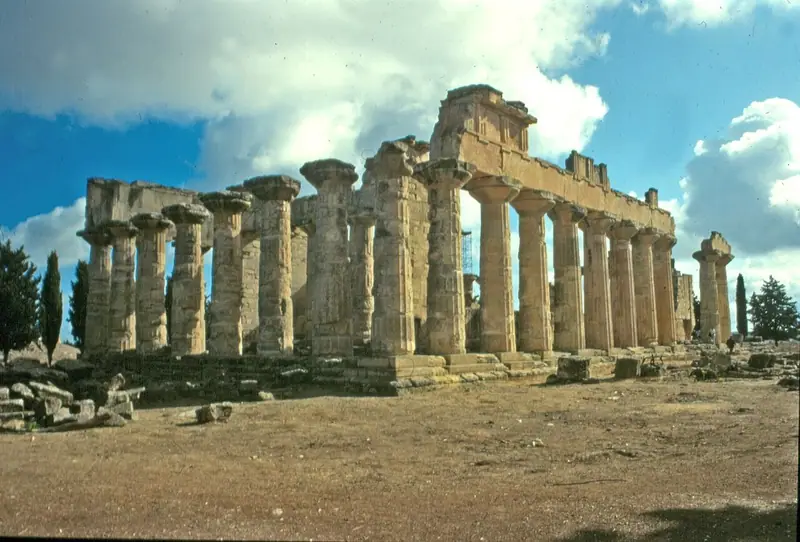 Greek8 stops · c. 631 BCE – 4th century CE
Cyrene audio guide
One of the great cities of the Greek world on the Jebel Akhdar: the Temple of Zeus, the agora, the Sanctuary of Apollo and its spring, the Greek theatre and a vast necropolis.
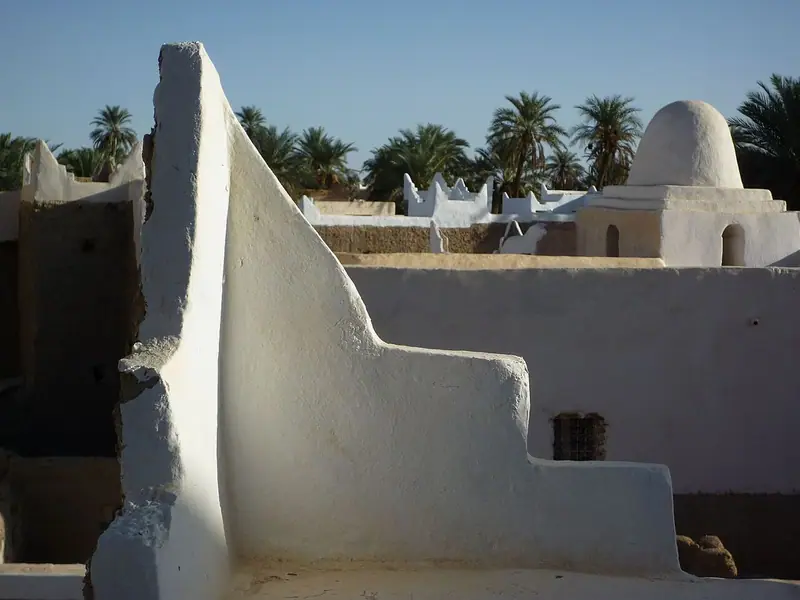 Amazigh7 stops · 1st millennium BCE – 20th century CE
Ghadames audio guide
The Pearl of the Desert: the spring of Ain al-Faras, covered lanes of the old town, the Seven Quarters, a whitewashed Ghadamsi house, the women’s rooftop paths and the palm gardens.
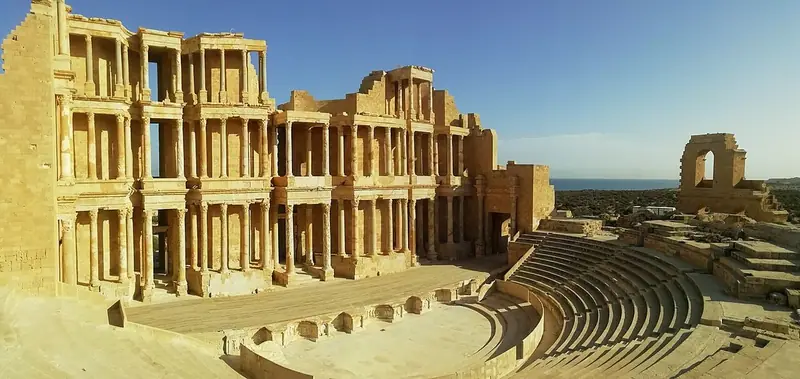 Roman8 stops · 5th century BCE – 7th century CE
Sabratha audio guide
A Punic port turned Roman city by the sea: the towering Punic Mausoleum B, the forum and basilicas, the seaward baths, the three-storey theatre stage and the Temple of Isis.
Every guide, in every country
Leptis Magna and every other guide we publish, including future ones. One payment, no subscription.