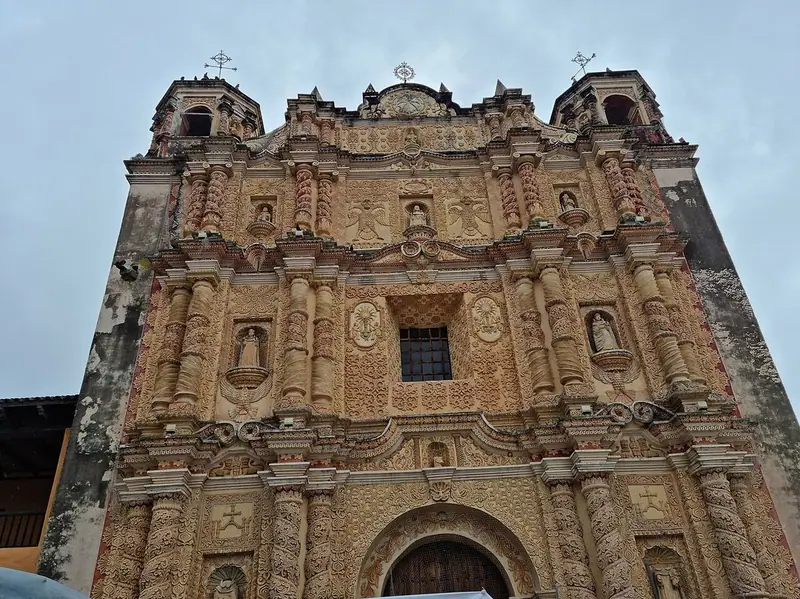
Before you start
San Cristóbal de las Casas lies in a high valley in the highlands of Chiapas, in the far south of Mexico, more than two thousand two hundred metres above sea level and ringed by forested hills. Its low houses, painted in strong colours under tiled roofs, line a grid of streets laid out by the Spanish in the sixteenth century. For more than three centuries it was the seat of Spanish and then Mexican government in Chiapas, and it is still the market town of the Tsotsil and Tseltal Maya communities of the surrounding mountains, whose languages you will hear in its streets. This guide starts at the Arco del Carmen at the southern edge of the centre, walks north through the main square and past the cathedral to Santo Domingo, then heads east to Na Bolom and ends on the hill of Guadalupe.
Use it as a self-guided tour of San Cristóbal de las Casas: 6 stops in visit order, each played when you’re ready, at your own pace.
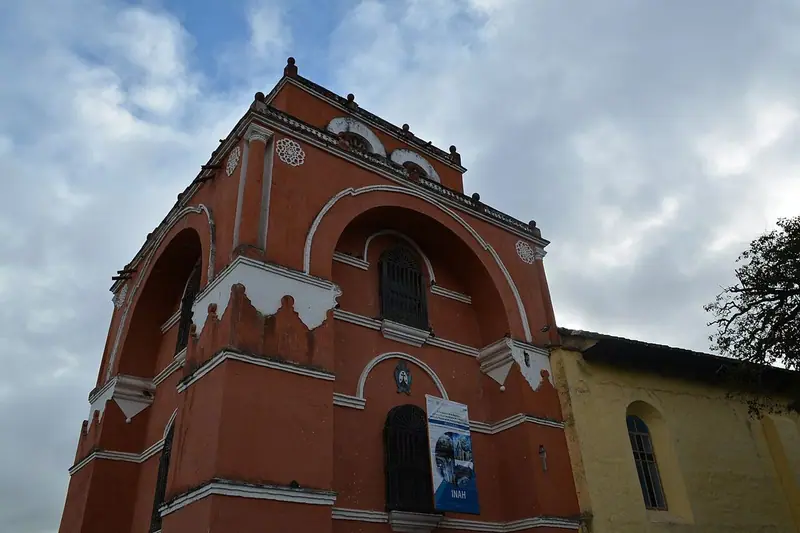 Free preview · Stop 1
The Arco del Carmen
Begin at the Arco del Carmen, the tower with a wide arch that spans the street at the southern end of the pedestrian Andador Hidalgo. It was built in 1677 as the bell tower of the Convent of La Encarnación, a house of Conceptionist nuns. The convent's buildings stood on both sides of the street, and the tower allowed the nuns to pass between them without breaking their enclosure. It also served as a gateway into Ciudad Real. The art historian Manuel Toussaint called it Mudéjar, because its heavy square shape and plaster ornament recall the Islamic-influenced building of Spain; look up inside the arch for the wooden vault with its eight-pointed star. Beside it stands the Templo del Carmen, first dedicated to Saint Sebastian in 1578. In March 1993 a fire spread from a neighbouring bookshop and destroyed its interior, with altarpieces, paintings and a celebrated sixteenth-century statue of Saint Sebastian. The former convent buildings beside the tower are now a cultural centre.
Photo: ProtoplasmaKid · CC BY-SA 4.0 · Wikimedia Commons
What to see at San Cristóbal de las Casas: 6 stops, in visit order
- 01
 The Arco del CarmenA Mudéjar tower over the streetFree preview
- 02
 The Plaza 31 de MarzoThe main square and the town hallIn the guide
- 03
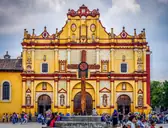 The Cathedral of San CristóbalPlaster lace on a Baroque frontIn the guide
- 04
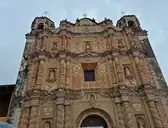 Santo Domingo and La CaridadThe Dominican church and the city's protectorIn the guide
- 05
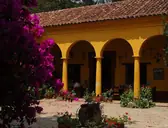 Na BolomThe House of the JaguarIn the guide
- 06
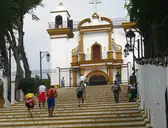 The Hill of GuadalupeSteps to a view over the valleyIn the guide
History of San Cristóbal de las Casas
The valley was Tsotsil Maya land, known in their language as Jovel. In 1528 the conquistador Diego de Mazariegos founded a Spanish town here, Villa Real de Chiapa, after campaigns against the Tsotsil; in 1536 it became Ciudad Real. Dominican friars arrived in 1545, and in the same year Bartolomé de las Casas, the friar who became famous for defending the rights of Indigenous peoples, came to the town as bishop of Chiapas. The Spanish town ruled a province of Maya villages that paid tribute and labour, and in 1712 a great rising of Tseltal, Tsotsil and Chol communities spread across much of the highlands. After independence Chiapas joined Mexico, and in 1848 the town took the name of San Cristóbal de las Casas, in honour of the bishop. It was the state capital until 1892, when the government moved to Tuxtla Gutiérrez.
The full history continues in the guide.
San Cristóbal de las Casas guide: questions
How many stops does the San Cristóbal de las Casas guide have?
6 stops, in visit order: 1. The Arco del Carmen; 2. The Plaza 31 de Marzo; 3. The Cathedral of San Cristóbal; 4. Santo Domingo and La Caridad; 5. Na Bolom; 6. The Hill of Guadalupe.
Can I do a self-guided tour of San Cristóbal de las Casas with this guide?
Yes. The guide is made for a self-guided tour: 6 stops in visit order, each with a photo, a story and a voice, so you can explore San Cristóbal de las Casas at your own pace, without joining a group. Download it before you go and it works offline.
How long is each guide?
The 6 stops add up to about 5 minutes of listening in total. You play each stop when you’re ready, so you can go at your own pace.
Does the guide work offline?
Yes, once it’s downloaded. The guide is a single self-contained web page (about 6.8 MB) with the photos, text and audio built in. Download it to your phone before you go (Wi-Fi is best); after that it opens in any modern browser on iPhone or Android, with no app, account or mobile signal needed.
Does it use GPS or need my location?
No. The guide doesn’t use GPS and doesn’t know where you are: you play each stop when you reach it. It works on iPhone and Android in any modern browser, and it’s in English.
What’s included?
One self-contained HTML guide: 6 stops in visit order, each with a photo, text and a voice, plus the story of who built the site.
Who built San Cristóbal de las Casas?
The valley was Tsotsil Maya land, known in their language as Jovel. In 1528 the conquistador Diego de Mazariegos founded a Spanish town here, Villa Real de Chiapa, after campaigns against the Tsotsil; in 1536 it became Ciudad Real.
Where is San Cristóbal de las Casas?
San Cristóbal de las Casas lies in a high valley in the highlands of Chiapas, in the far south of Mexico, more than two thousand two hundred metres above sea level and ringed by forested hills.
Is there a free audio guide to San Cristóbal de las Casas?
The first stop, The Arco del Carmen, is free to read and hear on this page, so you can try the San Cristóbal de las Casas audio tour before you buy. The full guide, with all 6 stops, is a one-off purchase: download it once and it’s yours to keep, working offline.
Is the San Cristóbal de las Casas guide worth it?
If you’d like to know what you’re looking at, yes. For $10 you get 6 stops in visit order, each with a photo, a short history and a voice you play when you’re ready, about 5 minutes of listening in all. It’s short on purpose, so you spend your time looking, not listening. It’s yours to keep, works offline and needs no app. The first stop is free on this page, so you can try it before you buy. If you’d like hours of detail, a guided tour will go deeper.
Audio guide or guided tour?
It depends how you like to visit. This guide lets you explore San Cristóbal de las Casas at your own pace, at any time, for a one-off price. A guided tour gives you a live expert you can ask questions, but at fixed times and usually for a higher price. Many people use both: a tour for the big picture, and the guide to read beforehand or to revisit the stops in their own time.
Is this the official San Cristóbal de las Casas guide?
No. It’s an independent guide by The Historian Guide, not affiliated with or endorsed by the operator of San Cristóbal de las Casas. For tickets and opening hours, check the official site operator before you go.
Does the guide include entry tickets or opening hours?
No. The guide is a digital companion only. Admission to San Cristóbal de las Casas is separate, so check the official site operator for current tickets and opening hours before you go.
- Stop 1 · The Arco del Carmen: ProtoplasmaKid · CC BY-SA 4.0 · Wikimedia Commons · resized
- Stop 2 · The Plaza 31 de Marzo: Agguizar~commonswiki · Public domain · Wikimedia Commons · resized
- Stop 3 · The Cathedral of San Cristóbal: GameOfLight · CC BY-SA 3.0 · Wikimedia Commons · resized
- Stop 4 · Santo Domingo and La Caridad (also the cover): Globetrotteur17... Ici, là-bas ou ailleurs... · CC BY-SA 2.0 · Wikimedia Commons · resized
- Stop 5 · Na Bolom: Comisión Mexicana de Filmaciones from México D. F., México · CC BY-SA 2.0 · Wikimedia Commons · resized
- Stop 6 · The Hill of Guadalupe: BIOLOGO JORGE AYALA · CC BY-SA 4.0 · Wikimedia Commons · resized


All photographs from Wikimedia Commons under the licences shown.
More guides in Mexico
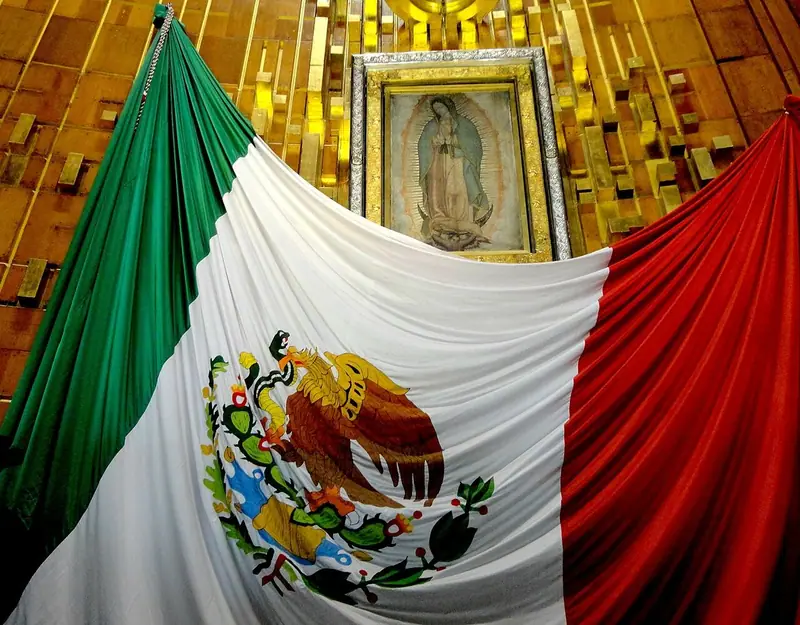 New Spain and Mexico8 stops · Colonial and modern Mexico
The Basilica of Guadalupe audio guide
Cross the great plaza of the world’s most visited Catholic shrine to see the image of Our Lady of Guadalupe, then climb the hill of Tepeyac.
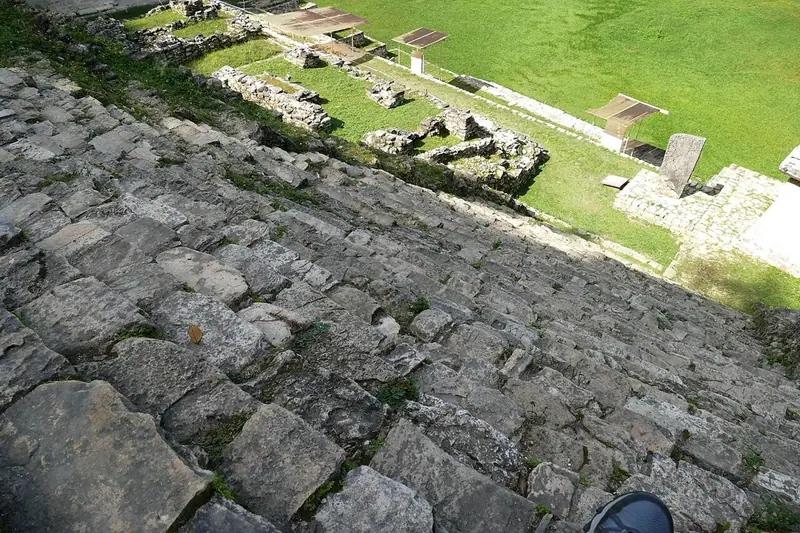 Maya6 stops · c. 600–800 CE
Bonampak audio guide
Three small rooms in the Lacandon forest painted with vivid Maya murals: a royal court, a battle and a celebration.
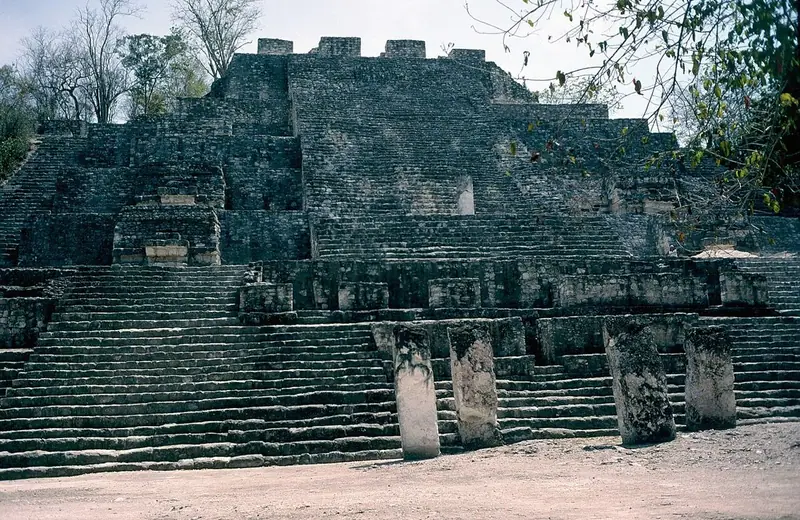 Maya6 stops · c. 250–900 CE
Calakmul audio guide
Capital of the Snake Kingdom, rising out of the Campeche rainforest.
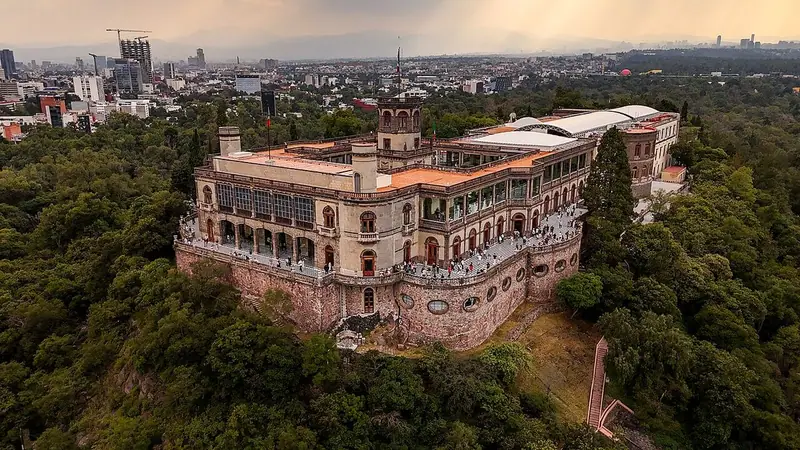 New Spain and Mexico8 stops · Second Mexican Empire
Chapultepec Castle audio guide
Climb the hill of Chapultepec to the castle of a viceroy, an emperor and presidents, now the National Museum of History.
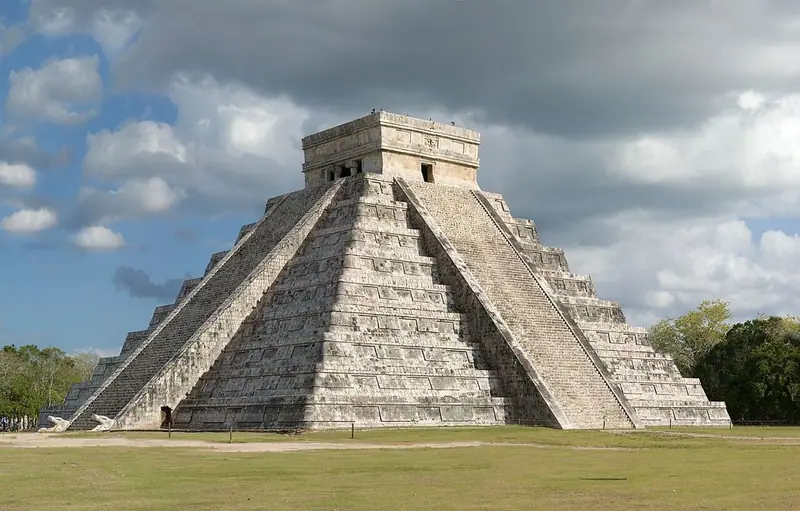 Maya8 stops · c. 600–1200 CE
Chichén Itzá audio guide
El Castillo and its serpent of light, the greatest ballcourt in Mesoamerica and the Sacred Cenote.
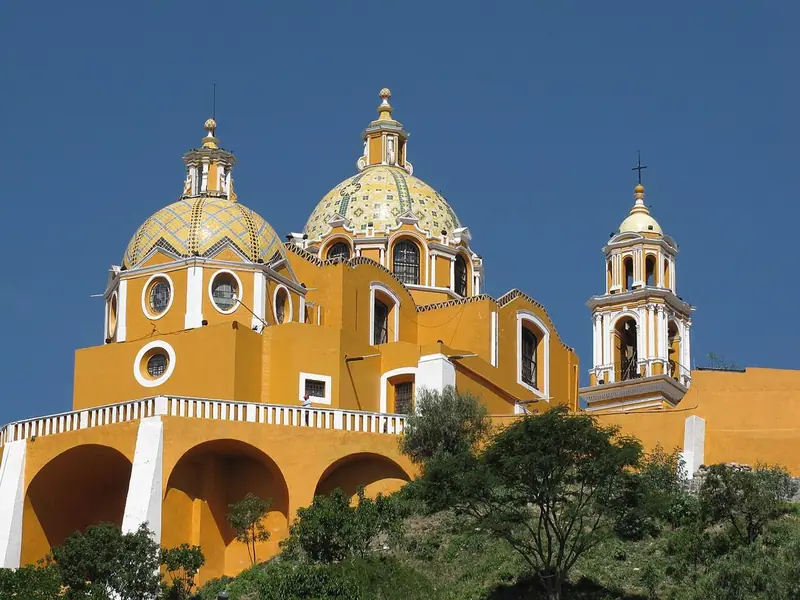 Mesoamerican6 stops · c. 300 BCE – 900 CE (pyramid)
Cholula audio guide
Tunnel into the Great Pyramid, then climb to the church on its summit and the view of the volcanoes.
Every guide, in every country
San Cristóbal de las Casas and every other guide we publish, including future ones. One payment, no subscription.