Before you start
This is a driving route, not a town walk. It crosses the district of Sogn, around the inner arms of the Sognefjord, and links four medieval stave churches with a historic mountain road and a timber village. The day begins at Urnes, the oldest and the only stave church on the World Heritage List, reached by a short ferry from Solvorn. It then calls at Kaupanger and, as a westward detour, at Hopperstad in Vik, before heading east to Borgund, the best preserved of all stave churches, the hairpin road of Vindhellavegen, and the old wooden quarter of Lærdalsøyri. Distances are large: allow a full day, or better two, and check ferry times before you set out. In winter some passes and side roads may be closed or difficult.
Use it as a self-guided tour of Norwegian Stave Churches: 6 stops in visit order, each played when you’re ready, at your own pace.
 Free preview · Stop 1
Urnes Stave Church
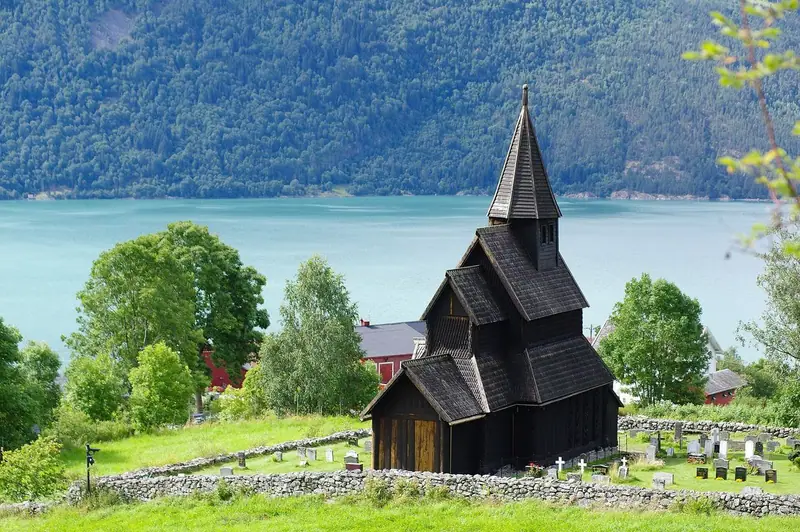
Urnes stands on a terrace above the Lustrafjord at the hamlet of Ornes, looking across the water to Solvorn. It is among the oldest stave churches in Norway: much of the present building dates from the first half of the twelfth century, and some of the timber was reused from an eleventh-century church on the same site. The north portal is the masterpiece of what is called the Urnes style, a weaving of animals and snakes in high, slender relief, a last flowering of Viking carving on a Christian door. Inside, cylindrical columns and capitals of the same style support a dim, basilican nave. The church has belonged to the Society for the Preservation of Ancient Norwegian Monuments since 1881, and in 1979 it was inscribed as a World Heritage Site, the only stave church on that list. From Ornes, take the ferry back to Solvorn and drive south to Kaupanger, on the Sognefjord.
Photo: Bjørn Erik Pedersen · CC BY-SA 4.0 · Wikimedia Commons
What to see at Norwegian Stave Churches: 6 stops, in visit order
- 01
 Urnes Stave ChurchThe World Heritage churchFree preview
- 02
 Kaupanger Stave ChurchThe church by the fjordIn the guide
- 03
 Hopperstad Stave ChurchThe church at VikIn the guide
- 04
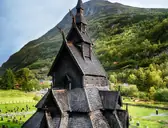 Borgund Stave ChurchThe classic stave churchIn the guide
- 05
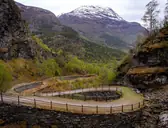 VindhellavegenThe old king’s roadIn the guide
- 06
 LærdalsøyriThe timber villageIn the guide
Site map of Norwegian Stave Churches
History of Norwegian Stave Churches
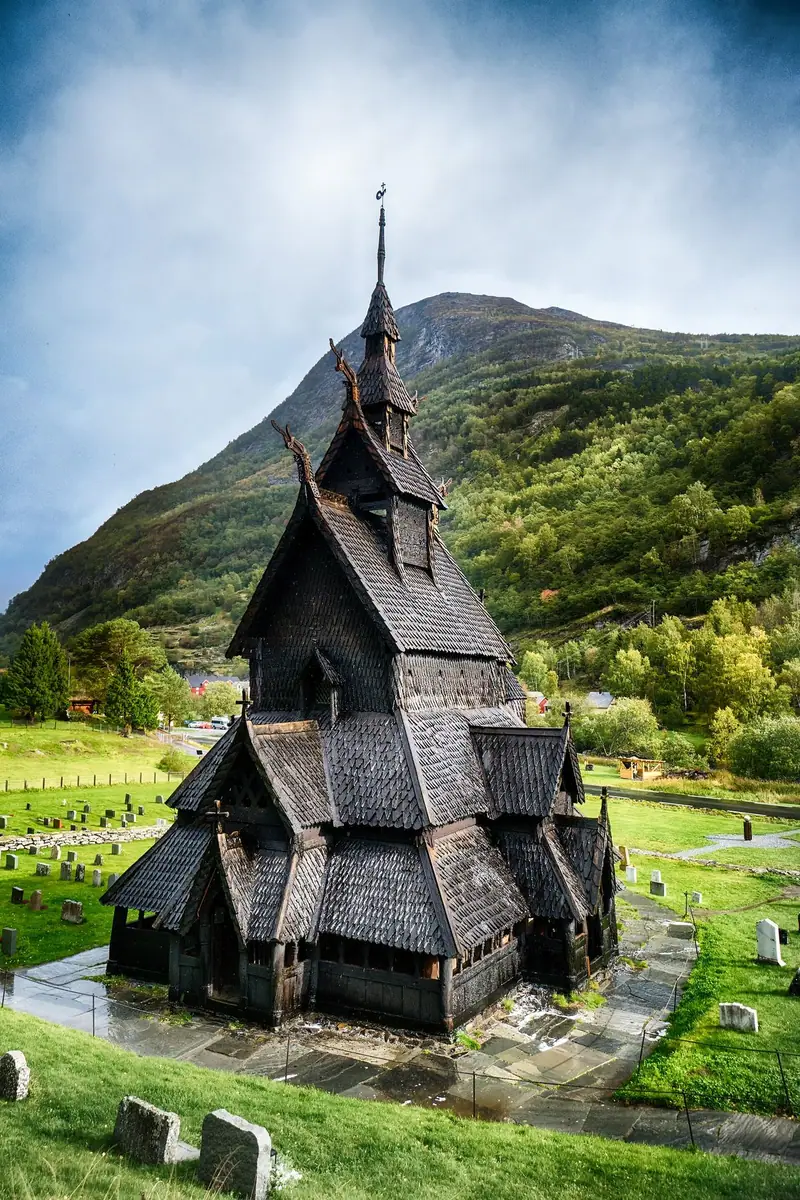
A stave church is a wooden church whose walls are of upright planks, or staves, set on a timber frame that rests on a stone foundation. Hundreds were built in Norway in the twelfth and thirteenth centuries, as the country became Christian, and a small number survive, most of them in the fjord country of the west. Their dragon-head eaves, carved portals and dark, scented interiors belong to a moment when Viking ornament and Christian architecture met. Urnes, begun in the twelfth century with timber from an even earlier church, gave its name to a style of carving, and was declared a World Heritage Site in 1979. Borgund, built around 1200, is the one that looks most as people imagine a stave church to look. The later villages and roads of Sogn — Vindhellavegen, Lærdalsøyri — show how this same landscape was travelled and settled in the centuries after the churches were raised.
Norwegian Stave Churches guide: questions
How many stops does the Norwegian Stave Churches guide have?
6 stops, in visit order: 1. Urnes Stave Church; 2. Kaupanger Stave Church; 3. Hopperstad Stave Church; 4. Borgund Stave Church; 5. Vindhellavegen; 6. Lærdalsøyri.
Can I do a self-guided tour of Norwegian Stave Churches with this guide?
Yes. The guide is made for a self-guided tour: 6 stops in visit order, each with a photo, a story and a voice, so you can explore Norwegian Stave Churches at your own pace, without joining a group. Download it before you go and it works offline.
How long is each guide?
The 6 stops add up to about 4 minutes of listening in total. You play each stop when you’re ready, so you can go at your own pace.
Does the guide work offline?
Yes, once it’s downloaded. The guide is a single self-contained web page (about 7.0 MB) with the photos, text and audio built in. Download it to your phone before you go (Wi-Fi is best); after that it opens in any modern browser on iPhone or Android, with no app, account or mobile signal needed.
Does it use GPS or need my location?
No. The guide doesn’t use GPS and doesn’t know where you are: you play each stop when you reach it. It works on iPhone and Android in any modern browser, and it’s in English.
What’s included?
One self-contained HTML guide: 6 stops in visit order, each with a photo, text and a voice, plus the story of who built the site.
Who built Norwegian Stave Churches?
A stave church is a wooden church whose walls are of upright planks, or staves, set on a timber frame that rests on a stone foundation. Hundreds were built in Norway in the twelfth and thirteenth centuries, as the country became Christian, and a small number survive, most of them in the fjord country of the west.
Is there a free audio guide to Norwegian Stave Churches?
The first stop, Urnes Stave Church, is free to read and hear on this page, so you can try the Norwegian Stave Churches audio tour before you buy. The full guide, with all 6 stops, is a one-off purchase: download it once and it’s yours to keep, working offline.
Is the Norwegian Stave Churches guide worth it?
If you’d like to know what you’re looking at, yes. For $10 you get 6 stops in visit order, each with a photo, a short history and a voice you play when you’re ready, plus a site map of the stops, and about 4 minutes of listening in all. It’s short on purpose, so you spend your time looking, not listening. It’s yours to keep, works offline and needs no app. The first stop is free on this page, so you can try it before you buy. If you’d like hours of detail, a guided tour will go deeper.
Audio guide or guided tour?
It depends how you like to visit. This guide lets you explore Norwegian Stave Churches at your own pace, at any time, for a one-off price. A guided tour gives you a live expert you can ask questions, but at fixed times and usually for a higher price. Many people use both: a tour for the big picture, and the guide to read beforehand or to revisit the stops in their own time.
Is this the official Norwegian Stave Churches guide?
No. It’s an independent guide by The Historian Guide, not affiliated with or endorsed by the operator of Norwegian Stave Churches. For tickets and opening hours, check the official site operator before you go.
Does the guide include entry tickets or opening hours?
No. The guide is a digital companion only. Admission to Norwegian Stave Churches is separate, so check the official site operator for current tickets and opening hours before you go.
- Stop 1 · Urnes Stave Church: Bjørn Erik Pedersen · CC BY-SA 4.0 · Wikimedia Commons · resized
- Stop 2 · Kaupanger Stave Church: Bjørn Erik Pedersen · CC BY-SA 4.0 · Wikimedia Commons · resized
- Stop 3 · Hopperstad Stave Church: Bjørn Erik Pedersen · CC BY-SA 4.0 · Wikimedia Commons · resized
- Stop 4 · Borgund Stave Church (also the cover): mendhak · CC BY-SA 2.0 · Wikimedia Commons · resized
- Stop 5 · Vindhellavegen: Auglanda · CC BY-SA 4.0 · Wikimedia Commons · resized
- Stop 6 · Lærdalsøyri: Bjørn Erik Pedersen · CC BY-SA 4.0 · Wikimedia Commons · resized


All photographs from Wikimedia Commons under the licences shown.
More guides in Norway
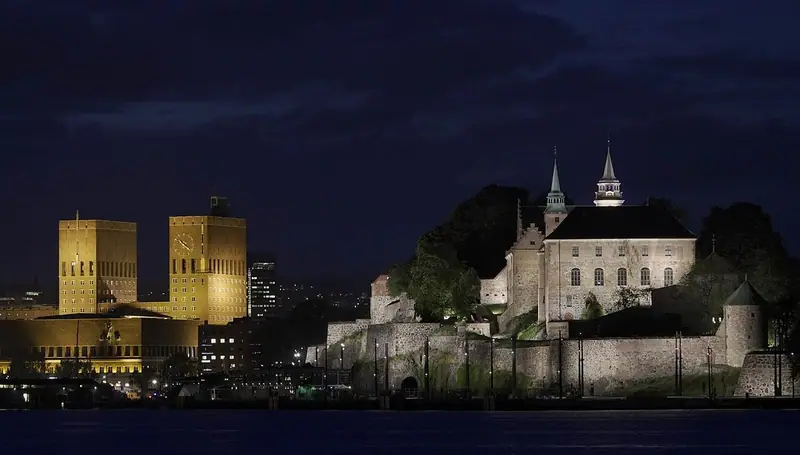 Kingdom of Norway7 stops · c. 1300–1945
Akershus Fortress audio guide
Pass through the gate and along the ramparts of Oslo’s headland fortress, into the castle halls and the tombs of Norway’s kings.
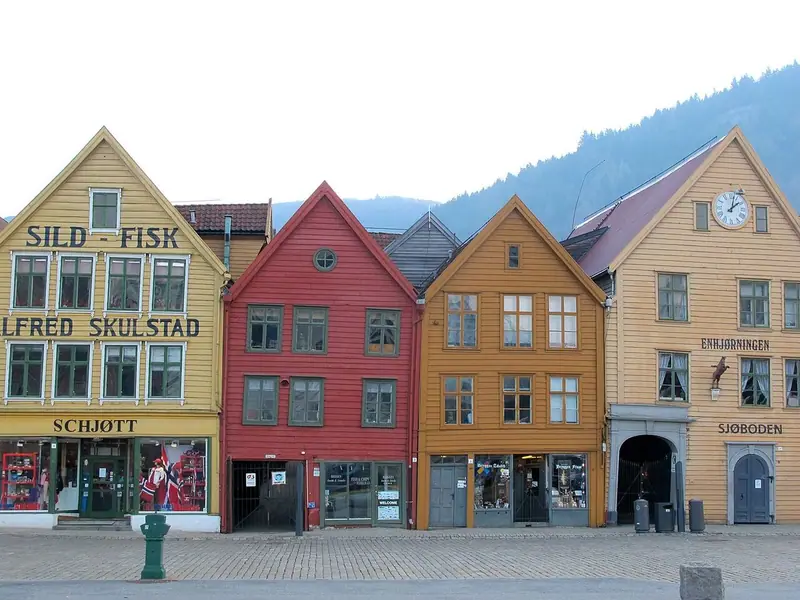 Hanseatic8 stops · 14th–18th century
Bryggen audio guide
Explore the gabled wooden wharf of Bergen, one of the great trading posts of the Hanseatic League, and its narrow passages.
 Norse8 stops · 997–1537
Nidaros and Old Trondheim audio guide
From the market square past the royal wooden palace to Nidaros Cathedral, shrine of Saint Olav, then across the Old Town Bridge to Bakklandet.
Every guide, in every country
Norwegian Stave Churches and every other guide we publish, including future ones. One payment, no subscription.