Before you start
Old Muscat is a small, walled harbour city, held between the sea and a ring of dark hills, with a ceremonial palace between two Portuguese forts. A short way along the coast, Muttrah was the merchant harbour, with a corniche, a fort and a historic market quarter. This guide begins in Old Muscat, at the façade of Al Alam Palace and the forts of Al Jalali and Al Mirani, and follows the corniche to Muttrah Fort and the historic souq. It then returns towards the National Museum, in the old city, and finishes at the Sultan Qaboos Grand Mosque, a drive of some fifteen to twenty minutes west, in the modern town. The first five stops lie along a few kilometres of coast; the mosque is a separate journey. If you wish to go inside the mosque, note that non-Muslim visitors are admitted only on Saturday to Thursday mornings, and it may be better to start the day there and come back to Old Muscat afterwards.
Use it as a self-guided tour of Muscat and Muttrah: 6 stops in visit order, each played when you’re ready, at your own pace.
 Free preview · Stop 1
Al Alam Palace
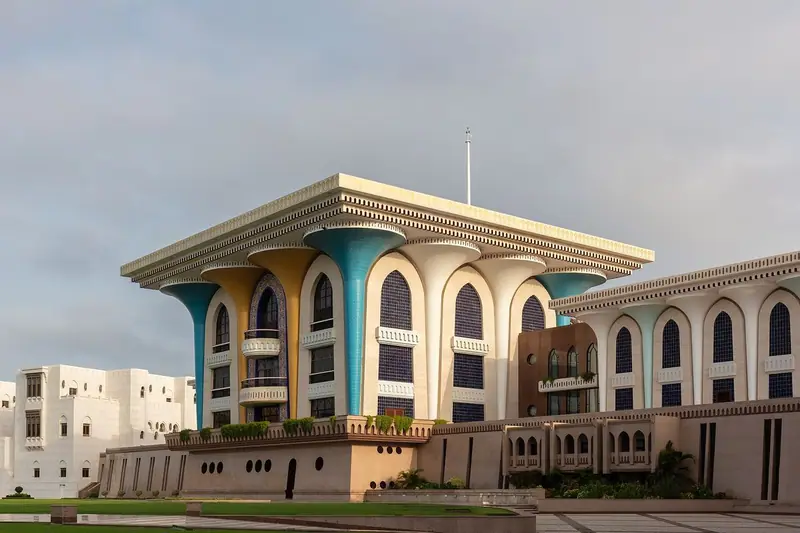
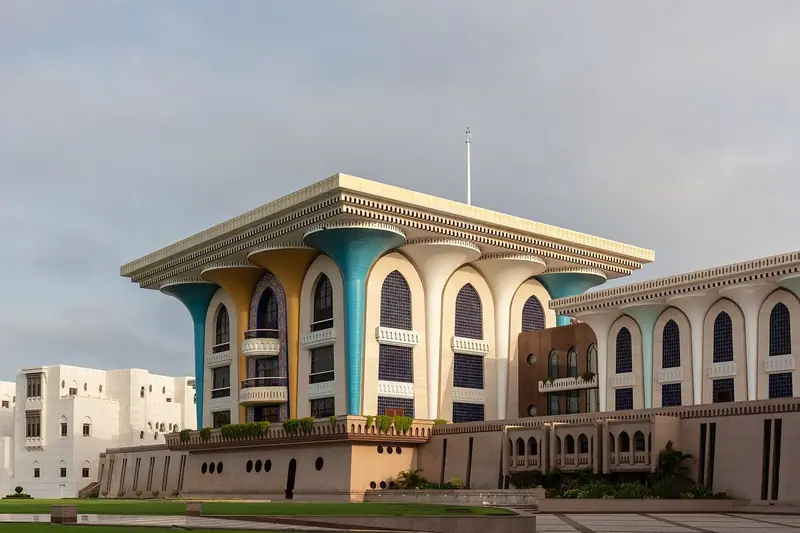
Al Alam Palace, the Palace of the Flag, is the sultan’s ceremonial palace in Old Muscat, a long façade of gold and blue columns facing a formal square, with the harbour and the two Portuguese forts on either side. The present front was completed in 1972, early in the reign of Sultan Qaboos, on a site of older palaces, and it is used for state occasions rather than as a daily residence. The building is not generally open to the public, and this stop is about the façade, the square and the setting: a modern ceremonial front placed, very deliberately, in the heart of the old harbour city, between the forts that once commanded it. From the square, look left and right to Al Jalali and Al Mirani, the two forts that close the cove.
Photo: Diego Delso · CC BY-SA 4.0 · Wikimedia Commons
What to see at Muscat and Muttrah: 6 stops, in visit order
- 01
 Al Alam PalaceThe ceremonial façadeFree preview
- 02
 Al Jalali and Al Mirani FortsThe Portuguese harbourIn the guide
- 03
 The Muttrah Corniche and Muttrah FortThe merchant harbourIn the guide
- 04
 The Muttrah SouqThe historic market quarterIn the guide
- 05
 The National MuseumThe story of OmanIn the guide
- 06
 The Sultan Qaboos Grand MosqueThe mosque of the modern sultanateIn the guide
Site map of Muscat and Muttrah
History of Muscat and Muttrah
Muscat’s harbour was already in use in the Islamic Middle Ages, and in 1507 it was seized by the Portuguese under Afonso de Albuquerque, who made it a strongpoint on the way to India. They rebuilt the forts of Al Jalali and Al Mirani on either side of the cove, and held the town, with interruptions, until the mid-seventeenth century, when the Omanis drove them out and the Ya‘ariba and later the Al Bu Sa‘id imams and sultans made Muscat their capital. A wall with gates, completed in the seventeenth century, still closes the old city on the landward side. Muttrah, just beyond the next headland, was the busier commercial harbour. In the late twentieth century Sultan Qaboos bin Said moved the ceremonial centre into a new palace façade on the old waterfront, and in 2001 he opened a grand mosque in the western suburbs, a monument of the modern sultanate rather than of the walled town.
Muscat and Muttrah guide: questions
How many stops does the Muscat and Muttrah guide have?
6 stops, in visit order: 1. Al Alam Palace; 2. Al Jalali and Al Mirani Forts; 3. The Muttrah Corniche and Muttrah Fort; 4. The Muttrah Souq; 5. The National Museum; 6. The Sultan Qaboos Grand Mosque.
Can I do a self-guided tour of Muscat and Muttrah with this guide?
Yes. The guide is made for a self-guided tour: 6 stops in visit order, each with a photo, a story and a voice, so you can explore Muscat and Muttrah at your own pace, without joining a group. Download it before you go and it works offline.
How long is each guide?
The 6 stops add up to about 4 minutes of listening in total. You play each stop when you’re ready, so you can go at your own pace.
Does the guide work offline?
Yes, once it’s downloaded. The guide is a single self-contained web page (about 5.5 MB) with the photos, text and audio built in. Download it to your phone before you go (Wi-Fi is best); after that it opens in any modern browser on iPhone or Android, with no app, account or mobile signal needed.
Does it use GPS or need my location?
No. The guide doesn’t use GPS and doesn’t know where you are: you play each stop when you reach it. It works on iPhone and Android in any modern browser, and it’s in English.
What’s included?
One self-contained HTML guide: 6 stops in visit order, each with a photo, text and a voice, plus the story of who built the site.
Who built Muscat and Muttrah?
Muscat’s harbour was already in use in the Islamic Middle Ages, and in 1507 it was seized by the Portuguese under Afonso de Albuquerque, who made it a strongpoint on the way to India. They rebuilt the forts of Al Jalali and Al Mirani on either side of the cove, and held the town, with interruptions, until the mid-seventeenth century, when the Omanis drove them out and the Ya‘ariba and later the Al Bu Sa‘id imams and sultans made Muscat their capital.
Where is Muscat and Muttrah?
Old Muscat is a small, walled harbour city, held between the sea and a ring of dark hills, with a ceremonial palace between two Portuguese forts.
Is there a free audio guide to Muscat and Muttrah?
The first stop, Al Alam Palace, is free to read and hear on this page, so you can try the Muscat and Muttrah audio tour before you buy. The full guide, with all 6 stops, is a one-off purchase: download it once and it’s yours to keep, working offline.
Is the Muscat and Muttrah guide worth it?
If you’d like to know what you’re looking at, yes. For $10 you get 6 stops in visit order, each with a photo, a short history and a voice you play when you’re ready, plus a site map of the stops, and about 4 minutes of listening in all. It’s short on purpose, so you spend your time looking, not listening. It’s yours to keep, works offline and needs no app. The first stop is free on this page, so you can try it before you buy. If you’d like hours of detail, a guided tour will go deeper.
Audio guide or guided tour?
It depends how you like to visit. This guide lets you explore Muscat and Muttrah at your own pace, at any time, for a one-off price. A guided tour gives you a live expert you can ask questions, but at fixed times and usually for a higher price. Many people use both: a tour for the big picture, and the guide to read beforehand or to revisit the stops in their own time.
Is this the official Muscat and Muttrah guide?
No. It’s an independent guide by The Historian Guide, not affiliated with or endorsed by the operator of Muscat and Muttrah. For tickets and opening hours, check the official site operator before you go.
Does the guide include entry tickets or opening hours?
No. The guide is a digital companion only. Admission to Muscat and Muttrah is separate, so check the official site operator for current tickets and opening hours before you go.
- Stop 1 · Al Alam Palace (also the cover): Diego Delso · CC BY-SA 4.0 · Wikimedia Commons · resized
- Stop 2 · Al Jalali and Al Mirani Forts: Diego Delso · CC BY-SA 4.0 · Wikimedia Commons · resized
- Stop 3 · The Muttrah Corniche and Muttrah Fort: Albinfo · CC BY 4.0 · Wikimedia Commons · resized
- Stop 4 · The Muttrah Souq: dronepicr · CC BY 2.0 · Wikimedia Commons · resized
- Stop 5 · The National Museum: Michael Homan · CC BY 2.0 · Wikimedia Commons · resized
- Stop 6 · The Sultan Qaboos Grand Mosque: Mostafameraji · CC BY-SA 4.0 · Wikimedia Commons · resized


All photographs from Wikimedia Commons under the licences shown.
More guides in Oman
 Omani7 stops · 12th–15th century
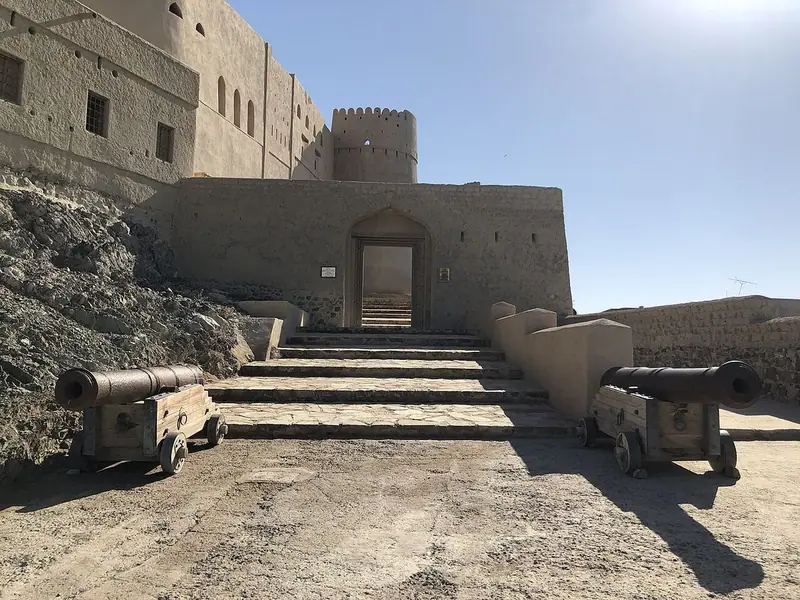
Bahla Fort audio guide
The gates and courtyards of Bahla’s great mud-brick fort above the palm groves, Oman’s first World Heritage Site.
 Omani7 stops · 1650s
Nizwa Fort and Souq audio guide
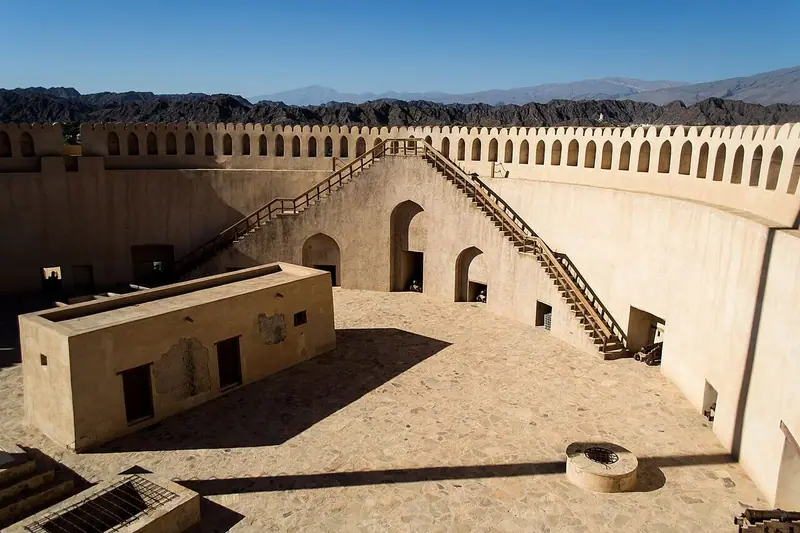
The date and silver souqs of the oasis town of Nizwa, and the stairs of its great round tower.
 Carolingian6 stops · 788–1531
Aachen audio guide
From Charlemagne’s Palatine Chapel and the cathedral treasury, across the courtyard to the Town Hall and the Carolingian Granus Tower, then to the Elisenbrunnen spa fountain and the fourteenth-century Ponttor.
Every guide, in every country
Muscat and Muttrah and every other guide we publish, including future ones. One payment, no subscription.