Before you start
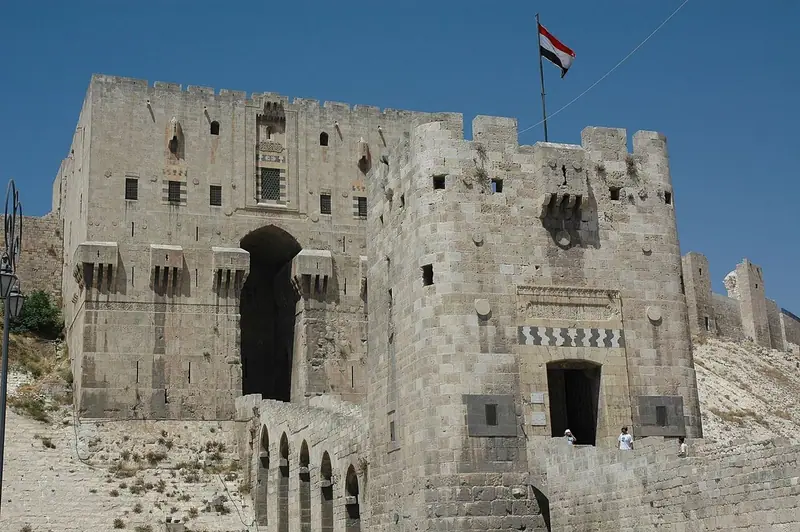
Aleppo, in northern Syria, is one of the oldest cities in the world, and for centuries it was a great market at the western end of the trade routes from Persia, India and beyond. Its old city is crowned by a citadel on a huge mound, and below it lies a maze of covered souqs, mosques, madrasas, caravanserais and courtyard houses. UNESCO inscribed the Ancient City of Aleppo as a World Heritage Site in 1986. Since 2013 it has been on the List of World Heritage in Danger. The old city was a front line in the battle for Aleppo from 2012 to 2016, and a large part of its historic fabric was damaged or destroyed; the earthquake of February 2023 caused further damage. Restoration has been under way since 2017: the citadel has reopened, souqs are reopening one by one, and the Great Mosque reopened fully in October 2026. Check your government’s current travel advice before you plan a visit.
Use it as a self-guided tour of the Ancient City of Aleppo: 10 stops in visit order, each played when you’re ready, at your own pace.
 Free preview · Stop 1
The Citadel Mound
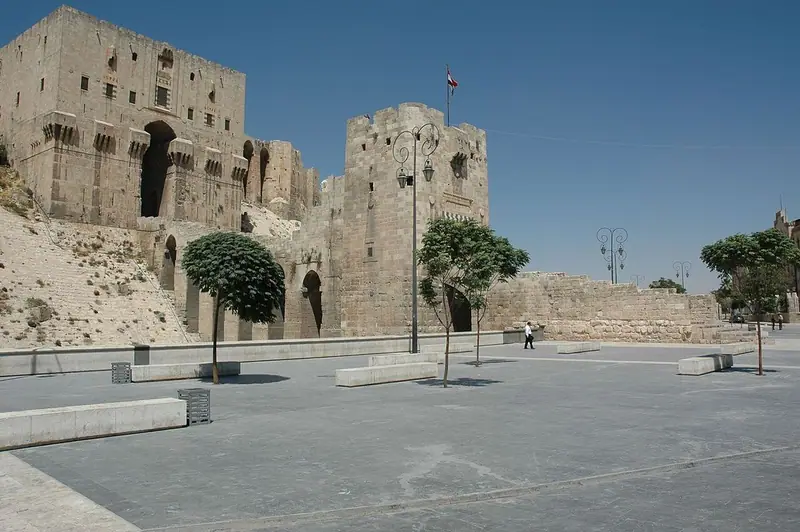
Begin in the square south of the Citadel, which rises from the heart of the old city on an oval mound about 50 metres high. Partly natural rock, it was raised over thousands of years by layers of settlement, and in the Middle Ages its slopes were faced with smooth limestone, some of which survives. A moat about 22 metres deep and 30 metres wide surrounds it. Most of what you see dates from the Ayyubid period, especially the reign of al-Zahir Ghazi between 1193 and 1215, with later Mamluk towers. During the battle for Aleppo the Citadel served as a military base, and it was damaged by shelling in 2012 and by a tunnel bomb under its walls in 2015. Look across the square too: the Khusruwiyah Mosque and the Carlton Hotel opposite were destroyed in 2014, and the Grand Serail was almost entirely destroyed the same year.
Photo: Ron Van Oers · CC BY-SA 3.0 IGO · Wikimedia Commons
What to see at the Ancient City of Aleppo: 10 stops, in visit order
- 01
 The Citadel MoundA fortress on an ancient hillFree preview
- 02
 Hammam YalbughaA bathhouse at the foot of the CitadelIn the guide
- 03
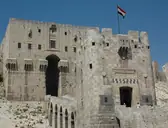 The Bridge and GateSix turns to the topIn the guide
- 04
 The Throne HallA Mamluk audience chamberIn the guide
- 05
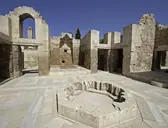 The Ayyubid PalaceSplendour on the summitIn the guide
- 06
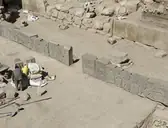 The Temple of the Storm GodFive thousand years of worshipIn the guide
- 07
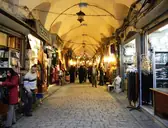 The Souq al-MadinaMiles of covered marketsIn the guide
- 08
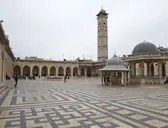 The Great MosqueA minaret rebuilt from its stonesIn the guide
- 09
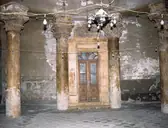 The Halawiyah MadrasaA cathedral within a schoolIn the guide
- 10
 The Jdeydeh QuarterMansions, churches and squaresIn the guide
Site map of the Ancient City of Aleppo
History of the Ancient City of Aleppo
People have lived on and around the citadel hill for at least five thousand years. In the Bronze Age Aleppo was the capital of the kingdom of Yamhad, and a temple to the storm god Hadad stood on the hill. Hittites, Assyrians and Persians followed, and after Alexander the Great the Seleucid kings laid out a Greek city called Beroea, whose street grid can still be traced. Arab armies took the city in 636. In the tenth century the Hamdanid prince Sayf al-Dawla made it a brilliant court, and in the twelfth century Nur al-Din made it a bastion against the Crusaders. Saladin’s son al-Zahir Ghazi rebuilt the citadel around 1200.
The full history continues in the guide.
Ancient City of Aleppo guide: questions
How many stops does the Ancient City of Aleppo guide have?
10 stops, in visit order: 1. The Citadel Mound; 2. Hammam Yalbugha; 3. The Bridge and Gate; 4. The Throne Hall; 5. The Ayyubid Palace; 6. The Temple of the Storm God; 7. The Souq al-Madina; 8. The Great Mosque; 9. The Halawiyah Madrasa; 10. The Jdeydeh Quarter.
Can I do a self-guided tour of the Ancient City of Aleppo with this guide?
Yes. The guide is made for a self-guided tour: 10 stops in visit order, each with a photo, a story and a voice, so you can explore the Ancient City of Aleppo at your own pace, without joining a group. Download it before you go and it works offline.
How long do you need at the Ancient City of Aleppo?
We suggest allowing A full day. The 10 stops add up to about 7 minutes of listening, and you play each one when you’re ready, so you can linger wherever you like.
How long is each guide?
The 10 stops add up to about 7 minutes of listening in total. You play each stop when you’re ready, so you can go at your own pace.
Does the guide work offline?
Yes, once it’s downloaded. The guide is a single self-contained web page (about 8.6 MB) with the photos, text and audio built in. Download it to your phone before you go (Wi-Fi is best); after that it opens in any modern browser on iPhone or Android, with no app, account or mobile signal needed.
Does it use GPS or need my location?
No. The guide doesn’t use GPS and doesn’t know where you are: you play each stop when you reach it. It works on iPhone and Android in any modern browser, and it’s in English.
What’s included?
One self-contained HTML guide: 10 stops in visit order, each with a photo, text and a voice, plus the story of who built the site.
Who built the Ancient City of Aleppo?
People have lived on and around the citadel hill for at least five thousand years. In the Bronze Age Aleppo was the capital of the kingdom of Yamhad, and a temple to the storm god Hadad stood on the hill.
Where is the Ancient City of Aleppo?
Aleppo, in northern Syria, is one of the oldest cities in the world, and for centuries it was a great market at the western end of the trade routes from Persia, India and beyond.
Is there a free audio guide to the Ancient City of Aleppo?
The first stop, The Citadel Mound, is free to read and hear on this page, so you can try the Ancient City of Aleppo audio tour before you buy. The full guide, with all 10 stops, is a one-off purchase: download it once and it’s yours to keep, working offline.
Is the Ancient City of Aleppo guide worth it?
If you’d like to know what you’re looking at, yes. For $10 you get 10 stops in visit order, each with a photo, a short history and a voice you play when you’re ready, plus a site map of the stops, and about 7 minutes of listening in all. It’s short on purpose, so you spend your time looking, not listening. It’s yours to keep, works offline and needs no app. The first stop is free on this page, so you can try it before you buy. If you’d like hours of detail, a guided tour will go deeper.
Audio guide or guided tour?
It depends how you like to visit. This guide lets you explore the Ancient City of Aleppo at your own pace, at any time, for a one-off price. A guided tour gives you a live expert you can ask questions, but at fixed times and usually for a higher price. Many people use both: a tour for the big picture, and the guide to read beforehand or to revisit the stops in their own time.
Is this the official Ancient City of Aleppo guide?
No. It’s an independent guide by The Historian Guide, not affiliated with or endorsed by the operator of the Ancient City of Aleppo. For tickets and opening hours, check the official site operator before you go.
Does the guide include entry tickets or opening hours?
No. The guide is a digital companion only. Admission to the Ancient City of Aleppo is separate, so check the official site operator for current tickets and opening hours before you go.
- Stop 1 · The Citadel Mound: Ron Van Oers · CC BY-SA 3.0 igo · Wikimedia Commons · resized
- Stop 2 · Hammam Yalbugha: Bernard Gagnon · CC BY-SA 3.0 · Wikimedia Commons · resized
- Stop 3 · The Bridge and Gate (also the cover): Ron Van Oers · CC BY-SA 3.0 igo · Wikimedia Commons · resized
- Stop 4 · The Throne Hall: Mousa alhilal · CC BY-SA 4.0 · Wikimedia Commons · resized
- Stop 5 · The Ayyubid Palace: Dosseman · CC BY-SA 4.0 · Wikimedia Commons · resized
- Stop 6 · The Temple of the Storm God: Dosseman · CC BY-SA 4.0 · Wikimedia Commons · resized
- Stop 7 · The Souq al-Madina: Spetsnaz1945 · CC BY-SA 2.0 · Wikimedia Commons · resized
- Stop 8 · The Great Mosque: Dosseman · CC BY-SA 4.0 · Wikimedia Commons · resized
- Stop 9 · The Halawiyah Madrasa: Frank Kidner · CC BY-SA 4.0 · Wikimedia Commons · resized
- Stop 10 · The Jdeydeh Quarter: Dosseman · CC BY-SA 4.0 · Wikimedia Commons · resized


All photographs from Wikimedia Commons under the licences shown.
More guides in Syria
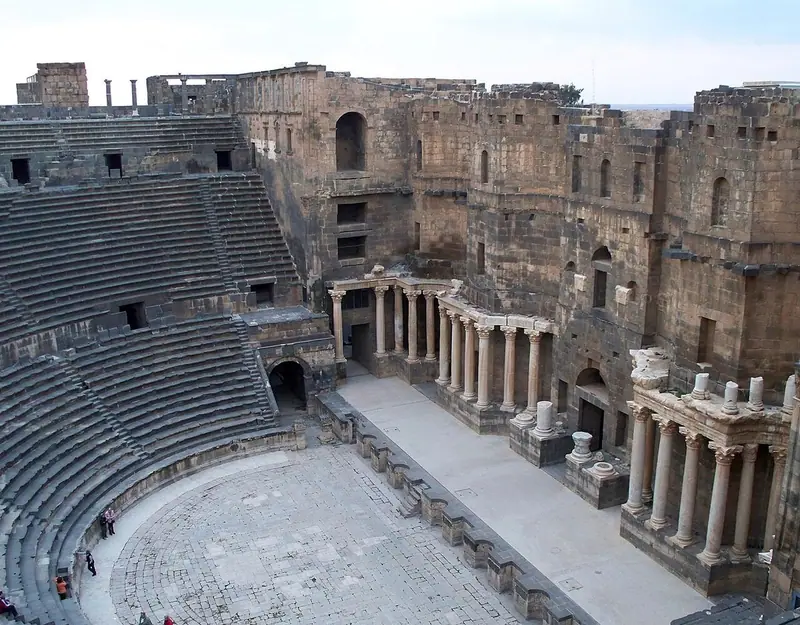 Roman10 stops · 2nd – 7th century CE
Ancient City of Bosra audio guide
Capital of Roman Arabia in black basalt: a near-complete Roman theatre sealed inside an Ayyubid citadel, colonnaded streets, early churches and one of Islam’s oldest mosques.
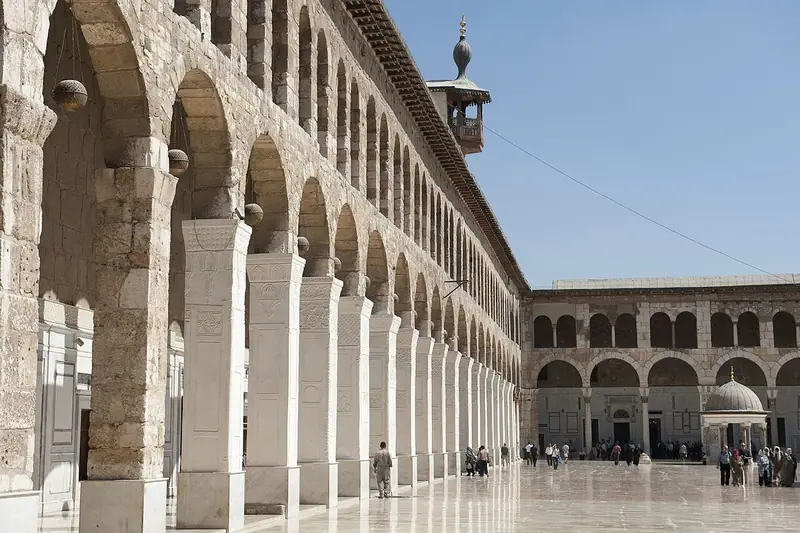 Umayyad10 stops · From the 2nd millennium BCE; Umayyad capital 661–750
Ancient City of Damascus audio guide
One of the world’s oldest cities: the Umayyad Mosque and its golden mosaics, the Citadel, Saladin’s tomb, Ottoman palaces and caravanserais, and the Street called Straight.
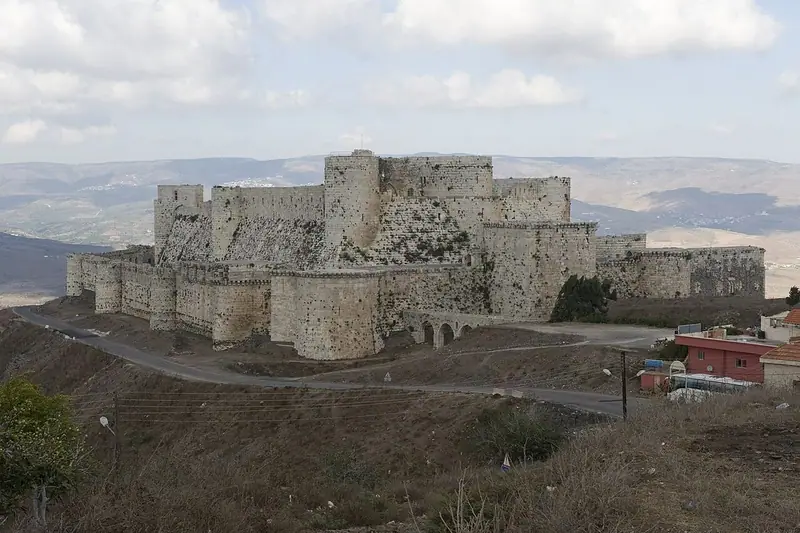 Knights Hospitaller10 stops · 1142 – 1271 (Hospitaller rule)
Crac des Chevaliers audio guide
The most celebrated Crusader castle of all: the Hospitallers' concentric walls, vaulted ramp, glacis, chapel and Gothic loggia, with the war and earthquake damage of 2012–2023 explained.
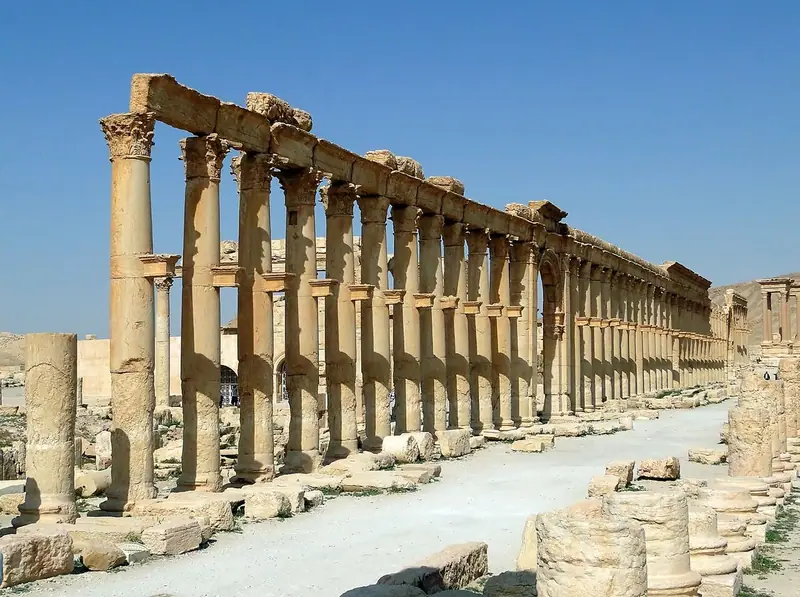 Palmyrene10 stops · 1st – 3rd century CE
Palmyra audio guide
The caravan city of Queen Zenobia in the Syrian desert: a great colonnade, a theatre and tower tombs, with the temples of Bel and Baalshamin destroyed in 2015 shown as they once stood.
Every guide, in every country
Ancient City of Aleppo and every other guide we publish, including future ones. One payment, no subscription.