Before you start
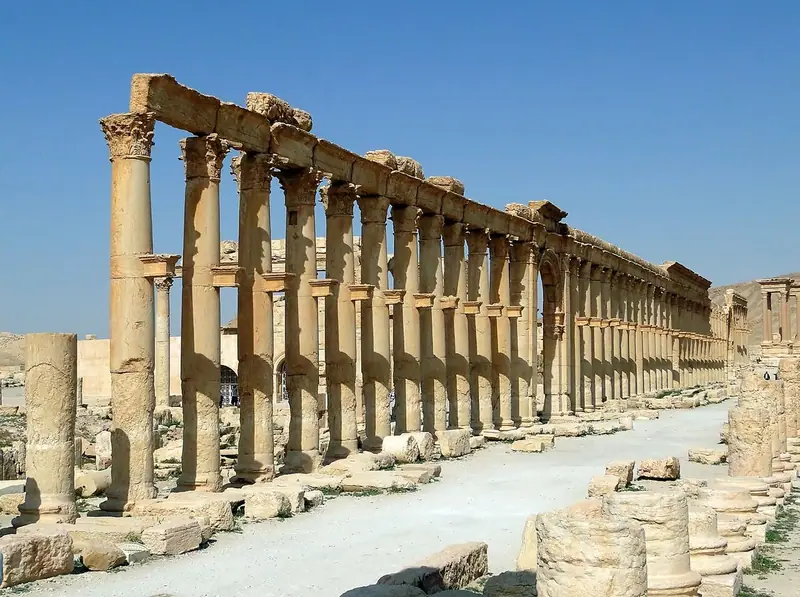
Palmyra stands in an oasis of date palms in the Syrian desert, about 215 kilometres north-east of Damascus, beside the modern town of Tadmur. From the first to the third century CE it was one of the great caravan cities of the ancient world, and UNESCO, which inscribed it as a World Heritage Site in 1980, describes its art and architecture as a marriage of Graeco-Roman techniques with local traditions and Persian influences. Since 2013 it has been on the List of World Heritage in Danger. The site was fought over during the Syrian civil war, and the Islamic State group, which held Palmyra from May 2015 to March 2016 and again from December 2016 to March 2017, deliberately destroyed several of its greatest monuments. This guide says plainly what was lost, and what still stands. Long stretches of the Great Colonnade, the theatre, the agora and the castle survive, but visitor facilities are few. Check your government’s current travel advice before you plan a visit.
Use it as a self-guided tour of Palmyra: 10 stops in visit order, each played when you’re ready, at your own pace.
 Free preview · Stop 1
The Temple of Bel
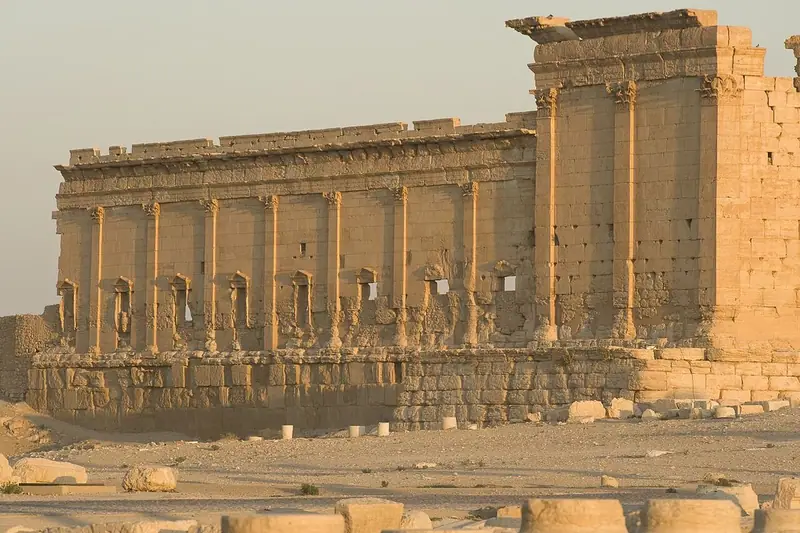
Begin at the Temple of Bel, the religious heart of ancient Palmyra. It was dedicated in 32 CE to Bel, the city’s great god, worshipped together with the moon god Aglibol and the sun god Yarhibol. A massive wall about 205 metres long enclosed a vast courtyard lined with porticoes, and in its centre the temple itself stood on a podium, ringed by columns, with two inner shrines. It later became a church, and in 1132 it was fortified and turned into a mosque, while a village of mud-brick houses filled the courtyard until its people were moved out between 1929 and 1932. In late August 2015 the Islamic State group packed the temple with explosives and destroyed it. Today the great stone gateway of the shrine still stands amid the rubble, inside the surviving enclosure walls. The photograph, taken in 2009, shows the temple before its destruction.
Photo: Dosseman · CC BY-SA 4.0 · Wikimedia Commons. Taken in 2009, before the temple was destroyed in 2015
What to see at Palmyra: 10 stops, in visit order
- 01
 The Temple of BelThe heart of Palmyra’s faithFree preview
- 02
 The Monumental ArchA gateway that hid a bendIn the guide
- 03
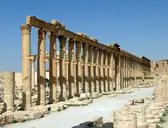 The Great ColonnadeThe spine of the cityIn the guide
- 04
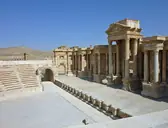 The TheatreA stage of joy and of griefIn the guide
- 05
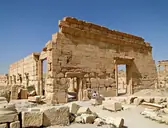 The Agora and the Tariff CourtStatues, banquets and taxesIn the guide
- 06
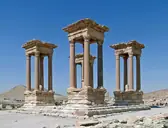 The TetrapylonFour groups of fourIn the guide
- 07
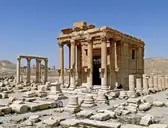 The Temple of BaalshaminA gift from Male AgrippaIn the guide
- 08
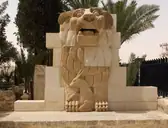 The Camp of DiocletianSoldiers and a sacred lionIn the guide
- 09
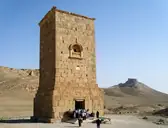 The Valley of the TombsTowers for the deadIn the guide
- 10
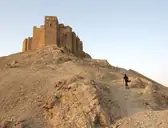 The CastleA view over the oasisIn the guide
Site map of Palmyra
History of Palmyra
Palmyra’s own name, Tadmor, appears in tablets from Mari as early as the eighteenth century BCE, when it was a stop for caravans crossing the desert. Its people, known as Palmyrenes, grew from Amorite, Aramaean and Arab roots; they spoke Palmyrene Aramaic and used Greek for trade and diplomacy, and they worshipped local, Mesopotamian and Arabian gods. Rome took control early in the first century CE, but the city kept much of its independence and grew rich on the trade between the Roman world, Persia and India; the emperor Hadrian visited in 129. In 260 its leader Odaenathus defeated the Persian king Shapur I, and after his murder his widow, Zenobia, ruled for their young son and seized Egypt and much of Anatolia. The emperor Aurelian captured the city in 272 and sacked it after a revolt in 273.
The full history continues in the guide.
Palmyra guide: questions
How many stops does the Palmyra guide have?
10 stops, in visit order: 1. The Temple of Bel; 2. The Monumental Arch; 3. The Great Colonnade; 4. The Theatre; 5. The Agora and the Tariff Court; 6. The Tetrapylon; 7. The Temple of Baalshamin; 8. The Camp of Diocletian; 9. The Valley of the Tombs; 10. The Castle.
Can I do a self-guided tour of Palmyra with this guide?
Yes. The guide is made for a self-guided tour: 10 stops in visit order, each with a photo, a story and a voice, so you can explore Palmyra at your own pace, without joining a group. Download it before you go and it works offline.
How long do you need at Palmyra?
We suggest allowing half a day. The 10 stops add up to about 8 minutes of listening, and you play each one when you’re ready, so you can linger wherever you like.
How long is each guide?
The 10 stops add up to about 8 minutes of listening in total. You play each stop when you’re ready, so you can go at your own pace.
Does the guide work offline?
Yes, once it’s downloaded. The guide is a single self-contained web page (about 9.1 MB) with the photos, text and audio built in. Download it to your phone before you go (Wi-Fi is best); after that it opens in any modern browser on iPhone or Android, with no app, account or mobile signal needed.
Does it use GPS or need my location?
No. The guide doesn’t use GPS and doesn’t know where you are: you play each stop when you reach it. It works on iPhone and Android in any modern browser, and it’s in English.
What’s included?
One self-contained HTML guide: 10 stops in visit order, each with a photo, text and a voice, plus the story of who built the site.
Who built Palmyra?
Palmyra’s own name, Tadmor, appears in tablets from Mari as early as the eighteenth century BCE, when it was a stop for caravans crossing the desert. Its people, known as Palmyrenes, grew from Amorite, Aramaean and Arab roots; they spoke Palmyrene Aramaic and used Greek for trade and diplomacy, and they worshipped local, Mesopotamian and Arabian gods.
Where is Palmyra?
Palmyra stands in an oasis of date palms in the Syrian desert, about 215 kilometres north-east of Damascus, beside the modern town of Tadmur.
Is there a free audio guide to Palmyra?
The first stop, The Temple of Bel, is free to read and hear on this page, so you can try the Palmyra audio tour before you buy. The full guide, with all 10 stops, is a one-off purchase: download it once and it’s yours to keep, working offline.
Is the Palmyra guide worth it?
If you’d like to know what you’re looking at, yes. For $10 you get 10 stops in visit order, each with a photo, a short history and a voice you play when you’re ready, plus a site map of the stops, and about 8 minutes of listening in all. It’s short on purpose, so you spend your time looking, not listening. It’s yours to keep, works offline and needs no app. The first stop is free on this page, so you can try it before you buy. If you’d like hours of detail, a guided tour will go deeper.
Audio guide or guided tour?
It depends how you like to visit. This guide lets you explore Palmyra at your own pace, at any time, for a one-off price. A guided tour gives you a live expert you can ask questions, but at fixed times and usually for a higher price. Many people use both: a tour for the big picture, and the guide to read beforehand or to revisit the stops in their own time.
Is this the official Palmyra guide?
No. It’s an independent guide by The Historian Guide, not affiliated with or endorsed by the operator of Palmyra. For tickets and opening hours, check the official site operator before you go.
Does the guide include entry tickets or opening hours?
No. The guide is a digital companion only. Admission to Palmyra is separate, so check the official site operator for current tickets and opening hours before you go.
- Stop 1 · The Temple of Bel: Dosseman · CC BY-SA 4.0 · Wikimedia Commons · resized
- Stop 2 · The Monumental Arch: Dosseman · CC BY-SA 4.0 · Wikimedia Commons · resized
- Stop 3 · The Great Colonnade (also the cover): Bernard Gagnon · CC BY-SA 4.0 · Wikimedia Commons · resized
- Stop 4 · The Theatre: Bernard Gagnon · CC BY-SA 3.0 · Wikimedia Commons · resized
- Stop 5 · The Agora and the Tariff Court: Bernard Gagnon · CC BY-SA 3.0 · Wikimedia Commons · resized
- Stop 6 · The Tetrapylon: Bernard Gagnon · CC BY-SA 3.0 · Wikimedia Commons · resized
- Stop 7 · The Temple of Baalshamin: Bernard Gagnon · CC BY-SA 3.0 · Wikimedia Commons · resized
- Stop 8 · The Camp of Diocletian: Mappo · Public domain · Wikimedia Commons · resized
- Stop 9 · The Valley of the Tombs: Bernard Gagnon · CC BY-SA 3.0 · Wikimedia Commons · resized
- Stop 10 · The Castle: © Vyacheslav Argenberg · CC BY 4.0 · Wikimedia Commons · resized


All photographs from Wikimedia Commons under the licences shown.
More guides in Syria
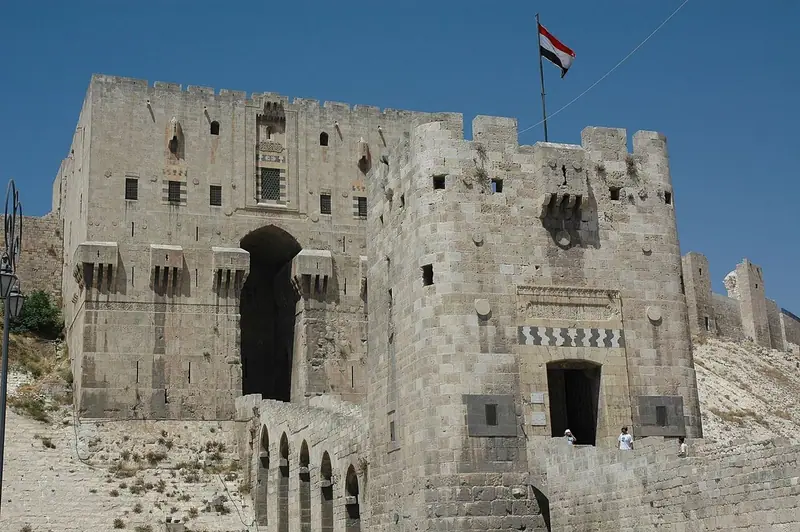 Ayyubid10 stops · Ayyubid citadel, c. 1186–1260
Ancient City of Aleppo audio guide
The great Citadel on its mound, the covered souqs, the Great Mosque and the Jdeydeh quarter, with what was lost in 2012–2016 and what has since been restored set out plainly.
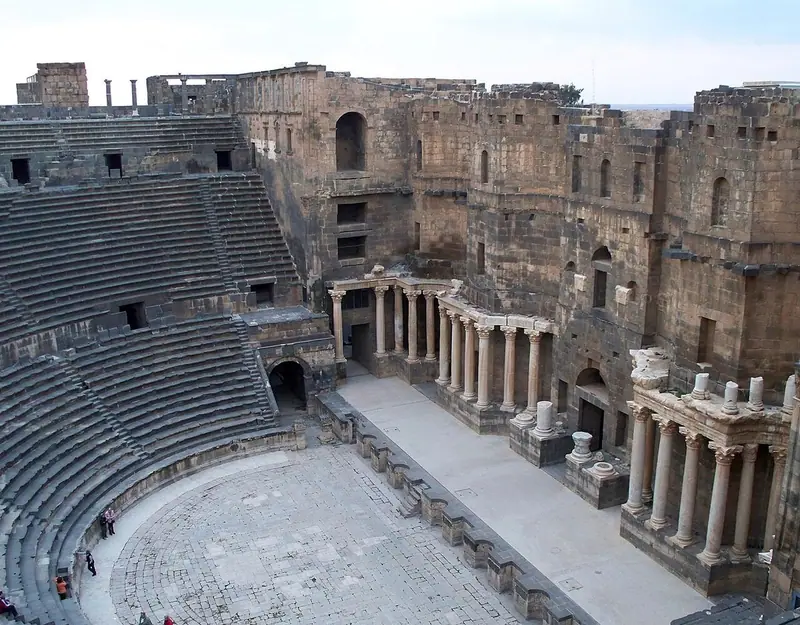 Roman10 stops · 2nd – 7th century CE
Ancient City of Bosra audio guide
Capital of Roman Arabia in black basalt: a near-complete Roman theatre sealed inside an Ayyubid citadel, colonnaded streets, early churches and one of Islam’s oldest mosques.
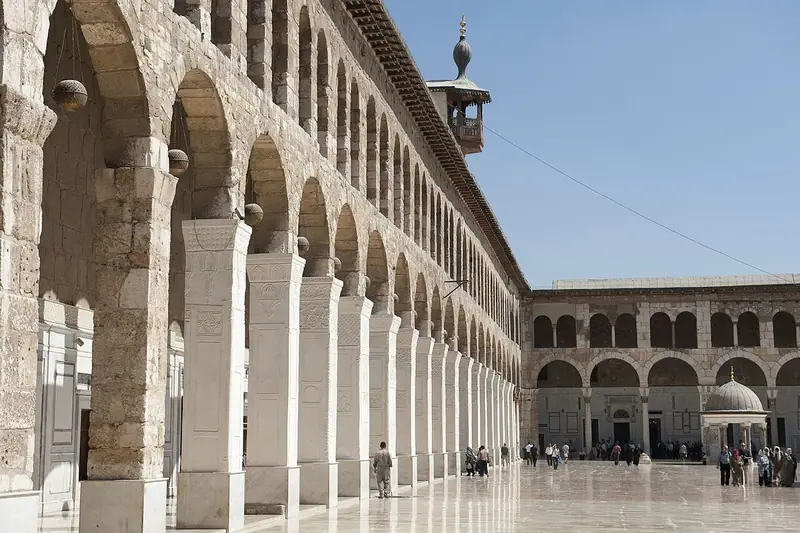 Umayyad10 stops · From the 2nd millennium BCE; Umayyad capital 661–750
Ancient City of Damascus audio guide
One of the world’s oldest cities: the Umayyad Mosque and its golden mosaics, the Citadel, Saladin’s tomb, Ottoman palaces and caravanserais, and the Street called Straight.
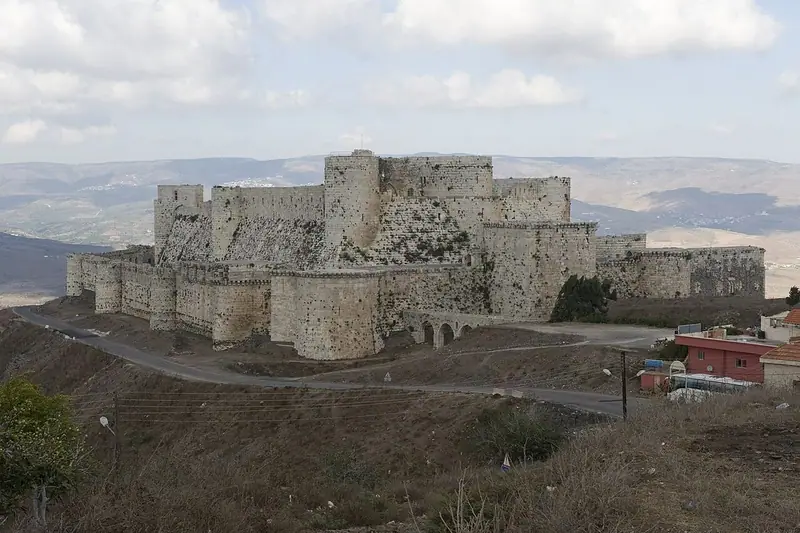 Knights Hospitaller10 stops · 1142 – 1271 (Hospitaller rule)
Crac des Chevaliers audio guide
The most celebrated Crusader castle of all: the Hospitallers' concentric walls, vaulted ramp, glacis, chapel and Gothic loggia, with the war and earthquake damage of 2012–2023 explained.
Every guide, in every country
Palmyra and every other guide we publish, including future ones. One payment, no subscription.