Before you start
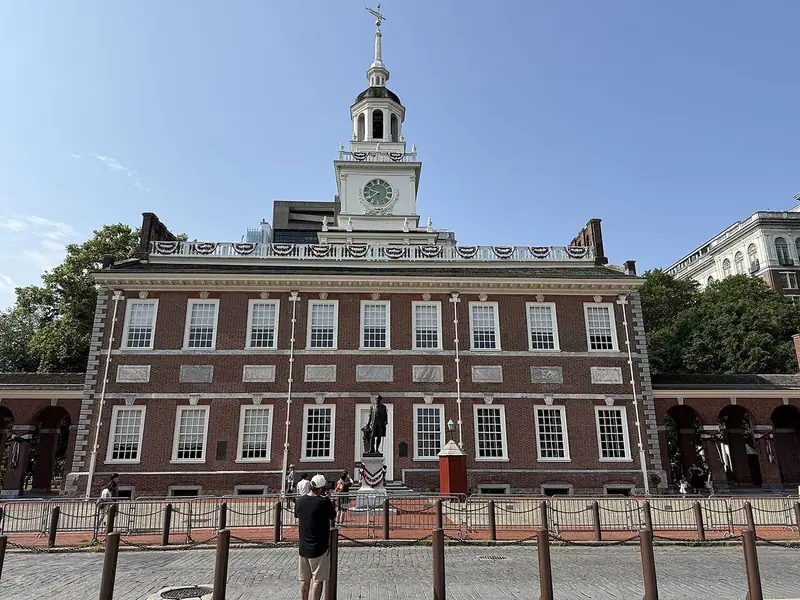
Independence Hall and the Liberty Bell stand at the heart of Independence National Historical Park, a cluster of eighteenth-century buildings and lawns in the Old City district of Philadelphia, cared for by the US National Park Service. Independence Hall was inscribed as a UNESCO World Heritage Site in 1979. For much of the year, entry to Independence Hall is by guided tour with a timed ticket, which you should arrange in advance through the National Park Service, and every building has airport-style security screening. The park is compact and flat, and all of the stops in this guide lie within a few blocks of one another. The tour starts at the Liberty Bell Center on Market Street, crosses Chestnut Street to Independence Hall and its neighbours around Independence Square, then heads east to Carpenters’ Hall, Franklin Court and Christ Church.
Use it as a self-guided tour of Independence Hall: 8 stops in visit order, each played when you’re ready, at your own pace.
 Free preview · Stop 1
Liberty Bell Center
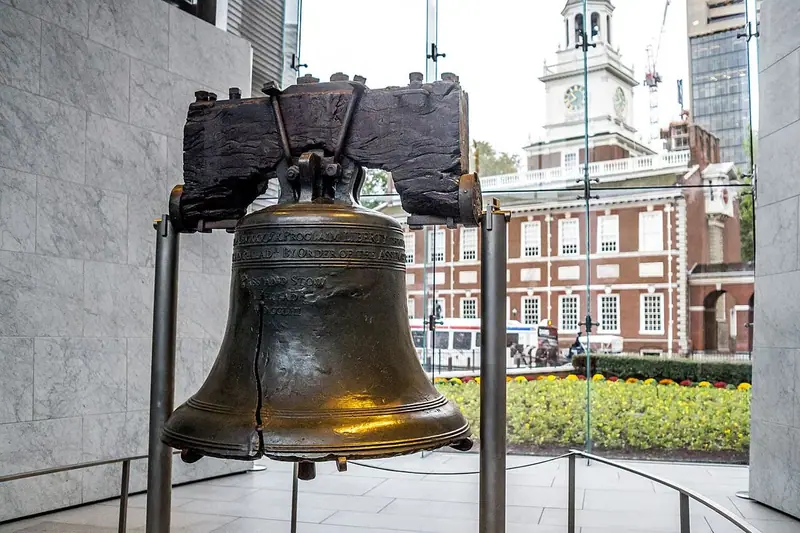
Begin at the glass-walled Liberty Bell Center on Market Street, where exhibits trace the bell’s story before you reach the bell itself. It was ordered from London in 1751 for the Pennsylvania State House, cracked when it was first rung, and was recast twice by two local metalworkers, John Pass and John Stow, whose names appear on it. Read the inscription around the top, a line from the Book of Leviticus: ‘Proclaim Liberty throughout all the Land unto all the Inhabitants thereof’. In the 1830s campaigners against slavery adopted it as a symbol and gave it the name the Liberty Bell. The famous crack widened in the nineteenth century, and the bell has not been rung in the normal way since 1846. Look through the window behind it for the tower of Independence Hall across Chestnut Street.
Photo: Phil Roeder · CC BY 2.0 · Wikimedia Commons
What to see at Independence Hall: 8 stops, in visit order
- 01
 Liberty Bell CenterIndependence MallFree preview
- 02
 Congress HallSeat of Congress, 1790 to 1800In the guide
- 03
 Independence HallPennsylvania State HouseIn the guide
- 04
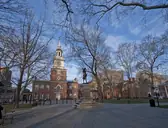 Independence SquareState House YardIn the guide
- 05
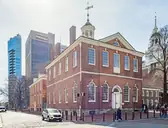 Old City HallFirst home of the Supreme CourtIn the guide
- 06
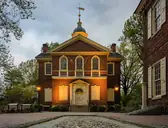 Carpenters’ HallFirst Continental CongressIn the guide
- 07
 Franklin CourtBenjamin Franklin’s houseIn the guide
- 08
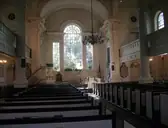 Christ ChurchChurch of the foundersIn the guide
Site map of Independence Hall
History of Independence Hall
Independence Hall was built by the people of colonial Pennsylvania, one of the thirteen British colonies on the Atlantic coast of North America. The land had long been home to the Lenape people when William Penn, an English Quaker, received a royal charter for Pennsylvania in 1681 and founded Philadelphia the following year. British colonial America lasted from the founding of Jamestown, Virginia, in 1607 until the colonies declared their independence in 1776; Britain recognised the new United States in the Treaty of Paris of 1783. The colonial assembly began building its State House in 1732, and it was largely finished by the early 1750s. Here the Second Continental Congress adopted the Declaration of Independence in 1776, and the Constitutional Convention drafted the United States Constitution in 1787. Philadelphia served as the national capital from 1790 to 1800, before the government moved to Washington.
Independence Hall guide: questions
How many stops does the Independence Hall guide have?
8 stops, in visit order: 1. Liberty Bell Center; 2. Congress Hall; 3. Independence Hall; 4. Independence Square; 5. Old City Hall; 6. Carpenters’ Hall; 7. Franklin Court; 8. Christ Church.
Can I do a self-guided tour of Independence Hall with this guide?
Yes. The guide is made for a self-guided tour: 8 stops in visit order, each with a photo, a story and a voice, so you can explore Independence Hall at your own pace, without joining a group. Download it before you go and it works offline.
How long is each guide?
The 8 stops add up to about 6 minutes of listening in total. You play each stop when you’re ready, so you can go at your own pace.
Does the guide work offline?
Yes, once it’s downloaded. The guide is a single self-contained web page (about 7.6 MB) with the photos, text and audio built in. Download it to your phone before you go (Wi-Fi is best); after that it opens in any modern browser on iPhone or Android, with no app, account or mobile signal needed.
Does it use GPS or need my location?
No. The guide doesn’t use GPS and doesn’t know where you are: you play each stop when you reach it. It works on iPhone and Android in any modern browser, and it’s in English.
What’s included?
One self-contained HTML guide: 8 stops in visit order, each with a photo, text and a voice, plus the story of who built the site.
Who built Independence Hall?
Independence Hall was built by the people of colonial Pennsylvania, one of the thirteen British colonies on the Atlantic coast of North America. The land had long been home to the Lenape people when William Penn, an English Quaker, received a royal charter for Pennsylvania in 1681 and founded Philadelphia the following year.
Where is Independence Hall?
Independence Hall and the Liberty Bell stand at the heart of Independence National Historical Park, a cluster of eighteenth-century buildings and lawns in the Old City district of Philadelphia, cared for by the US National Park Service.
Is there a free audio guide to Independence Hall?
The first stop, Liberty Bell Center, is free to read and hear on this page, so you can try the Independence Hall audio tour before you buy. The full guide, with all 8 stops, is a one-off purchase: download it once and it’s yours to keep, working offline.
Is the Independence Hall guide worth it?
If you’d like to know what you’re looking at, yes. For $10 you get 8 stops in visit order, each with a photo, a short history and a voice you play when you’re ready, plus a site map of the stops, and about 6 minutes of listening in all. It’s short on purpose, so you spend your time looking, not listening. It’s yours to keep, works offline and needs no app. The first stop is free on this page, so you can try it before you buy. If you’d like hours of detail, a guided tour will go deeper.
Audio guide or guided tour?
It depends how you like to visit. This guide lets you explore Independence Hall at your own pace, at any time, for a one-off price. A guided tour gives you a live expert you can ask questions, but at fixed times and usually for a higher price. Many people use both: a tour for the big picture, and the guide to read beforehand or to revisit the stops in their own time.
Is this the official Independence Hall guide?
No. It’s an independent guide by The Historian Guide, not affiliated with or endorsed by the operator of Independence Hall. For tickets and opening hours, check the official site operator before you go.
Does the guide include entry tickets or opening hours?
No. The guide is a digital companion only. Admission to Independence Hall is separate, so check the official site operator for current tickets and opening hours before you go.
- Stop 1 · Liberty Bell Center: Phil Roeder · CC BY 2.0 · Wikimedia Commons · resized
- Stop 2 · Congress Hall: Ben Franske · CC BY-SA 4.0 · Wikimedia Commons · resized
- Stop 3 · Independence Hall (also the cover): Dough4872 · CC BY-SA 4.0 · Wikimedia Commons · resized
- Stop 4 · Independence Square: National Park Service · CC BY 2.0 · Wikimedia Commons · resized
- Stop 5 · Old City Hall: ajay_suresh · CC BY 2.0 · Wikimedia Commons · resized
- Stop 6 · Carpenters’ Hall: Pbjamesphoto · CC BY-SA 4.0 · Wikimedia Commons · resized
- Stop 7 · Franklin Court: Missvain · CC0 · Wikimedia Commons · resized
- Stop 8 · Christ Church: Reading Tom from Reading, UK · CC BY 2.0 · Wikimedia Commons · resized


All photographs from Wikimedia Commons under the licences shown.
More guides in United States
 Spanish Colonial7 stops · 1718–1782
Alamo and San Antonio Missions audio guide
From the battle-scarred Alamo to Mission San José and the Espada Aqueduct, the five missions that made San Antonio.
 Modern8 stops · 1853–1963
Alcatraz audio guide
Step off the boat into the cellhouse, walk D Block and the yard, and hear the story of the 1962 escape.
 Mississippian8 stops · c. 1050 – 1350 CE
Cahokia Mounds audio guide
The largest pre-Columbian city north of Mexico, with Monks Mound, the Grand Plaza and the remains of its solar calendar posts.
 Ancestral Puebloan8 stops · c. 850–1150 CE
Chaco Canyon audio guide
The great houses of Pueblo Bonito and Chetro Ketl, planned buildings of stone that rose several storeys high.
 Colonial American12 stops · 17th–20th century CE
Charleston audio guide
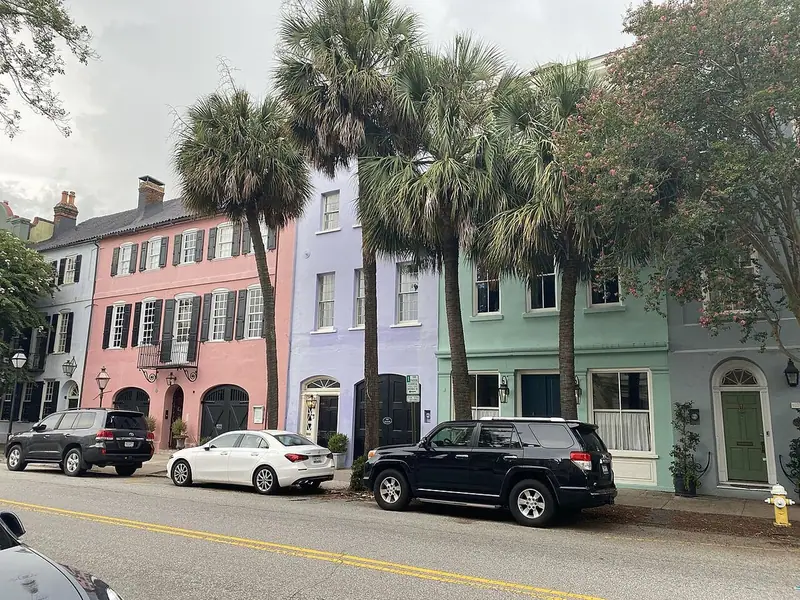
Mother Emanuel and Beth Elohim, St Philip’s and the Huguenot Church, the Old Slave Mart, the Four Corners of Law, Rainbow Row and the Battery.
 Colonial American8 stops · 1699–1780
Colonial Williamsburg audio guide
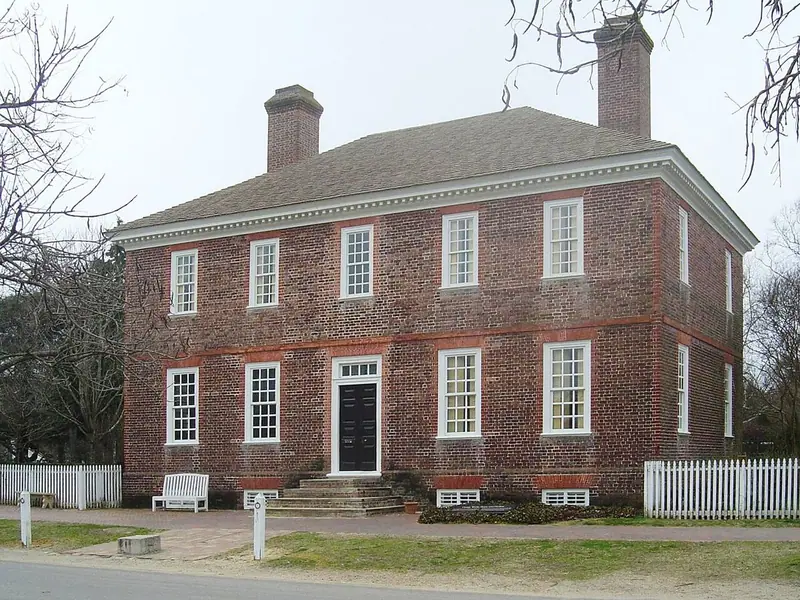
Duke of Gloucester Street, from the Capitol to the Governor’s Palace, in the restored capital of colonial Virginia.
Every guide, in every country
Independence Hall and every other guide we publish, including future ones. One payment, no subscription.