Before you start
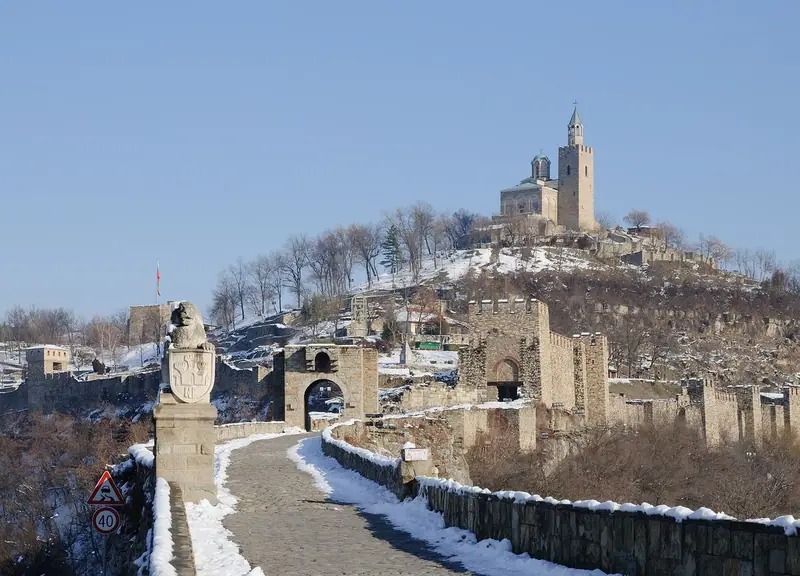
For two centuries, from 1185 to 1393, Tarnovo was the capital of the Second Bulgarian Empire, one of the great powers of the medieval Balkans, and was compared by its people to Rome and Constantinople. Its tsars and patriarchs lived on the fortified hill of Tsarevets, wrapped by a loop of the river Yantra, while the town climbed the cliffs opposite. This guide begins at the monument to the Asen dynasty, walks through the old craftsmen’s street, and crosses into the fortress of Tsarevets, to Baldwin’s Tower, the Patriarchal Cathedral and the royal palace, ending at the Church of the Forty Martyrs, where Bulgaria declared its independence in 1908.
Use it as a self-guided tour of Veliko Tarnovo: 7 stops in visit order, each played when you’re ready, at your own pace.
 Free preview · Stop 1
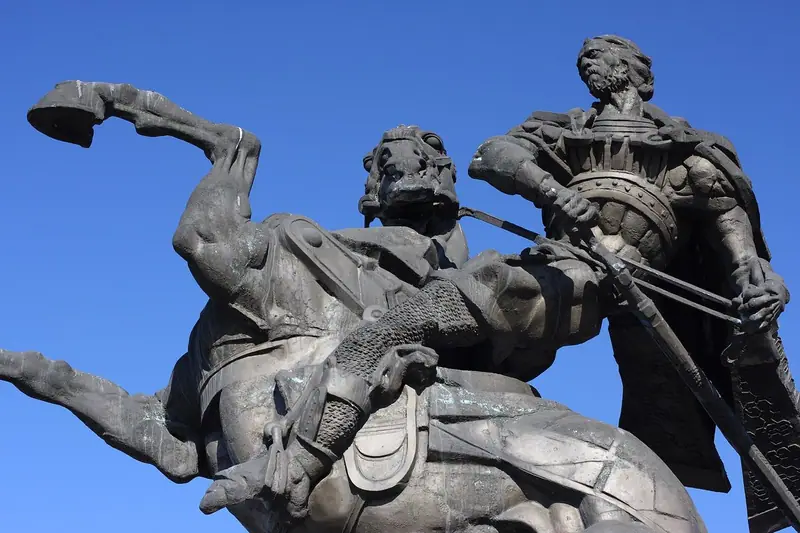
The Asen Monument
Begin at the great monument to the Asen dynasty, which stands on a bend of the Yantra river below the old town. It was unveiled in 1985, to mark eight hundred years since the rising of Asen and Peter against the Byzantines. Around a tall central sword, four bronze horsemen represent the tsars who built the Second Bulgarian Empire: the brothers Asen and Peter, who led the rebellion in 1185; their younger brother Kaloyan, who defeated the crusaders; and Ivan Asen the Second, under whom the empire reached its greatest size. From the monument there is a fine view of the houses of the old town, stacked on the cliffs above the river. Cross the river and climb up into the old town, to the street of the craftsmen.
Photo: yeowatzup · CC BY 2.0 · Wikimedia Commons
What to see at Veliko Tarnovo: 7 stops, in visit order
- 01
 The Asen MonumentThe founders of the empireFree preview
- 02
 Samovodska CharshiyaThe craftsmen’s streetIn the guide
- 03
 The Gate of TsarevetsThe entrance to the fortressIn the guide
- 04
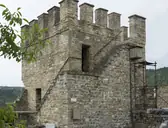 Baldwin’s TowerThe prison of an emperorIn the guide
- 05
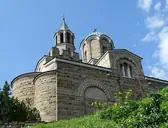 The Patriarchal CathedralThe church of the patriarchsIn the guide
- 06
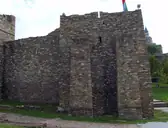 The Royal PalaceThe court of the tsarsIn the guide
- 07
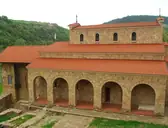 The Church of the Forty MartyrsA church of victory and independenceIn the guide
Site map of Veliko Tarnovo
History of Veliko Tarnovo
In the late twelfth century, Bulgaria had been ruled by the Byzantine Empire for more than a century and a half. In 1185 two brothers from Tarnovo, the nobles Asen and Peter, led a rebellion against Byzantine rule, and restored the Bulgarian state, with Tarnovo as its capital. Their younger brother Kaloyan defeated the crusaders of the Latin Empire, and under Ivan Asen the Second, in the thirteenth century, the empire reached its greatest extent, stretching from the Black Sea to the Adriatic and the Aegean. Tarnovo became a centre of Orthodox learning and art, with a patriarch of its own, scholars, painters and monasteries. In 1393, after a siege of three months, the Ottoman Turks captured and burned the city, and the empire fell. Nearly five centuries of Ottoman rule followed, until the Russo-Turkish War of 1877 and 1878.
The full history continues in the guide.
Veliko Tarnovo guide: questions
How many stops does the Veliko Tarnovo guide have?
7 stops, in visit order: 1. The Asen Monument; 2. Samovodska Charshiya; 3. The Gate of Tsarevets; 4. Baldwin’s Tower; 5. The Patriarchal Cathedral; 6. The Royal Palace; 7. The Church of the Forty Martyrs.
Can I do a self-guided tour of Veliko Tarnovo with this guide?
Yes. The guide is made for a self-guided tour: 7 stops in visit order, each with a photo, a story and a voice, so you can explore Veliko Tarnovo at your own pace, without joining a group. Download it before you go and it works offline.
How long is each guide?
The 7 stops add up to about 5 minutes of listening in total. You play each stop when you’re ready, so you can go at your own pace.
Does the guide work offline?
Yes, once it’s downloaded. The guide is a single self-contained web page (about 6.7 MB) with the photos, text and audio built in. Download it to your phone before you go (Wi-Fi is best); after that it opens in any modern browser on iPhone or Android, with no app, account or mobile signal needed.
Does it use GPS or need my location?
No. The guide doesn’t use GPS and doesn’t know where you are: you play each stop when you reach it. It works on iPhone and Android in any modern browser, and it’s in English.
What’s included?
One self-contained HTML guide: 7 stops in visit order, each with a photo, text and a voice, plus the story of who built the site.
Who built Veliko Tarnovo?
In the late twelfth century, Bulgaria had been ruled by the Byzantine Empire for more than a century and a half. In 1185 two brothers from Tarnovo, the nobles Asen and Peter, led a rebellion against Byzantine rule, and restored the Bulgarian state, with Tarnovo as its capital.
Where is Veliko Tarnovo?
For two centuries, from 1185 to 1393, Tarnovo was the capital of the Second Bulgarian Empire, one of the great powers of the medieval Balkans, and was compared by its people to Rome and Constantinople.
Is there a free audio guide to Veliko Tarnovo?
The first stop, The Asen Monument, is free to read and hear on this page, so you can try the Veliko Tarnovo audio tour before you buy. The full guide, with all 7 stops, is a one-off purchase: download it once and it’s yours to keep, working offline.
Is the Veliko Tarnovo guide worth it?
If you’d like to know what you’re looking at, yes. For $10 you get 7 stops in visit order, each with a photo, a short history and a voice you play when you’re ready, plus a site map of the stops, and about 5 minutes of listening in all. It’s short on purpose, so you spend your time looking, not listening. It’s yours to keep, works offline and needs no app. The first stop is free on this page, so you can try it before you buy. If you’d like hours of detail, a guided tour will go deeper.
Audio guide or guided tour?
It depends how you like to visit. This guide lets you explore Veliko Tarnovo at your own pace, at any time, for a one-off price. A guided tour gives you a live expert you can ask questions, but at fixed times and usually for a higher price. Many people use both: a tour for the big picture, and the guide to read beforehand or to revisit the stops in their own time.
Is this the official Veliko Tarnovo guide?
No. It’s an independent guide by The Historian Guide, not affiliated with or endorsed by the operator of Veliko Tarnovo. For tickets and opening hours, check the official site operator before you go.
Does the guide include entry tickets or opening hours?
No. The guide is a digital companion only. Admission to Veliko Tarnovo is separate, so check the official site operator for current tickets and opening hours before you go.
- Stop 1 · The Asen Monument: yeowatzup · CC BY 2.0 · Wikimedia Commons · resized
- Stop 2 · Samovodska Charshiya: yeowatzup · CC BY 2.0 · Wikimedia Commons · resized
- Stop 3 · The Gate of Tsarevets (also the cover): MrPanyGoff · CC BY-SA 3.0 · Wikimedia Commons · resized
- Stop 4 · Baldwin’s Tower: Stanimir Stoyanoff · Public domain · Wikimedia Commons · resized
- Stop 5 · The Patriarchal Cathedral: Adam Jones · CC BY-SA 2.0 · Wikimedia Commons · resized
- Stop 6 · The Royal Palace: Kandi · Public domain · Wikimedia Commons · resized
- Stop 7 · The Church of the Forty Martyrs: Andrei Stroe · CC BY-SA 4.0 · Wikimedia Commons · resized


All photographs from Wikimedia Commons under the licences shown.
More guides in Bulgaria
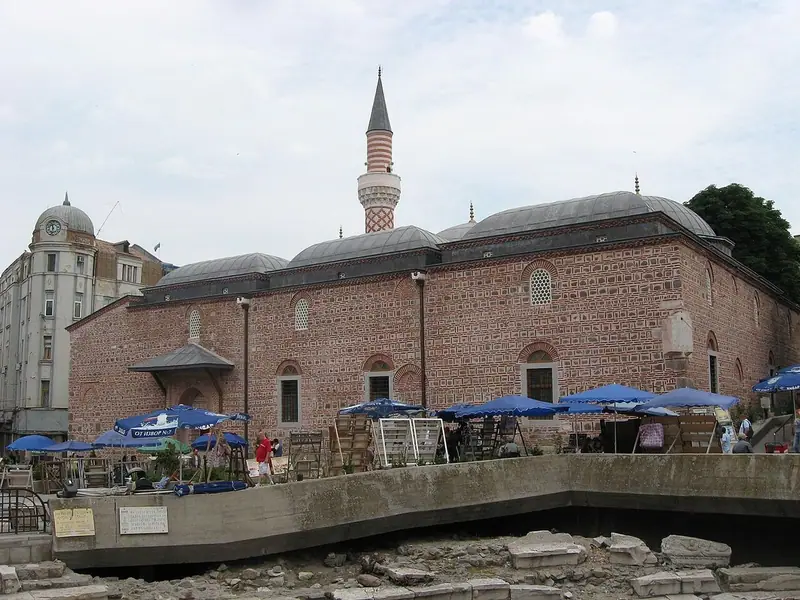 Roman8 stops · 1st–2nd century CE; 18th–19th century
Old Plovdiv audio guide
Find a Roman stadium beneath the main square, a Roman theatre still used for concerts and the colourful merchants’ houses of the old town.
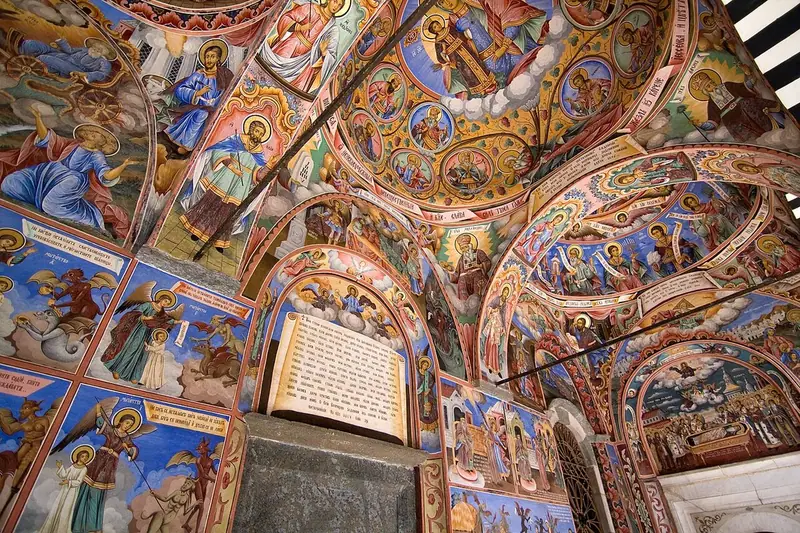 Bulgarian Empire7 stops · 10th–19th century
Rila Monastery audio guide
Pass through the gates of Bulgaria’s great monastery in the Rila Mountains to its striped arcades, painted church and Hrelyo’s Tower.
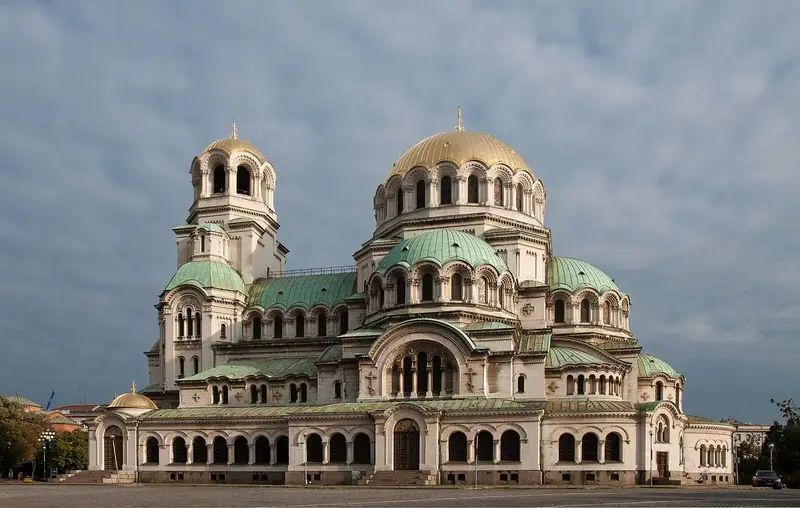 Roman, Byzantine, Ottoman and modern Bulgaria7 stops · c. 29 BCE – 1912 CE
Sofia audio guide
Roman Serdica beneath the streets, the rotunda of Saint George, an Ottoman mosque on the springs, and the churches of Saint Sofia and Alexander Nevsky.
Every guide, in every country
Veliko Tarnovo and every other guide we publish, including future ones. One payment, no subscription.