Before you start
Todai-ji stands in Nara Park on the eastern side of the city of Nara, about twenty minutes’ walk from Kintetsu Nara Station, or a little longer from JR Nara Station. It is part of the UNESCO World Heritage Site ‘Historic Monuments of Ancient Nara’, inscribed in 1998, and is still an active temple, the head temple of the Kegon school of Buddhism. The approach and the main halls are on fairly level ground, but the walk to Nigatsu-do climbs a stone-paved slope and steps. On the way you will meet the famous deer of Nara Park, which are protected as a Natural Monument; they can bow, nudge and nip, especially if they think you have food. The route enters through the Great South Gate, visits the Great Buddha Hall, then climbs east up the hillside to Nigatsu-do and Hokke-do.
Use it as a self-guided tour of Todai-ji: 7 stops in visit order, each played when you’re ready, at your own pace.
 Free preview · Stop 1
Nandaimon
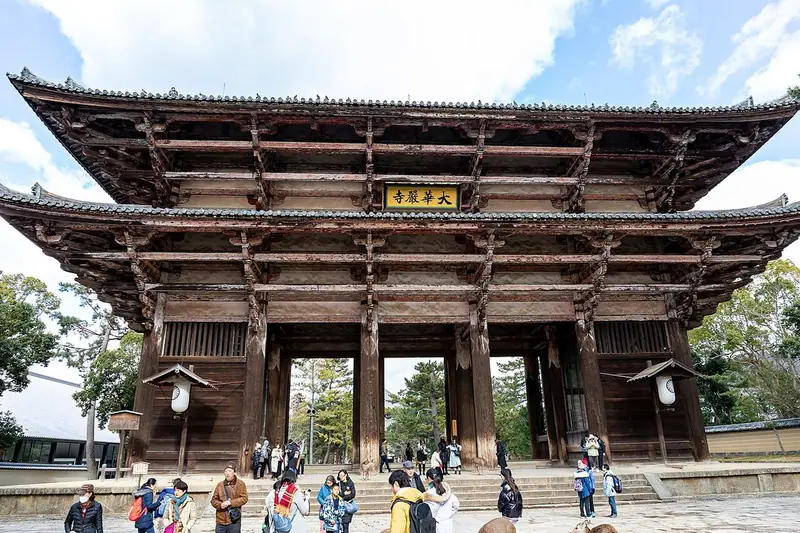
Begin at the Nandaimon, the Great South Gate, largest temple gate in Japan. The original gate was blown down by a storm in the Heian period, and the present one was raised at the end of the twelfth century, in 1199, during the rebuilding led by the monk Chogen. It is about twenty-five metres high and is built in the daibutsu-yo style that Chogen introduced from Song China, with tiers of brackets inserted directly into the huge pillars. Walk through and look into the side bays at the two Nio, the guardian kings, each about eight and a half metres tall. They were carved in wood in 1203 by the sculptors Unkei and Kaikei and their workshop, and they are among the masterpieces of Japanese sculpture. Unusually, they face each other across the passage rather than looking out. One has his mouth open and the other has it firmly closed.
Photo: Balon Greyjoy · CC0 · Wikimedia Commons
What to see at Todai-ji: 7 stops, in visit order
- 01
 NandaimonThe Great South GateFree preview
- 02
 Kagami-ike and ChumonThe pond and the middle gateIn the guide
- 03
 Octagonal LanternMusicians in bronzeIn the guide
- 04
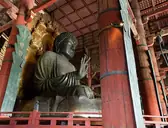 Great BuddhaVairocana, the cosmic BuddhaIn the guide
- 05
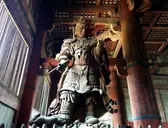 Inside the HallGuardians and the pillar holeIn the guide
- 06
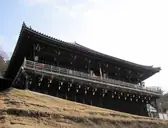 Nigatsu-doThe Hall of the Second MonthIn the guide
- 07
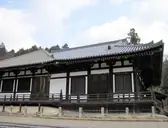 Hokke-doThe oldest hall of Todai-jiIn the guide
Site map of Todai-ji
History of Todai-ji
Todai-ji was built by order of Emperor Shomu in the Nara period, when Japan’s capital was at Heijo-kyo, the city now called Nara, from 710 to 784. After years of epidemics, famine and rebellion, Shomu ordered a network of state temples across the provinces, with Todai-ji at their head, and in 743 he commanded that a giant statue of the Buddha be made. The monk Gyoki travelled the country raising support, and the temple’s records say that more than two and a half million people contributed. The statue’s eye-opening ceremony, performed by the Indian monk Bodhisena, was held in 752. Buddhism had reached Japan from the Korean peninsula in the sixth century, and the Nara court modelled its temples on those of Tang China; the faith remains a living tradition today.
The full history continues in the guide.
Todai-ji guide: questions
How many stops does the Todai-ji guide have?
7 stops, in visit order: 1. Nandaimon; 2. Kagami-ike and Chumon; 3. Octagonal Lantern; 4. Great Buddha; 5. Inside the Hall; 6. Nigatsu-do; 7. Hokke-do.
Can I do a self-guided tour of Todai-ji with this guide?
Yes. The guide is made for a self-guided tour: 7 stops in visit order, each with a photo, a story and a voice, so you can explore Todai-ji at your own pace, without joining a group. Download it before you go and it works offline.
How long is each guide?
The 7 stops add up to about 5 minutes of listening in total. You play each stop when you’re ready, so you can go at your own pace.
Does the guide work offline?
Yes, once it’s downloaded. The guide is a single self-contained web page (about 6.5 MB) with the photos, text and audio built in. Download it to your phone before you go (Wi-Fi is best); after that it opens in any modern browser on iPhone or Android, with no app, account or mobile signal needed.
Does it use GPS or need my location?
No. The guide doesn’t use GPS and doesn’t know where you are: you play each stop when you reach it. It works on iPhone and Android in any modern browser, and it’s in English.
What’s included?
One self-contained HTML guide: 7 stops in visit order, each with a photo, text and a voice, plus the story of who built the site.
Who built Todai-ji?
Todai-ji was built by order of Emperor Shomu in the Nara period, when Japan’s capital was at Heijo-kyo, the city now called Nara, from 710 to 784. After years of epidemics, famine and rebellion, Shomu ordered a network of state temples across the provinces, with Todai-ji at their head, and in 743 he commanded that a giant statue of the Buddha be made.
Where is Todai-ji?
Todai-ji stands in Nara Park on the eastern side of the city of Nara, about twenty minutes’ walk from Kintetsu Nara Station, or a little longer from JR Nara Station.
Is there a free audio guide to Todai-ji?
The first stop, Nandaimon, is free to read and hear on this page, so you can try the Todai-ji audio tour before you buy. The full guide, with all 7 stops, is a one-off purchase: download it once and it’s yours to keep, working offline.
Is the Todai-ji guide worth it?
If you’d like to know what you’re looking at, yes. For $10 you get 7 stops in visit order, each with a photo, a short history and a voice you play when you’re ready, plus a site map of the stops, and about 5 minutes of listening in all. It’s short on purpose, so you spend your time looking, not listening. It’s yours to keep, works offline and needs no app. The first stop is free on this page, so you can try it before you buy. If you’d like hours of detail, a guided tour will go deeper.
Audio guide or guided tour?
It depends how you like to visit. This guide lets you explore Todai-ji at your own pace, at any time, for a one-off price. A guided tour gives you a live expert you can ask questions, but at fixed times and usually for a higher price. Many people use both: a tour for the big picture, and the guide to read beforehand or to revisit the stops in their own time.
Is this the official Todai-ji guide?
No. It’s an independent guide by The Historian Guide, not affiliated with or endorsed by the operator of Todai-ji. For tickets and opening hours, check the official site operator before you go.
Does the guide include entry tickets or opening hours?
No. The guide is a digital companion only. Admission to Todai-ji is separate, so check the official site operator for current tickets and opening hours before you go.
- Stop 1 · Nandaimon: Balon Greyjoy · CC0 · Wikimedia Commons · resized
- Stop 2 · Kagami-ike and Chumon: Cun Cun · CC BY-SA 4.0 · Wikimedia Commons · resized
- Stop 3 · Octagonal Lantern: 663highland · CC BY 2.5 · Wikimedia Commons · resized
- Stop 4 · Great Buddha (also the cover): Gilles Desjardins · CC BY-SA 4.0 · Wikimedia Commons · resized
- Stop 5 · Inside the Hall: Cory Doctorow from London, UK · CC BY-SA 2.0 · Wikimedia Commons · resized
- Stop 6 · Nigatsu-do: Nekosuki · CC BY-SA 4.0 · Wikimedia Commons · resized
- Stop 7 · Hokke-do: Nekosuki · CC BY-SA 4.0 · Wikimedia Commons · resized


All photographs from Wikimedia Commons under the licences shown.
More guides in Japan
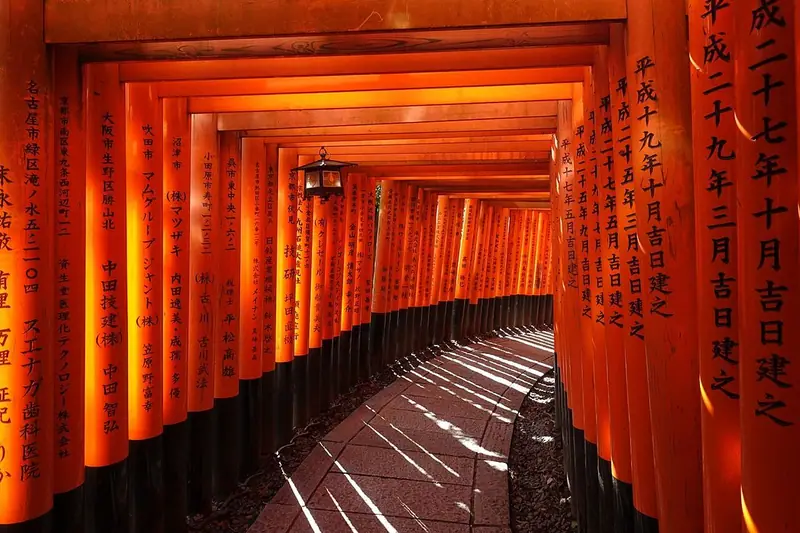 Shinto7 stops · founded 711; main hall 1499
Fushimi Inari Taisha audio guide
Pass through the Senbon Torii, the 'thousand gates', on the trail that winds up Mount Inari to the summit.
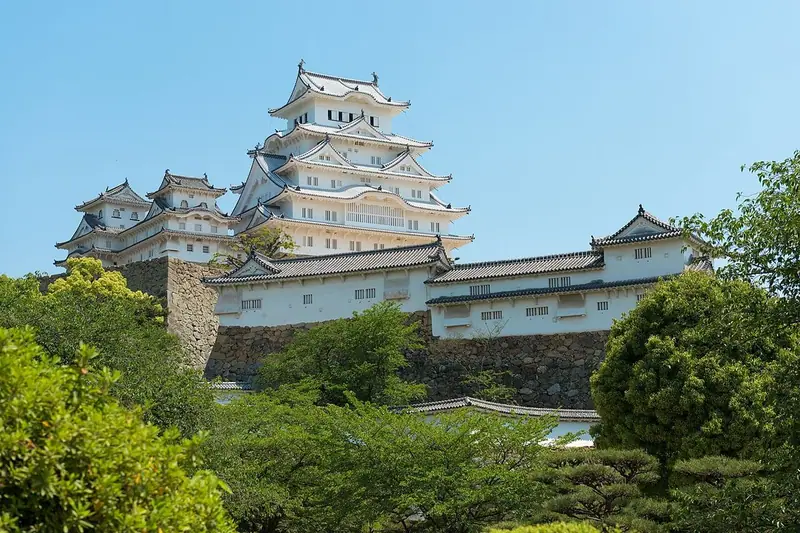 Edo7 stops · keep 1601–1609
Himeji Castle audio guide
Through the gates of the maze and the baileys to the main keep of Himeji, the great castle of the samurai lords.
 Shōwa Japan8 stops · Post-war Shōwa
Hiroshima Peace Memorial Park audio guide
The Peace Memorial Park, from the museum and the cenotaph to the Children’s Peace Monument and the Atomic Bomb Dome.
 Heian7 stops · plan of 1168
Itsukushima Shrine audio guide
Past the Great Torii to the shrine’s corridors, stages and Noh stage on the shore of Miyajima.
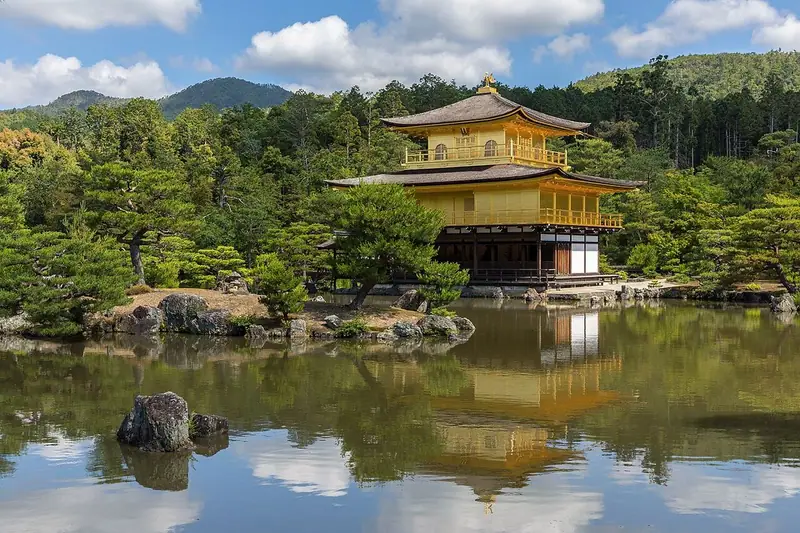 Muromachi7 stops · 1397 (rebuilt 1955)
Kinkaku-ji audio guide
The Golden Pavilion mirrored in its pond, then a garden path past the Ryumon Falls to an old teahouse.
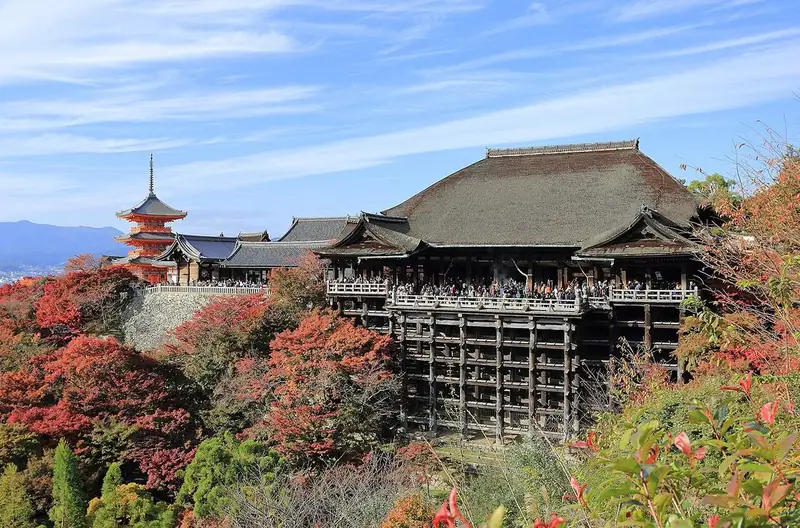 Japanese Buddhist7 stops · founded 778; main hall 1633
Kiyomizu-dera audio guide
Out onto the great wooden stage of the Main Hall, then down to the Otowa Waterfall below.
Every guide, in every country
Todai-ji and every other guide we publish, including future ones. One payment, no subscription.