Before you start
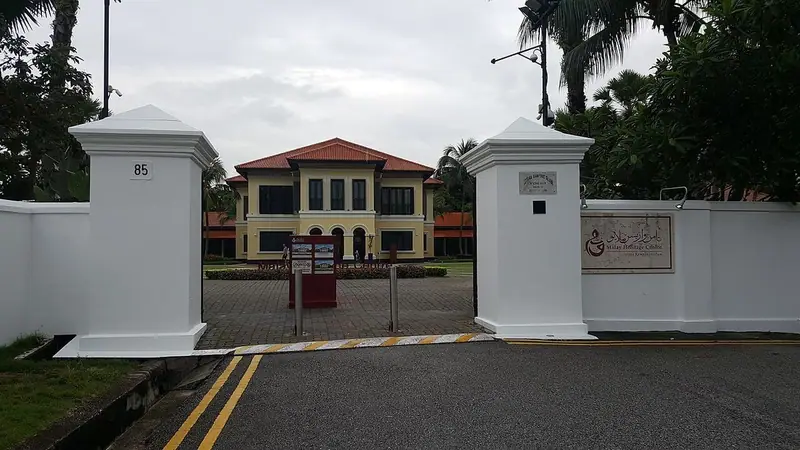
Kampong Glam lies just north of the Singapore River, a short walk from Bugis, between North Bridge Road and Beach Road. It was once the seat of the Malay sultan of Singapore, and it is still the heart of the city’s Malay and Muslim heritage. The route begins on Bussorah Street, visits the Sultan Mosque, wanders through Arab Street and Haji Lane to the old sultan’s palace, and ends at two of the area’s other historic mosques. The route is short and flat. Allow two to three hours, longer if you visit the Malay Heritage Centre or stop to eat.
Use it as a self-guided tour of Kampong Glam: 7 stops in visit order, each played when you’re ready, at your own pace.
 Free preview · Stop 1
Bussorah Street
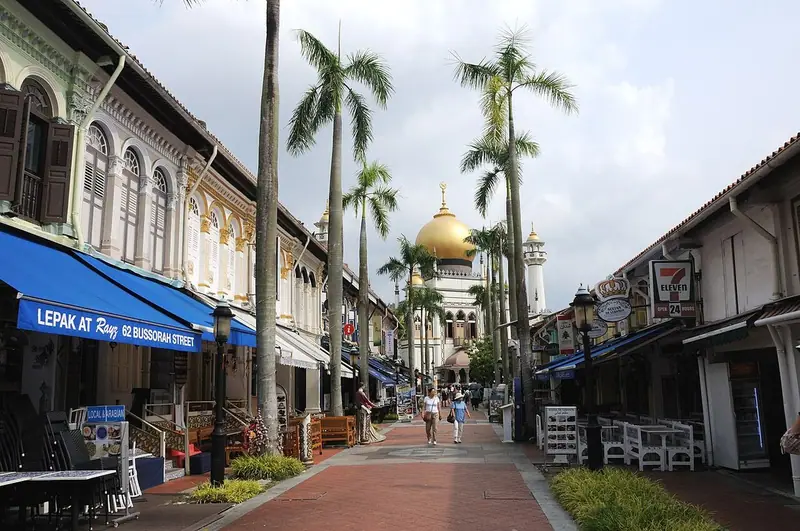
Begin on Bussorah Street, the pedestrian street lined with palm trees and shophouses that leads straight to the Sultan Mosque. The street is named after the city of Basra in Iraq, and it was once known as Kampong Kaji, the pilgrims’ village. Look at the two-storey shophouses on both sides, with shops below and homes above, their shuttered windows and their decorated fronts. Many have been restored and painted in bright colours, and they now hold restaurants, cafés and craft shops. Walk slowly towards the mosque, and look at how the street is lined up with its great golden dome, framing it at the end of the view. In the past, pilgrims from across the region gathered in streets like this before sailing to Mecca. Notice the smells of spices and coffee, and the mix of languages you hear around you.
Photo: Josep M. Gracia · CC BY-SA 4.0 · Wikimedia Commons
What to see at Kampong Glam: 7 stops, in visit order
- 01
 Bussorah StreetThe pilgrims’ villageFree preview
- 02
 The Sultan MosqueMasjid SultanIn the guide
- 03
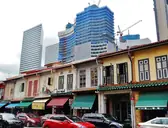 Arab StreetCloth and carpetsIn the guide
- 04
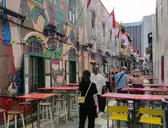 Haji LaneFrom pilgrims to boutiquesIn the guide
- 05
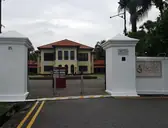 Malay Heritage CentreThe sultan’s palaceIn the guide
- 06
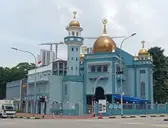 Malabar MosqueThe blue mosqueIn the guide
- 07
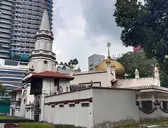 Hajjah Fatimah MosqueThe leaning minaretIn the guide
Site map of Kampong Glam
History of Kampong Glam
Before the British arrived, this area was already home to members of the Malay nobility of Singapore. In 1819 the British East India Company signed a treaty with Sultan Hussein Shah of Johor and the Temenggong Abdul Rahman, which allowed it to set up a trading post on the island. Under the town plan of 1822, Kampong Glam was set aside for the sultan and his household, and for Malay, Arab and Bugis communities, many of them merchants. Through the nineteenth and twentieth centuries, settlers came from Sumatra, Java, Malaya and beyond, and the area became a busy, mixed quarter of shophouses, mosques and markets. The name is thought to come from the gelam tree, a kind of paperbark that once grew here.
Kampong Glam guide: questions
How many stops does the Kampong Glam guide have?
7 stops, in visit order: 1. Bussorah Street; 2. The Sultan Mosque; 3. Arab Street; 4. Haji Lane; 5. Malay Heritage Centre; 6. Malabar Mosque; 7. Hajjah Fatimah Mosque.
Can I do a self-guided tour of Kampong Glam with this guide?
Yes. The guide is made for a self-guided tour: 7 stops in visit order, each with a photo, a story and a voice, so you can explore Kampong Glam at your own pace, without joining a group. Download it before you go and it works offline.
How long is each guide?
The 7 stops add up to about 5 minutes of listening in total. You play each stop when you’re ready, so you can go at your own pace.
Does the guide work offline?
Yes, once it’s downloaded. The guide is a single self-contained web page (about 6.5 MB) with the photos, text and audio built in. Download it to your phone before you go (Wi-Fi is best); after that it opens in any modern browser on iPhone or Android, with no app, account or mobile signal needed.
Does it use GPS or need my location?
No. The guide doesn’t use GPS and doesn’t know where you are: you play each stop when you reach it. It works on iPhone and Android in any modern browser, and it’s in English.
What’s included?
One self-contained HTML guide: 7 stops in visit order, each with a photo, text and a voice, plus the story of who built the site.
Who built Kampong Glam?
Before the British arrived, this area was already home to members of the Malay nobility of Singapore. In 1819 the British East India Company signed a treaty with Sultan Hussein Shah of Johor and the Temenggong Abdul Rahman, which allowed it to set up a trading post on the island.
Where is Kampong Glam?
Kampong Glam lies just north of the Singapore River, a short walk from Bugis, between North Bridge Road and Beach Road.
Is there a free audio guide to Kampong Glam?
The first stop, Bussorah Street, is free to read and hear on this page, so you can try the Kampong Glam audio tour before you buy. The full guide, with all 7 stops, is a one-off purchase: download it once and it’s yours to keep, working offline.
Is the Kampong Glam guide worth it?
If you’d like to know what you’re looking at, yes. For $10 you get 7 stops in visit order, each with a photo, a short history and a voice you play when you’re ready, plus a site map of the stops, and about 5 minutes of listening in all. It’s short on purpose, so you spend your time looking, not listening. It’s yours to keep, works offline and needs no app. The first stop is free on this page, so you can try it before you buy. If you’d like hours of detail, a guided tour will go deeper.
Audio guide or guided tour?
It depends how you like to visit. This guide lets you explore Kampong Glam at your own pace, at any time, for a one-off price. A guided tour gives you a live expert you can ask questions, but at fixed times and usually for a higher price. Many people use both: a tour for the big picture, and the guide to read beforehand or to revisit the stops in their own time.
Is this the official Kampong Glam guide?
No. It’s an independent guide by The Historian Guide, not affiliated with or endorsed by the operator of Kampong Glam. For tickets and opening hours, check the official site operator before you go.
Does the guide include entry tickets or opening hours?
No. The guide is a digital companion only. Admission to Kampong Glam is separate, so check the official site operator for current tickets and opening hours before you go.
- Stop 1 · Bussorah Street: Josep M. Gracia · CC BY-SA 4.0 · Wikimedia Commons · resized
- Stop 2 · The Sultan Mosque: Maksym Kozlenko · CC BY-SA 4.0 · Wikimedia Commons · resized
- Stop 3 · Arab Street: Zairon · CC BY-SA 4.0 · Wikimedia Commons · resized
- Stop 4 · Haji Lane: © Moheen Reeyad · CC BY-SA 4.0 · Wikimedia Commons · resized
- Stop 5 · Malay Heritage Centre (also the cover): GoAheadFan95 · CC BY-SA 4.0 · Wikimedia Commons · resized
- Stop 6 · Malabar Mosque: M. Adrian Jurhami · CC BY 4.0 · Wikimedia Commons · resized
- Stop 7 · Hajjah Fatimah Mosque: M. Adrian Jurhami · CC BY 4.0 · Wikimedia Commons · resized


All photographs from Wikimedia Commons under the licences shown.
More guides in Singapore
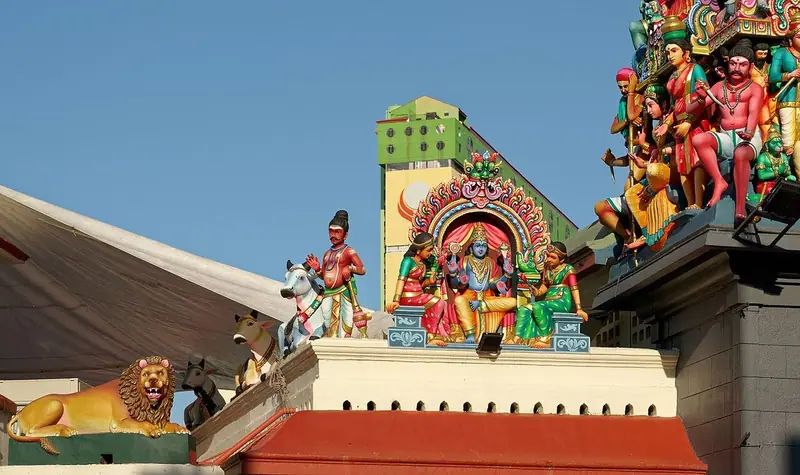 British Colonial7 stops · 1822–1965
Chinatown audio guide
The shophouses of Pagoda Street, the Sri Mariamman Temple, the Jamae Mosque and the Buddha Tooth Relic Temple.
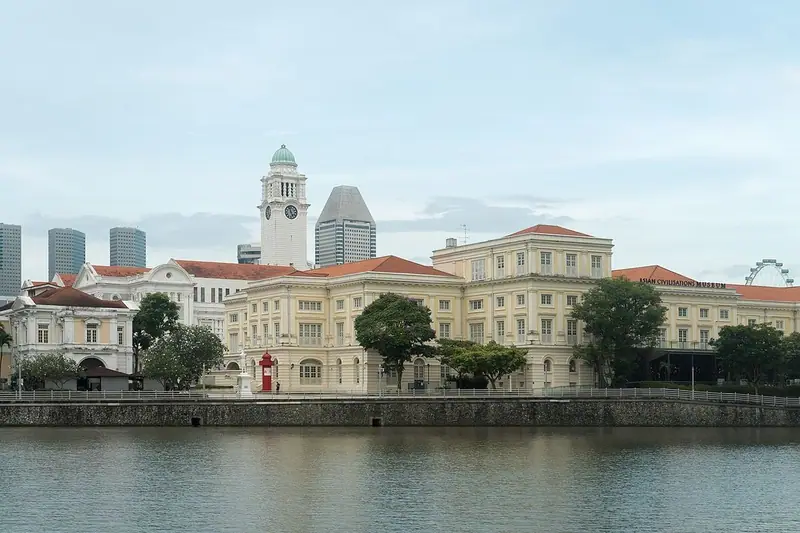 British Colonial9 stops · 1819 – 20th century
Singapore’s Civic District audio guide
From Fort Canning Hill down to Raffles’ Landing Site, round the Padang and past St Andrew’s Cathedral to the Raffles Hotel.
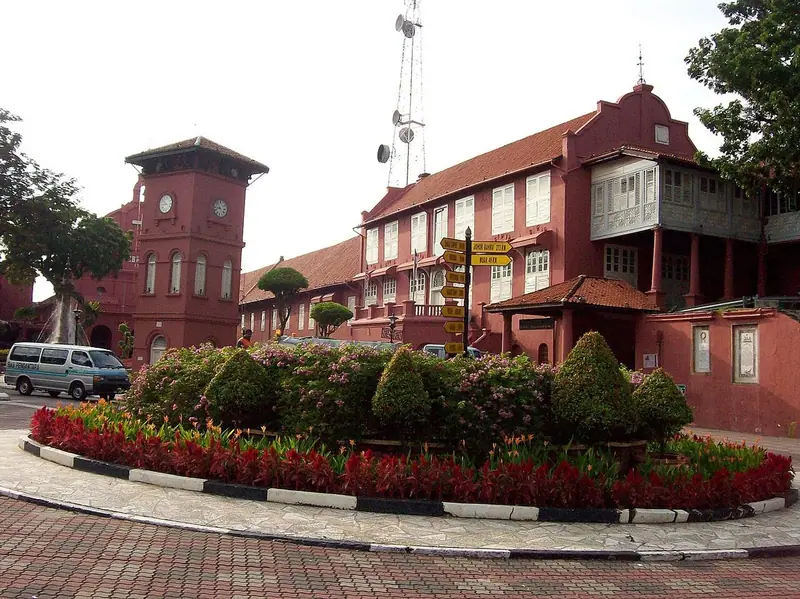 Malay9 stops · c. 1400 – 20th century
Historic Melaka audio guide
From the Dutch Square up St Paul’s Hill to the Porta de Santiago, then Jonker Street and Heeren Street beside the Melaka River.
Every guide, in every country
Kampong Glam and every other guide we publish, including future ones. One payment, no subscription.