Before you start
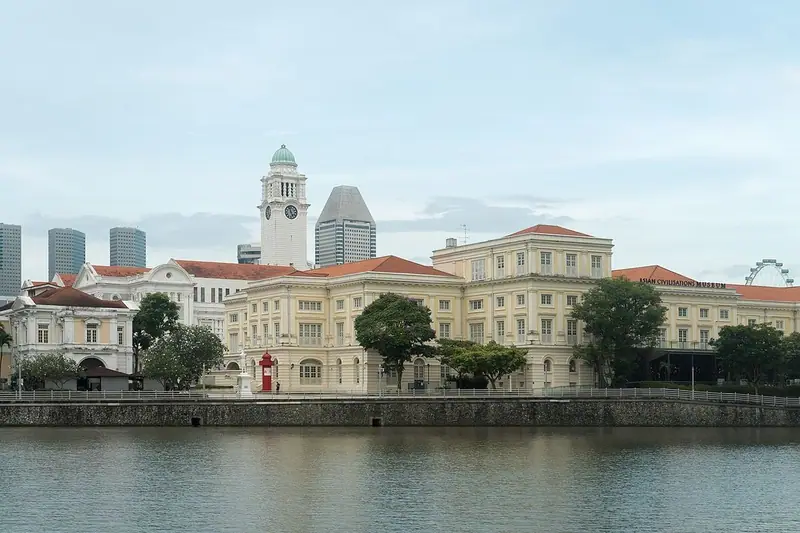
Singapore’s Civic District, on the north bank of the Singapore River, is where the modern city began. Here, among gleaming towers, stand the colonial buildings that grew up after the British arrived in 1819: courts, halls, churches and offices, many now museums and arts venues. This guide starts on Fort Canning Hill, the seat of Singapore’s early kings, then heads down to the river, around the great green Padang, and ends at the famous Raffles Hotel. Singapore is hot and humid, so go early in the morning or late in the afternoon, and carry water.
Use it as a self-guided tour of Singapore’s Civic District: 9 stops in visit order, each played when you’re ready, at your own pace.
 Free preview · Stop 1
Fort Canning Hill
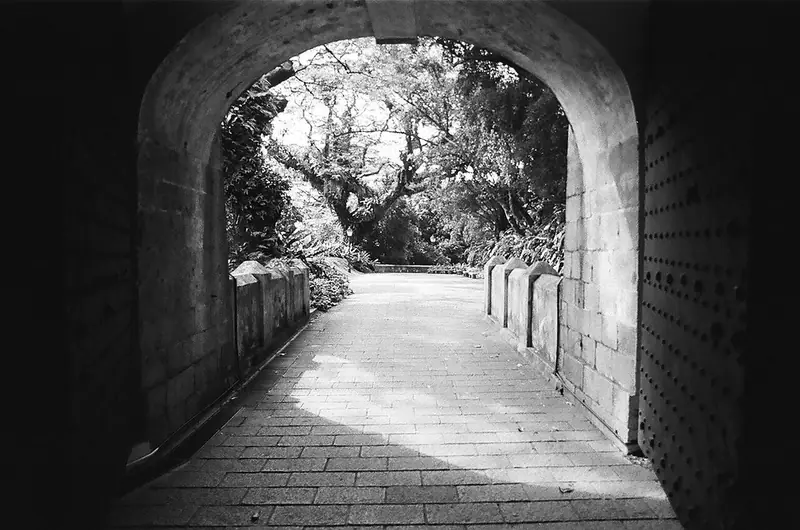
Begin on Fort Canning Hill, a green hill rising above the city centre. Malays have long called it Bukit Larangan, the Forbidden Hill, because it was believed to be the burial place of the ancient kings of Singapura. Archaeologists have found remains of a fourteenth-century settlement here, including Chinese porcelain and gold jewellery, and a shrine on the hill, the Keramat Iskandar Shah, is traditionally linked with a king of Singapura. After 1819, Stamford Raffles built a house on the hill, and later governors lived here, so it became known as Government Hill. In 1861 the British built a fort here and named it after Viscount Canning, the first Viceroy of India. Look for the Gothic gateway and the old cemetery walls. Deep inside the hill lies the Battlebox, an underground bunker where British commanders decided to surrender Singapore in February 1942.
Photo: Jonathan Protzenko · CC BY-SA 2.0 · Wikimedia Commons
What to see at Singapore’s Civic District: 9 stops, in visit order
- 01
 Fort Canning HillThe forbidden hillFree preview
- 02
 Old Parliament HouseThe oldest buildingIn the guide
- 03
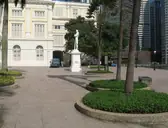 Raffles’ Landing SiteWhere it beganIn the guide
- 04
 Empress PlaceMuseum and bridgeIn the guide
- 05
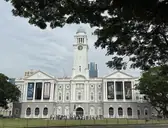 Victoria TheatreHalls and clock towerIn the guide
- 06
 The PadangThe great fieldIn the guide
- 07
 National GalleryCourt and town hallIn the guide
- 08
 St Andrew’s CathedralThe white churchIn the guide
- 09
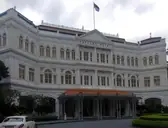 Raffles HotelA legendary hotelIn the guide
Site map of Singapore’s Civic District
History of Singapore’s Civic District
Long before the British arrived, a trading settlement called Temasek, later Singapura, flourished here in the fourteenth century, with its rulers based on the hill now called Fort Canning. In 1819 Stamford Raffles of the British East India Company signed a treaty with the local Malay rulers, Sultan Hussein Shah and Temenggong Abdul Rahman, allowing the British to set up a trading post. Settlers came from China, India, the Malay world and beyond, and the port grew rapidly. Singapore fell to Japan in 1942, returned to British rule in 1945, and became an independent republic in 1965.
Singapore’s Civic District guide: questions
How many stops does the Singapore’s Civic District guide have?
9 stops, in visit order: 1. Fort Canning Hill; 2. Old Parliament House; 3. Raffles’ Landing Site; 4. Empress Place; 5. Victoria Theatre; 6. The Padang; 7. National Gallery; 8. St Andrew’s Cathedral; 9. Raffles Hotel.
Can I do a self-guided tour of Singapore’s Civic District with this guide?
Yes. The guide is made for a self-guided tour: 9 stops in visit order, each with a photo, a story and a voice, so you can explore Singapore’s Civic District at your own pace, without joining a group. Download it before you go and it works offline.
How long is each guide?
The 9 stops add up to about 7 minutes of listening in total. You play each stop when you’re ready, so you can go at your own pace.
Does the guide work offline?
Yes, once it’s downloaded. The guide is a single self-contained web page (about 8.0 MB) with the photos, text and audio built in. Download it to your phone before you go (Wi-Fi is best); after that it opens in any modern browser on iPhone or Android, with no app, account or mobile signal needed.
Does it use GPS or need my location?
No. The guide doesn’t use GPS and doesn’t know where you are: you play each stop when you reach it. It works on iPhone and Android in any modern browser, and it’s in English.
What’s included?
One self-contained HTML guide: 9 stops in visit order, each with a photo, text and a voice, plus the story of who built the site.
Who built Singapore’s Civic District?
Long before the British arrived, a trading settlement called Temasek, later Singapura, flourished here in the fourteenth century, with its rulers based on the hill now called Fort Canning. In 1819 Stamford Raffles of the British East India Company signed a treaty with the local Malay rulers, Sultan Hussein Shah and Temenggong Abdul Rahman, allowing the British to set up a trading post.
Where is Singapore’s Civic District?
Singapore’s Civic District, on the north bank of the Singapore River, is where the modern city began.
Is there a free audio guide to Singapore’s Civic District?
The first stop, Fort Canning Hill, is free to read and hear on this page, so you can try the Singapore’s Civic District audio tour before you buy. The full guide, with all 9 stops, is a one-off purchase: download it once and it’s yours to keep, working offline.
Is the Singapore’s Civic District guide worth it?
If you’d like to know what you’re looking at, yes. For $10 you get 9 stops in visit order, each with a photo, a short history and a voice you play when you’re ready, plus a site map of the stops, and about 7 minutes of listening in all. It’s short on purpose, so you spend your time looking, not listening. It’s yours to keep, works offline and needs no app. The first stop is free on this page, so you can try it before you buy. If you’d like hours of detail, a guided tour will go deeper.
Audio guide or guided tour?
It depends how you like to visit. This guide lets you explore Singapore’s Civic District at your own pace, at any time, for a one-off price. A guided tour gives you a live expert you can ask questions, but at fixed times and usually for a higher price. Many people use both: a tour for the big picture, and the guide to read beforehand or to revisit the stops in their own time.
Is this the official Singapore’s Civic District guide?
No. It’s an independent guide by The Historian Guide, not affiliated with or endorsed by the operator of Singapore’s Civic District. For tickets and opening hours, check the official site operator before you go.
Does the guide include entry tickets or opening hours?
No. The guide is a digital companion only. Admission to Singapore’s Civic District is separate, so check the official site operator for current tickets and opening hours before you go.
- Stop 1 · Fort Canning Hill: Jonathan Protzenko. · CC BY-SA 2.0 · Wikimedia Commons · resized
- Stop 2 · Old Parliament House: Balon Greyjoy · CC0 · Wikimedia Commons · resized
- Stop 3 · Raffles’ Landing Site: Terence Ong · CC BY 2.5 · Wikimedia Commons · resized
- Stop 4 · Empress Place (also the cover): Alexey Komarov · CC BY-SA 4.0 · Wikimedia Commons · resized
- Stop 5 · Victoria Theatre: TTangMonuments · CC BY-SA 4.0 · Wikimedia Commons · resized
- Stop 6 · The Padang: Chensiyuan · CC BY-SA 4.0 · Wikimedia Commons · resized
- Stop 7 · National Gallery: ScribblingGeek · CC BY-SA 4.0 · Wikimedia Commons · resized
- Stop 8 · St Andrew’s Cathedral: Flaming Ferrari. · CC BY-SA 3.0 · Wikimedia Commons · resized
- Stop 9 · Raffles Hotel: Daniel Case · CC BY-SA 4.0 · Wikimedia Commons · resized


All photographs from Wikimedia Commons under the licences shown.
More guides in Singapore
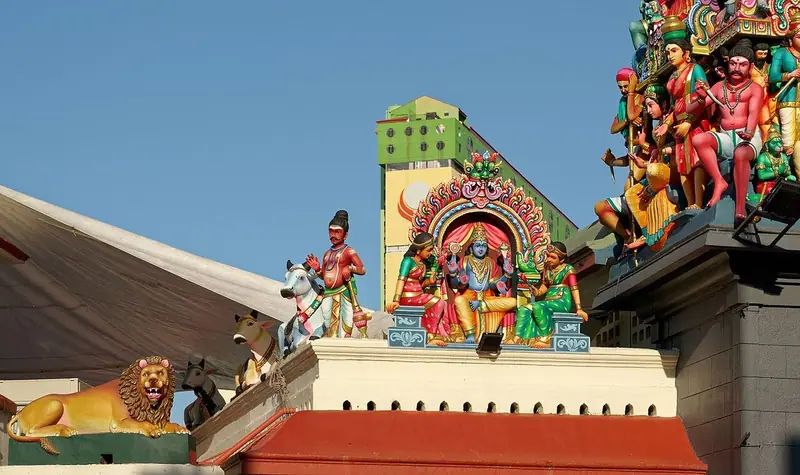 British Colonial7 stops · 1822–1965
Chinatown audio guide
The shophouses of Pagoda Street, the Sri Mariamman Temple, the Jamae Mosque and the Buddha Tooth Relic Temple.
 Malay7 stops · 1819–1932
Kampong Glam audio guide
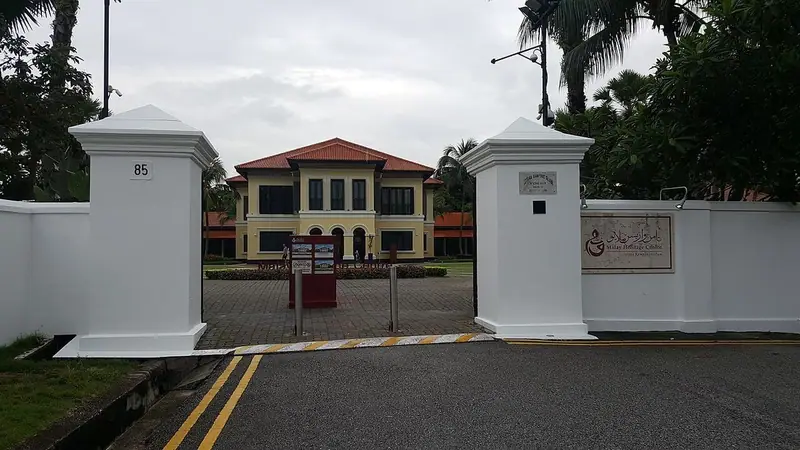
From Bussorah Street to the Sultan Mosque and the old sultan’s palace, then Arab Street and Haji Lane.
 British Colonial7 stops · 1850–1991
Fremantle Prison audio guide
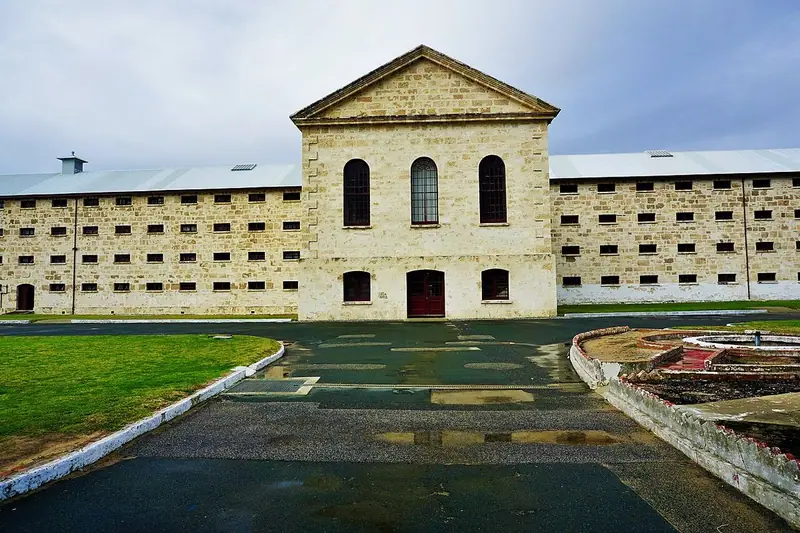
Pass through the gatehouse of the convict-built prison above Fremantle, from the main cell block and the gallows to the tunnels beneath.
Every guide, in every country
Singapore’s Civic District and every other guide we publish, including future ones. One payment, no subscription.