Before you start
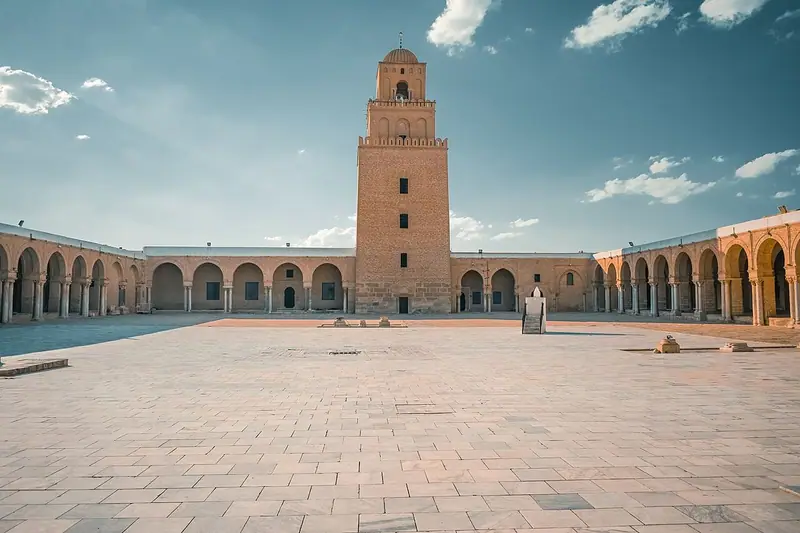
Kairouan, on the dry plains of central Tunisia, was founded in 670 by the Arab conqueror Uqba ibn Nafi, and became the first great Islamic city of North Africa and a centre of learning and faith. Its walled medina, its Great Mosque and its other monuments make up a World Heritage Site, and the city is revered as one of the holy cities of Islam. This guide begins at the great water reservoirs outside the walls, visits the shrine of Sidi Sahib, then the Great Mosque, and ends at the Mosque of the Three Doors in the medina. These are places of worship, so dress modestly, with shoulders and knees covered, and women may be asked to cover their hair. Non-Muslims may visit the courtyard of the Great Mosque, but not enter its prayer hall.
Use it as a self-guided tour of Kairouan: 8 stops in visit order, each played when you’re ready, at your own pace.
 Free preview · Stop 1
The Aghlabid Basins
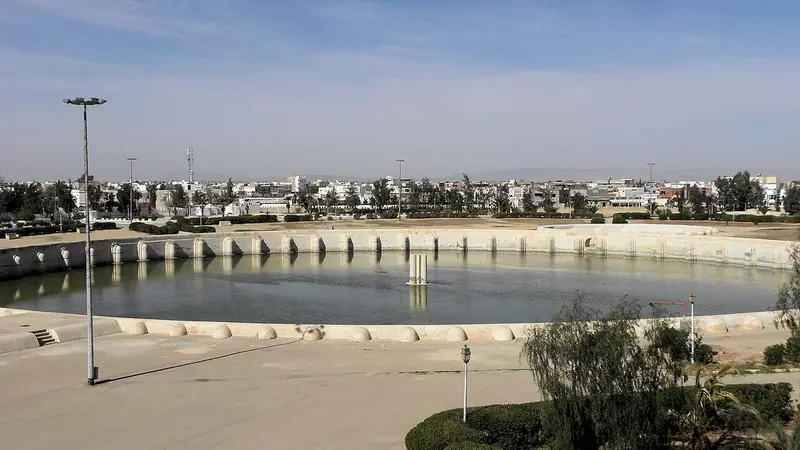
Begin just north of the medina at the Aghlabid Basins, two great open-air reservoirs built between 860 and 862 by the Aghlabid ruler Abu Ibrahim Ahmad. Kairouan lies in a dry plain, far from any river, and water was always precious. Look at the larger basin, a great round pool with forty-eight sides, about one hundred and twenty-eight metres across and nearly five metres deep, its walls strengthened by rounded buttresses inside and out. Water from the countryside flowed first into the smaller basin, where mud and sand settled, then into the larger one, and finally into covered cisterns, from which it was drawn. In the middle of the large basin, notice the stone pillar, which may once have supported a pavilion, where the rulers could relax beside the water. Look up from here at the walls of the medina.
Photo: Keith Roper · CC BY 2.0 · Wikimedia Commons
What to see at Kairouan: 8 stops, in visit order
- 01
 The Aghlabid BasinsWater for the CityFree preview
- 02
 The Zawiya of Sidi SahibThe Barber’s ShrineIn the guide
- 03
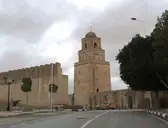 The Great MosqueA Fortress of FaithIn the guide
- 04
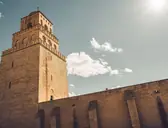 The MinaretA Tower of Three StoreysIn the guide
- 05
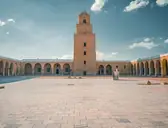 The CourtyardMarble and RainwaterIn the guide
- 06
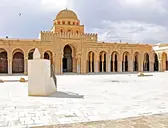 The Prayer Hall FaçadeThe Domed PorticoIn the guide
- 07
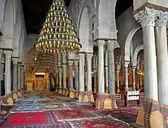 The Prayer HallA Forest of ColumnsIn the guide
- 08
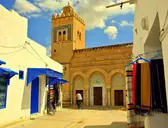 The Mosque of the Three DoorsA Carved FaçadeIn the guide
Site map of Kairouan
History of Kairouan
Uqba ibn Nafi founded Kairouan as a military base for the Arab conquest of North Africa, and built its first mosque. In the ninth century, under the Aghlabid emirs, who ruled on behalf of the Abbasid caliphs of Baghdad, the city reached the height of its power, and the Great Mosque was rebuilt in the form we see today. Kairouan remained a centre of Islamic scholarship for centuries, but declined after it was sacked by the Banu Hilal, Arab tribes from Egypt, in the eleventh century, and the capital moved to Tunis. Its medina, surrounded by brick walls, keeps much of its traditional character.
Kairouan guide: questions
How many stops does the Kairouan guide have?
8 stops, in visit order: 1. The Aghlabid Basins; 2. The Zawiya of Sidi Sahib; 3. The Great Mosque; 4. The Minaret; 5. The Courtyard; 6. The Prayer Hall Façade; 7. The Prayer Hall; 8. The Mosque of the Three Doors.
Can I do a self-guided tour of Kairouan with this guide?
Yes. The guide is made for a self-guided tour: 8 stops in visit order, each with a photo, a story and a voice, so you can explore Kairouan at your own pace, without joining a group. Download it before you go and it works offline.
How long is each guide?
The 8 stops add up to about 6 minutes of listening in total. You play each stop when you’re ready, so you can go at your own pace.
Does the guide work offline?
Yes, once it’s downloaded. The guide is a single self-contained web page (about 6.8 MB) with the photos, text and audio built in. Download it to your phone before you go (Wi-Fi is best); after that it opens in any modern browser on iPhone or Android, with no app, account or mobile signal needed.
Does it use GPS or need my location?
No. The guide doesn’t use GPS and doesn’t know where you are: you play each stop when you reach it. It works on iPhone and Android in any modern browser, and it’s in English.
What’s included?
One self-contained HTML guide: 8 stops in visit order, each with a photo, text and a voice, plus the story of who built the site.
Who built Kairouan?
Uqba ibn Nafi founded Kairouan as a military base for the Arab conquest of North Africa, and built its first mosque. In the ninth century, under the Aghlabid emirs, who ruled on behalf of the Abbasid caliphs of Baghdad, the city reached the height of its power, and the Great Mosque was rebuilt in the form we see today.
Where is Kairouan?
Kairouan, on the dry plains of central Tunisia, was founded in 670 by the Arab conqueror Uqba ibn Nafi, and became the first great Islamic city of North Africa and a centre of learning and faith.
Is there a free audio guide to Kairouan?
The first stop, The Aghlabid Basins, is free to read and hear on this page, so you can try the Kairouan audio tour before you buy. The full guide, with all 8 stops, is a one-off purchase: download it once and it’s yours to keep, working offline.
Is the Kairouan guide worth it?
If you’d like to know what you’re looking at, yes. For $10 you get 8 stops in visit order, each with a photo, a short history and a voice you play when you’re ready, plus a site map of the stops, and about 6 minutes of listening in all. It’s short on purpose, so you spend your time looking, not listening. It’s yours to keep, works offline and needs no app. The first stop is free on this page, so you can try it before you buy. If you’d like hours of detail, a guided tour will go deeper.
Audio guide or guided tour?
It depends how you like to visit. This guide lets you explore Kairouan at your own pace, at any time, for a one-off price. A guided tour gives you a live expert you can ask questions, but at fixed times and usually for a higher price. Many people use both: a tour for the big picture, and the guide to read beforehand or to revisit the stops in their own time.
Is this the official Kairouan guide?
No. It’s an independent guide by The Historian Guide, not affiliated with or endorsed by the operator of Kairouan. For tickets and opening hours, check the official site operator before you go.
Does the guide include entry tickets or opening hours?
No. The guide is a digital companion only. Admission to Kairouan is separate, so check the official site operator for current tickets and opening hours before you go.
- Stop 1 · The Aghlabid Basins: Keith Roper · CC BY 2.0 · Wikimedia Commons · resized
- Stop 2 · The Zawiya of Sidi Sahib: Dennis G. Jarvis · CC BY-SA 2.0 · Wikimedia Commons · resized
- Stop 3 · The Great Mosque: Rusty Clark · CC BY 2.0 · Wikimedia Commons · resized
- Stop 4 · The Minaret: Monaam Ben Fredj · CC BY-SA 4.0 · Wikimedia Commons · resized
- Stop 5 · The Courtyard (also the cover): Monaam Ben Fredj · CC BY-SA 4.0 · Wikimedia Commons · resized
- Stop 6 · The Prayer Hall Façade: Dennis G. Jarvis · CC BY-SA 2.0 · Wikimedia Commons · resized
- Stop 7 · The Prayer Hall: Dennis G. Jarvis · CC BY-SA 2.0 · Wikimedia Commons · resized
- Stop 8 · The Mosque of the Three Doors: IssamBarhoumi · CC BY-SA 4.0 · Wikimedia Commons · resized


All photographs from Wikimedia Commons under the licences shown.
More guides in Tunisia
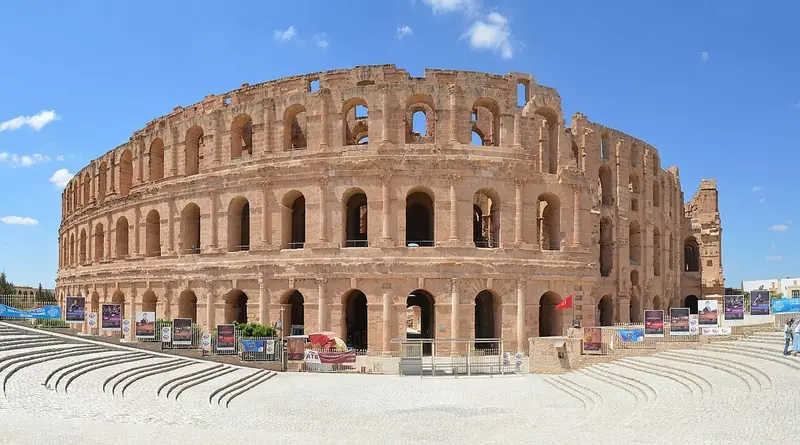 Roman8 stops · 3rd century CE
Amphitheatre of El Jem audio guide
Stand in the arena of one of the largest and best preserved amphitheatres of the Roman world, built for the town of Thysdrus and its thirty-five thousand spectators.
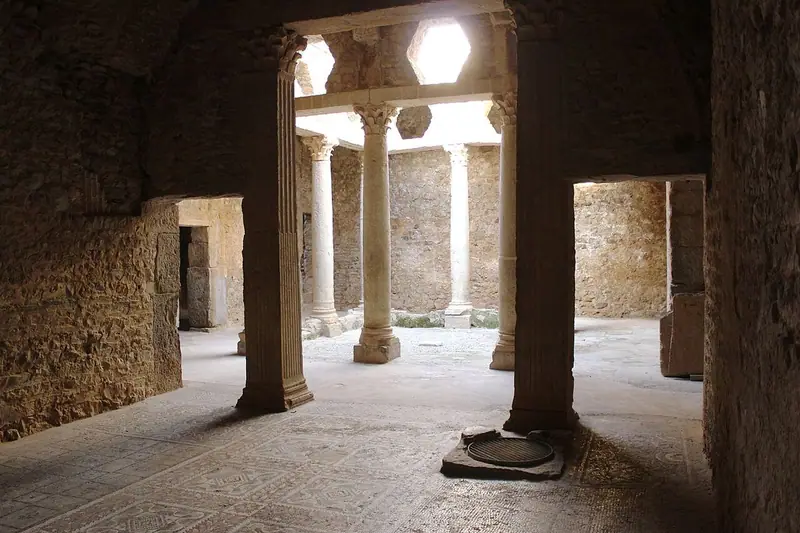 Roman8 stops · 2nd century BCE – 7th century CE
Bulla Regia audio guide
The royal Numidian town where Romans lived underground: villas with a whole storey below the street and their mosaics still in place.
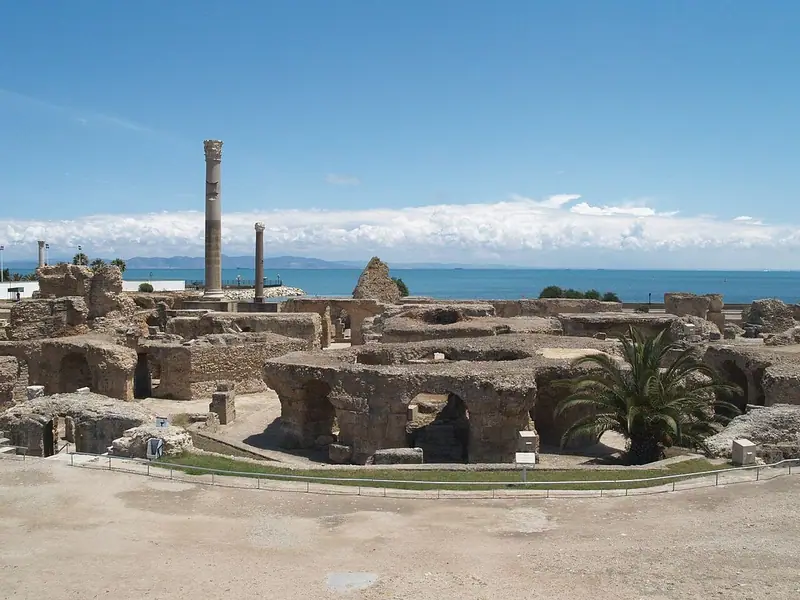 Phoenician8 stops · 9th century BCE – 7th century CE
Carthage audio guide
Trace the great Phoenician rival of Rome from Byrsa Hill and the Punic ports to the Antonine Baths of the Roman city that rose from its ruins.
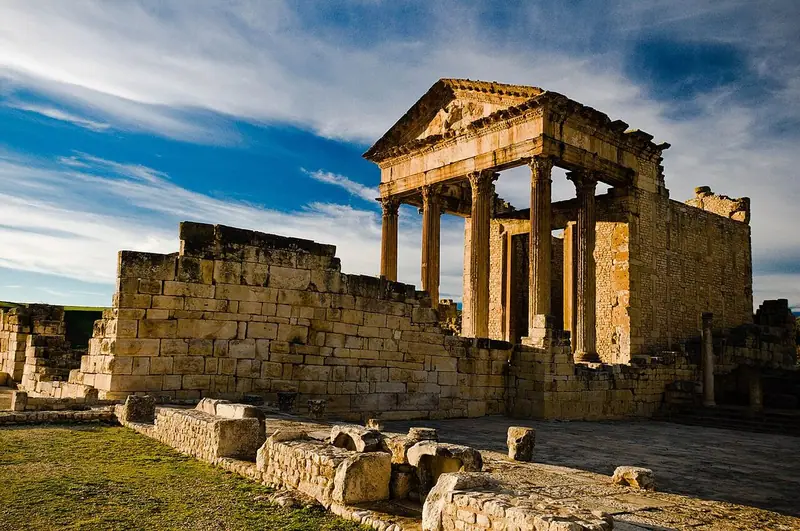 Roman8 stops · 2nd century BCE – late antiquity
Dougga audio guide
Explore the best-preserved Roman small town in North Africa, its theatre, Capitol and baths standing in open countryside above olive groves.
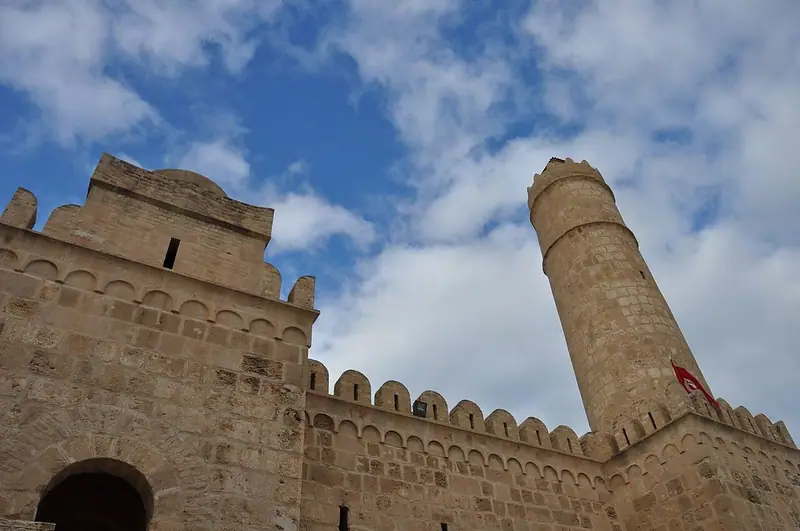 Aghlabid9 stops · 8th–11th century
Medina of Sousse audio guide
The fortified seaport of the Aghlabids: the ribat and its watchtower, the fortress-like Great Mosque, the souks and the mosaics of the kasbah museum.
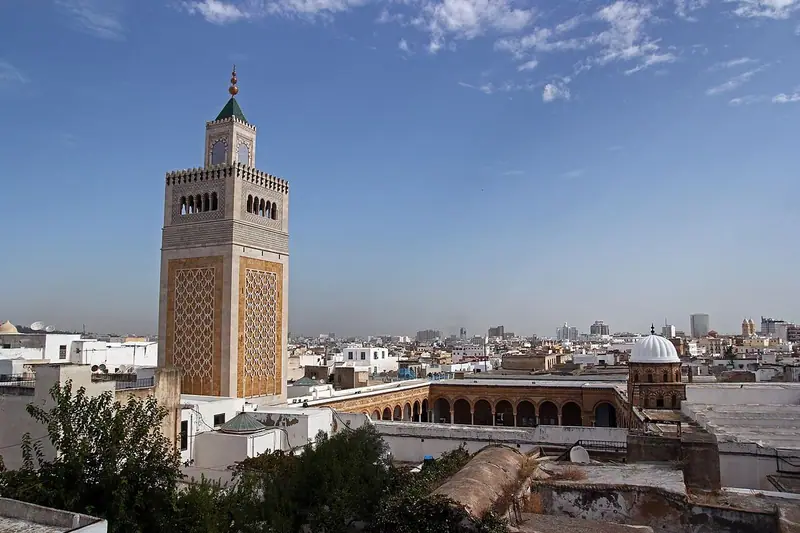 Hafsid9 stops · 698 – 19th century
Medina of Tunis audio guide
The old walled city of Tunis, with the Al-Zaytuna Mosque, its covered souks, palaces of the beys and the royal mausoleum of the Tourbet el Bey.
Every guide, in every country
Kairouan and every other guide we publish, including future ones. One payment, no subscription.