Before you start
The Medina of Sousse is the walled old town of Sousse, a port on Tunisia’s eastern coast, about 140 kilometres south of Tunis, with frequent trains and louages from the capital. UNESCO inscribed it as a World Heritage Site in 1988, as a typical example of a town of the first centuries of Islam in the Maghreb. UNESCO describes it, together with the Medina of Monastir, as a unique prototype of the military coastal architecture of that age, built to resist pirates and raiders from the sea. Within its walls lie the ribat, the Great Mosque, the small Bou Ftata Mosque and the kasbah, amid a maze of winding lanes and souks. The medina is a living town, so dress modestly, and remember that mosques are generally closed to non-Muslims except, at times, their courtyards. The lanes are busy and uneven, and the ribat’s towers have steep, narrow stairs. The route starts by the sea in the north-east of the medina and climbs to the kasbah at its highest point, in the south-west.
Use it as a self-guided tour of the Medina of Sousse: 9 stops in visit order, each played when you’re ready, at your own pace.
 Free preview · Stop 1
The Ribat
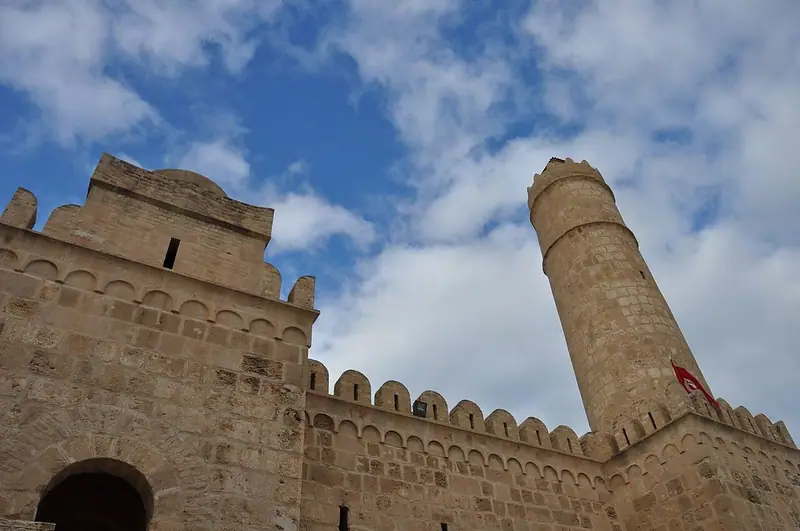
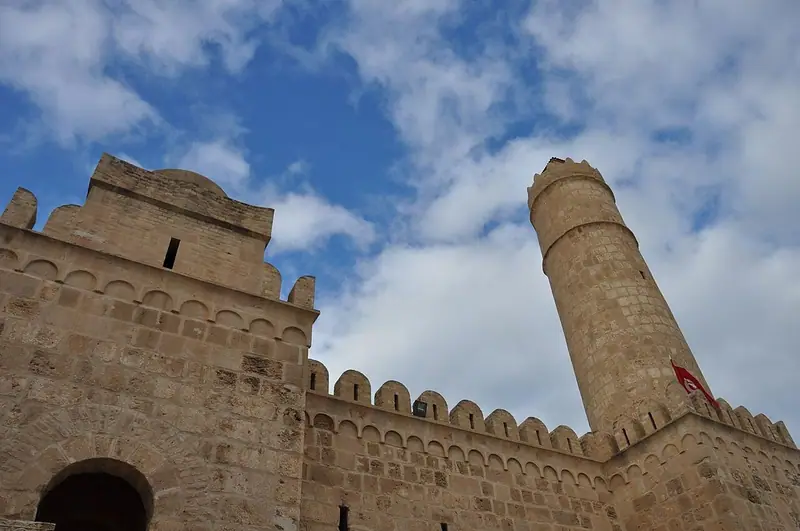
Begin at the ribat, the best-preserved of the many fortresses built along the coast of Ifriqiya in the early Islamic period. A ribat was both fort and religious retreat, garrisoned by men who combined military service with devotion. This one was probably founded in the late eighth century under the Abbasid governor Yazid ibn Hatim, and rebuilt in its present form by the Aghlabid emir Ziyadat Allah I. A marble plaque over the door of its round tower records his name and the year 821; it is the oldest surviving Islamic monumental inscription in Tunisia. Look at the single entrance on the south side, framed by reused ancient columns with Corinthian capitals, and inside it the slots through which defenders could drop missiles on attackers. The fortress is square, about thirty-eight metres on each side, with round towers at its corners and the middle of its walls.
Photo: Noomen9 · CC BY-SA 4.0 · Wikimedia Commons
What to see at the Medina of Sousse: 9 stops, in visit order
- 01
 The RibatFortress of the warrior-devoteesFree preview
- 02
 Ribat Courtyard and TowerPrayer hall and watchtowerIn the guide
- 03
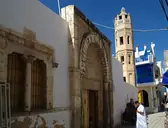 Zaqqaq MadrasaSchool and minaret in the lanesIn the guide
- 04
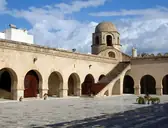 The Great MosqueA mosque built like a fortressIn the guide
- 05
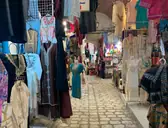 The SouksCovered markets of the medinaIn the guide
- 06
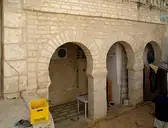 Bou Ftata MosqueThe town’s earliest mosqueIn the guide
- 07
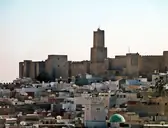 Kasbah and Khalaf TowerThe highest point of the medinaIn the guide
- 08
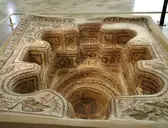 Archaeological MuseumMosaics of HadrumetumIn the guide
- 09
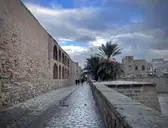 The RampartsWalls of the Aghlabid townIn the guide
Site map of the Medina of Sousse
History of the Medina of Sousse
The medina was built mainly by the Aghlabids, an Arab dynasty that ruled Ifriqiya, roughly modern Tunisia, through the ninth century. In 800 the Abbasid caliph Harun al-Rashid granted the governorship to Ibrahim ibn al-Aghlab, whose family then ruled from Kairouan, nominally on behalf of the Abbasids. The site was far older: the Phoenician town of Hadrumetum, said to be older than Carthage, sheltered Hannibal after his defeat at Zama, and the emperor Trajan made it a Roman colony. Vandals, Byzantines and finally the Arab conquerors of the seventh century followed. The Aghlabids made the town, now called Susa, their main port, and their invasion of Sicily in 827 was launched largely from its harbour. They fortified it with a ribat, a mosque and walls.
The full history continues in the guide.
Medina of Sousse guide: questions
How many stops does the Medina of Sousse guide have?
9 stops, in visit order: 1. The Ribat; 2. Ribat Courtyard and Tower; 3. Zaqqaq Madrasa; 4. The Great Mosque; 5. The Souks; 6. Bou Ftata Mosque; 7. Kasbah and Khalaf Tower; 8. Archaeological Museum; 9. The Ramparts.
Can I do a self-guided tour of the Medina of Sousse with this guide?
Yes. The guide is made for a self-guided tour: 9 stops in visit order, each with a photo, a story and a voice, so you can explore the Medina of Sousse at your own pace, without joining a group. Download it before you go and it works offline.
How long do you need at the Medina of Sousse?
We suggest allowing half a day. The 9 stops add up to about 7 minutes of listening, and you play each one when you’re ready, so you can linger wherever you like.
How long is each guide?
The 9 stops add up to about 7 minutes of listening in total. You play each stop when you’re ready, so you can go at your own pace.
Does the guide work offline?
Yes, once it’s downloaded. The guide is a single self-contained web page (about 8.0 MB) with the photos, text and audio built in. Download it to your phone before you go (Wi-Fi is best); after that it opens in any modern browser on iPhone or Android, with no app, account or mobile signal needed.
Does it use GPS or need my location?
No. The guide doesn’t use GPS and doesn’t know where you are: you play each stop when you reach it. It works on iPhone and Android in any modern browser, and it’s in English.
What’s included?
One self-contained HTML guide: 9 stops in visit order, each with a photo, text and a voice, plus the story of who built the site.
Who built the Medina of Sousse?
The medina was built mainly by the Aghlabids, an Arab dynasty that ruled Ifriqiya, roughly modern Tunisia, through the ninth century. In 800 the Abbasid caliph Harun al-Rashid granted the governorship to Ibrahim ibn al-Aghlab, whose family then ruled from Kairouan, nominally on behalf of the Abbasids.
Where is the Medina of Sousse?
The Medina of Sousse is the walled old town of Sousse, a port on Tunisia’s eastern coast, about 140 kilometres south of Tunis, with frequent trains and louages from the capital.
Is there a free audio guide to the Medina of Sousse?
The first stop, The Ribat, is free to read and hear on this page, so you can try the Medina of Sousse audio tour before you buy. The full guide, with all 9 stops, is a one-off purchase: download it once and it’s yours to keep, working offline.
Is the Medina of Sousse guide worth it?
If you’d like to know what you’re looking at, yes. For $10 you get 9 stops in visit order, each with a photo, a short history and a voice you play when you’re ready, plus a site map of the stops, and about 7 minutes of listening in all. It’s short on purpose, so you spend your time looking, not listening. It’s yours to keep, works offline and needs no app. The first stop is free on this page, so you can try it before you buy. If you’d like hours of detail, a guided tour will go deeper.
Audio guide or guided tour?
It depends how you like to visit. This guide lets you explore the Medina of Sousse at your own pace, at any time, for a one-off price. A guided tour gives you a live expert you can ask questions, but at fixed times and usually for a higher price. Many people use both: a tour for the big picture, and the guide to read beforehand or to revisit the stops in their own time.
Is this the official Medina of Sousse guide?
No. It’s an independent guide by The Historian Guide, not affiliated with or endorsed by the operator of the Medina of Sousse. For tickets and opening hours, check the official site operator before you go.
Does the guide include entry tickets or opening hours?
No. The guide is a digital companion only. Admission to the Medina of Sousse is separate, so check the official site operator for current tickets and opening hours before you go.
- Stop 1 · The Ribat (also the cover): Noomen9 · CC BY-SA 4.0 · Wikimedia Commons · resized
- Stop 2 · Ribat Courtyard and Tower: Jerzystrzelecki · CC BY 3.0 · Wikimedia Commons · resized
- Stop 3 · Zaqqaq Madrasa: Habib M'henni · CC BY-SA 3.0 · Wikimedia Commons · resized
- Stop 4 · The Great Mosque: Bernard Gagnon · CC BY-SA 3.0 · Wikimedia Commons · resized
- Stop 5 · The Souks: Hbensghaier · CC BY-SA 4.0 · Wikimedia Commons · resized
- Stop 6 · Bou Ftata Mosque: Habib M'henni · CC BY-SA 3.0 · Wikimedia Commons · resized
- Stop 7 · Kasbah and Khalaf Tower: Slim Alileche · CC BY-SA 3.0 · Wikimedia Commons · resized
- Stop 8 · Archaeological Museum: Habib M’henni · CC BY-SA 3.0 · Wikimedia Commons · resized
- Stop 9 · The Ramparts: Sharon Hahn Darlin · CC BY 2.0 · Wikimedia Commons · resized


All photographs from Wikimedia Commons under the licences shown.
More guides in Tunisia
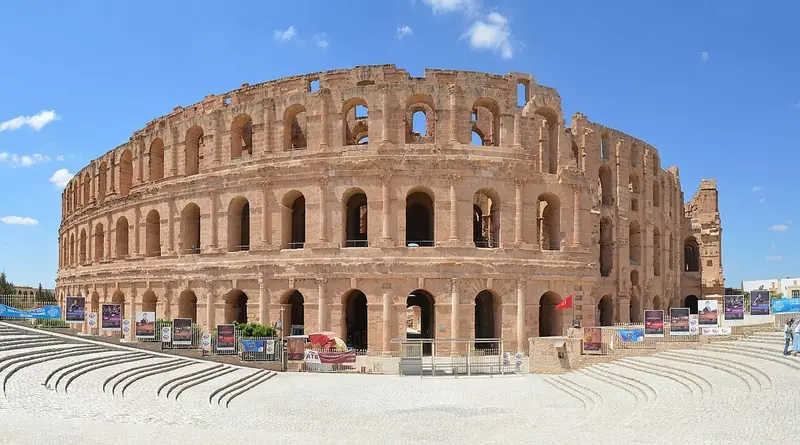 Roman8 stops · 3rd century CE
Amphitheatre of El Jem audio guide
Stand in the arena of one of the largest and best preserved amphitheatres of the Roman world, built for the town of Thysdrus and its thirty-five thousand spectators.
 Roman8 stops · 2nd century BCE – 7th century CE
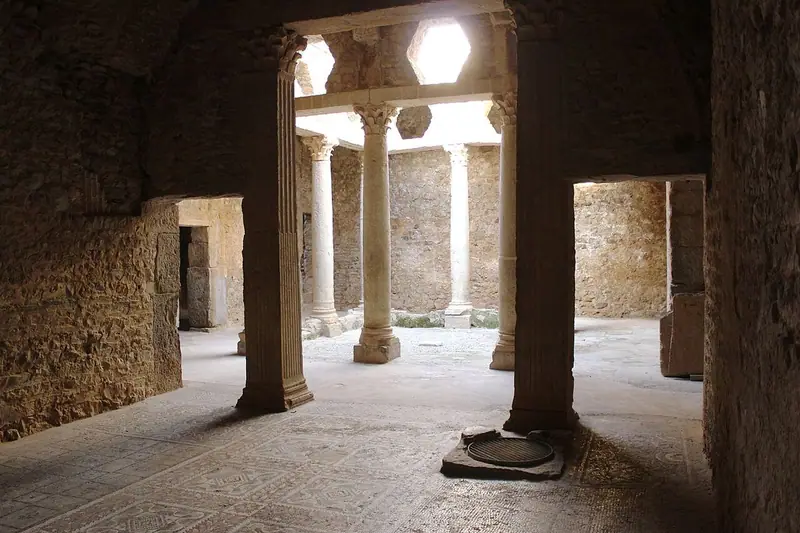
Bulla Regia audio guide
The royal Numidian town where Romans lived underground: villas with a whole storey below the street and their mosaics still in place.
 Phoenician8 stops · 9th century BCE – 7th century CE
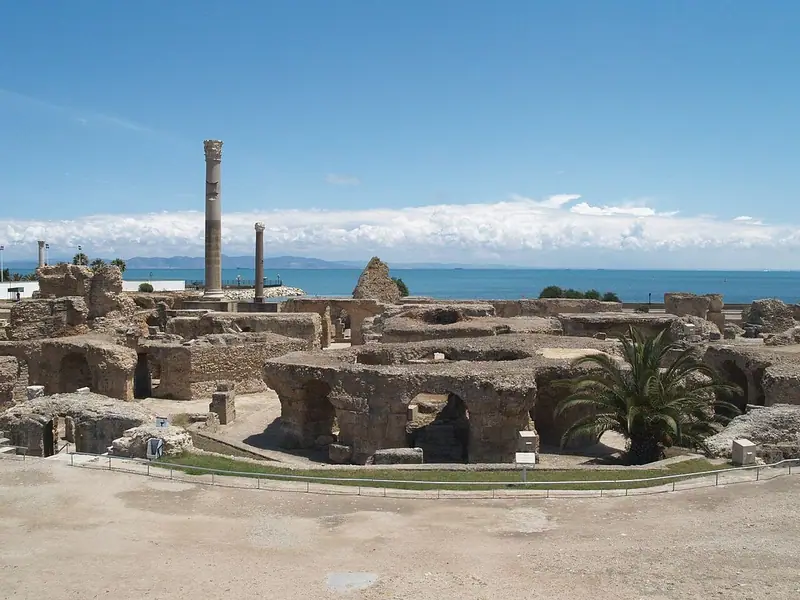
Carthage audio guide
Trace the great Phoenician rival of Rome from Byrsa Hill and the Punic ports to the Antonine Baths of the Roman city that rose from its ruins.
 Roman8 stops · 2nd century BCE – late antiquity
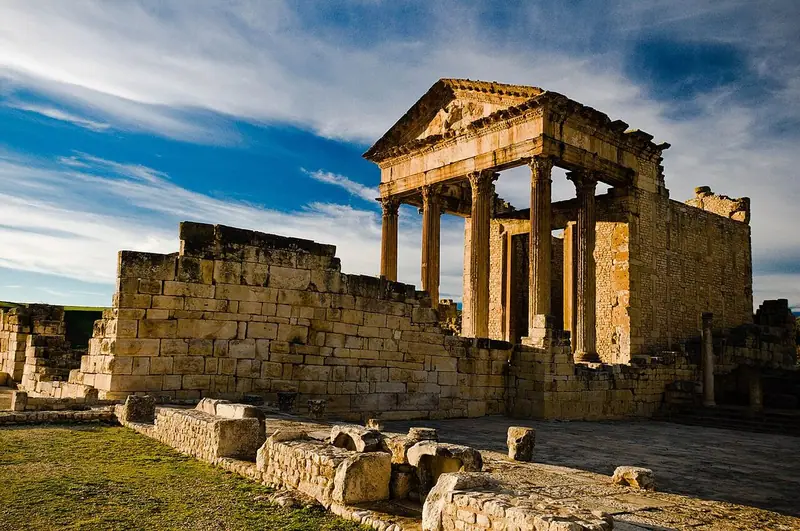
Dougga audio guide
Explore the best-preserved Roman small town in North Africa, its theatre, Capitol and baths standing in open countryside above olive groves.
 Aghlabid8 stops · 670–11th century CE
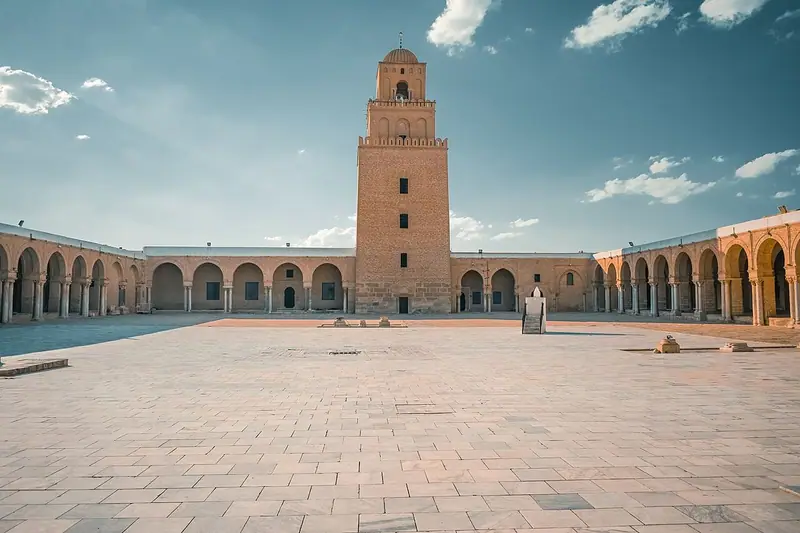
Kairouan audio guide
From the Aghlabid Basins to the Great Mosque of the first great Islamic city of North Africa, revered as one of the holy cities of Islam.
 Hafsid9 stops · 698 – 19th century
Medina of Tunis audio guide
The old walled city of Tunis, with the Al-Zaytuna Mosque, its covered souks, palaces of the beys and the royal mausoleum of the Tourbet el Bey.
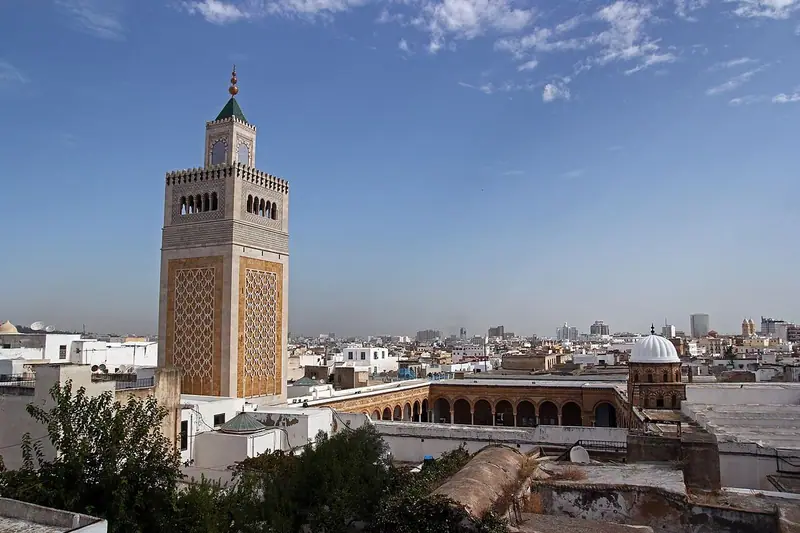
Every guide, in every country
Medina of Sousse and every other guide we publish, including future ones. One payment, no subscription.